Author Archives: Catherine Ann Lombard

A Spiritual Warrior for Human Rights

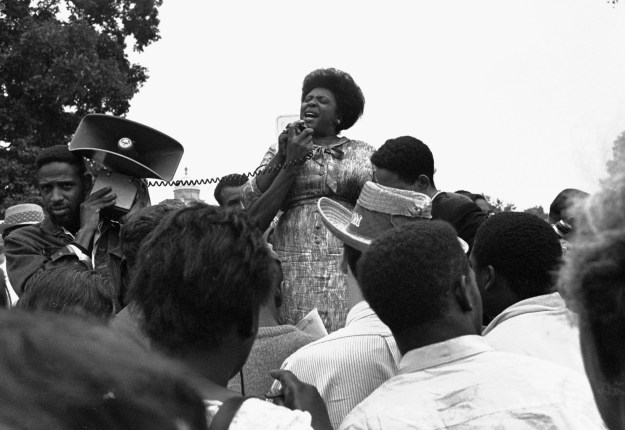
FILE – In this Sept. 17, 1965 file photo, Fannie Lou Hamer, of Ruleville, Miss., speaks to Mississippi Freedom Democratic Party sympathizers outside the Capitol in Washington after the House of Representatives rejected a challenger to the 1964 election of five Mississippi representatives. (AP Photo/William J. Smith, File)

February is black history month in the U.S., and I recently learned about Fannie Lou Hamer, an inspiring and heroic woman who fought for civil rights, women’s rights, class rights, and overall human rights. What caught my attention was that her courageous fight against oppression was motivated by a spiritual awakening that she had at the age of 44.

During her lifetime, Hamer was extorted, threatened, harassed, shot at, and assaulted by racists, including members of the police, while trying to register for and exercise her right to vote. She later helped and encouraged thousands of African-Americans in Mississippi to become registered voters and helped hundreds of poverty-strickened people through her work in programs like the Freedom Farm Cooperative.

Hamer (1917-1977) was the last of 20 children born to a sharecroppers in Mississippi. Tricked into picking cotton when she was only six, the owner of the plantation promised her snacks and sweets that her family could not afford from his store. She only attended school until the 6th grade, having to return to the fields to help support her aging parents. By age 13, she would pick 200–300 pounds (90 to 140 kg) of cotton daily while living with polio.

In 1944, she married Perry Hamer and the couple toiled on a Mississippi plantation. Because Hamer was the only worker who could read and write, she also served as plantation timekeeper. The Hamers wanted to have children, but in 1961, Fanny Lou received a hysterectomy by a white doctor without her consent while undergoing surgery to remove a uterine tumor. The Hamers later adopted two daughters.

In the summer of 1964, Hamer attended a meeting led by civil rights activists in the Student Non-Violent Coordinating Committee (SNCC) and Southern Christian Leadership Conference (SCLC). It was the first time she learned that black people had the right to vote. Hamer’s biographer, Dr. Keisha N. Blain says that, at that moment, Hamer found her calling. Blain explains:

“It was certainly a political awakening for Hamer, but it also was a spiritual awakening.

“She felt that it was God’s plan for her to become an activist and take a leading role in the expansion of black political rights.

“The one reason that she never gave up despite all she had to struggle through was that she really believed that ‘God was on her side.’ She truly believed that it was not so much a political mission, but a spiritual one. She saw herself ‘speaking light into a world of darkness’.”

Once the owner of the farm where she worked learned that she had tried to register to vote (which was initially denied because of a trumped up ‘literacy test’), she was immediately fired. Despite having to move house, loose most of her possessions, and ultimately flee for her life, Hamer was free to pursue her calling. Reflecting later, she said “They kicked me off the plantation, they set me free. It’s the best thing that could happen. Now I can work for my people.”

Hamer is perhaps most famous for her speech at the 1964 Democratic Convention during which she described her brutal beating in a Mississippi jail during her struggle to register to vote. President Lyndon Johnson was so frightened by the power of her message that he called an impromptu televised press conference so she would not get any television airtime. But her speech was later aired and inevitably moved even Johnson and many others to help pass the 1964 Voting Rights Act.

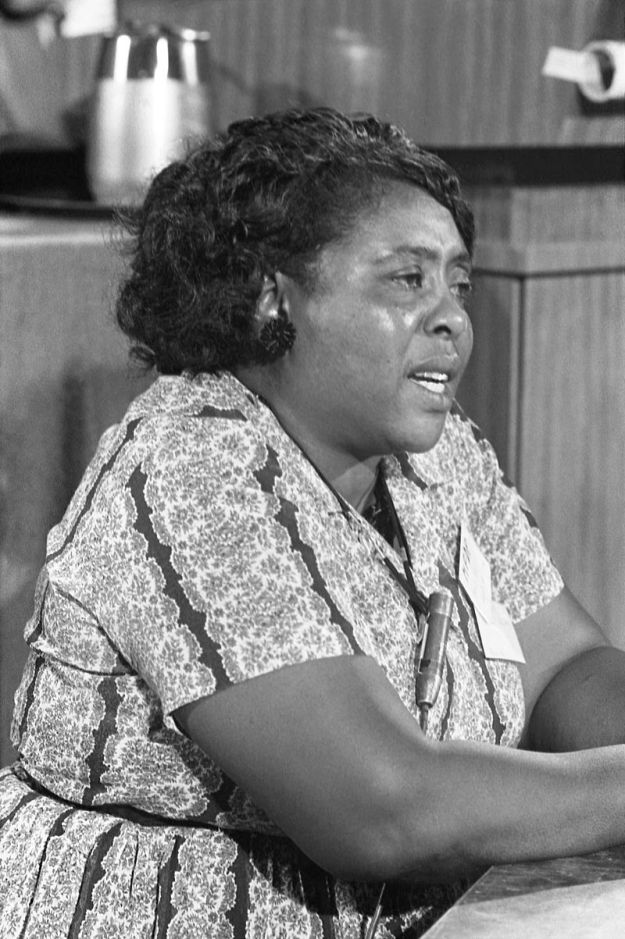
Hamer speaking at the 1964 Democratic National Convention in Atlantic City, N.J.

During Hamer’s time as an activist, she traveled extensively, giving powerful speeches on behalf of civil rights. Woven into her speeches was a deep level of confidence, biblical knowledge, and even comedy. One of her famous lines, that appears on her tombstone, is “I’m sick and tired of being sick and tired.” She often inspired other activists with her singing of spiritual Gospel songs during times of great stress and even terror.

In 1964, Hamer was one of the 11 SNCC delegates (including John Lewis and Harry Belefonte) who visited Ghana. The visit was revolutionary for her, for she saw for the first time black people in charge of their own destiny, including holding positions of political power. (Hamer would run for both for the U.S. Senate in 1964 and the Mississippi State Senate in 1971.) After a three-hour interview with the Diallo Alpha, Director General of the Ministry for Information and Tourism, Hamer received a musical instrument only found in Africa.

In the end, Hamer grew frustrated with politics. She said she was “tired of all this beating” and “there’s so much hate. Only God has kept the Negro sane”. A great cook and knowledgeable about growing crops and raising animals, in 1968, she returned to her hometown of Ruleville, Mississippi, and began a “pig bank” to provide free pigs for black farmers to breed, raise, and slaughter. A year later she launched the Freedom Farm Cooperative, buying up land that blacks could own and farm collectively. With the assistance of donors, she purchased 640 acres and launched a coop store, boutique, and sewing enterprise. She single-handedly ensured that 200 units of low-income housing were built—many still exist in Ruleville today.

Hamer may be remembered best as a civil rights activist, but she was foremost a spiritual warrior. Her faith and calling is what sustained her. Hamer was convinced that God was working through the civil rights movement to usher in the Kingdom of God.  Her favorite Bible passage was from the Gospel of Luke 4:18:

The Spirit of the Lord is upon me, he as sent me to heal the brokenhearted, to preach deliverance to the captive, and recover the sight to the blind, to set at liberty to them who are bruised, to preach the acceptable year of the Lord.

In the end, Hamer died of breast cancer after suffering for many years with various physical illinesses, some sustained from her beatings. May God rest her soul.

May God grant us all the her spiritual strength to preserver in whatever area of activism we are called upon to passionately undertake.

Discover More about Fanny Lou Hamer

Read the speech Hamer gave with Malcolm X in Harlem, New York.

Read the full report of the SNCC visit to Ghana.

Read an article about Hamer’s pastoral and prophetic styles of leadership as acts of public prayer by Breanne K. Barber.

Buy Until I Am Free: Fannie Lou Hamer’s Enduring Message to America by Dr. Keisha N. Blain 

Search for more information on Fanny Lou Hammer in the digital collection at the University of Southern Mississippi

The Box of Dates

After two years, aren’t we tired by now of hearing, talking, reading about but mostly fearing Covid-19? My biggest heartache is witnessing the disintegration of the social fabric that once united the villagers where I live. Many of the agricultural traditions were already wobbling on creaky foundations. It’s as if the big bad wolf of fear has blown it all down.

Located in the heart of Italy, the village has about 100 inhabitants; nearly 30 of whom are over 70 years old.  The town’s activities revolve around feast days and holidays, mainly associated with the village’s Catholic Church. Nearly every month there used to be a celebration with most of the villagers gathering for a communal meal afterwards.

The spring feast of Ascension had us in procession around the town’s fields, blessing the earth, sun, and rain for providing us with nature’s abundance. In July we honored the local Franciscan Saint Marzio with porchetta sandwiches and homemade wine. August brought the entire village together for the three-day preparing to make gnocchi Sacra di Gnocco. In early December, we climbed the hill out of town at dusk with lit torches, song and prayer to celebrate Saint Barbara, her statue atop the shoulders of four strong men.

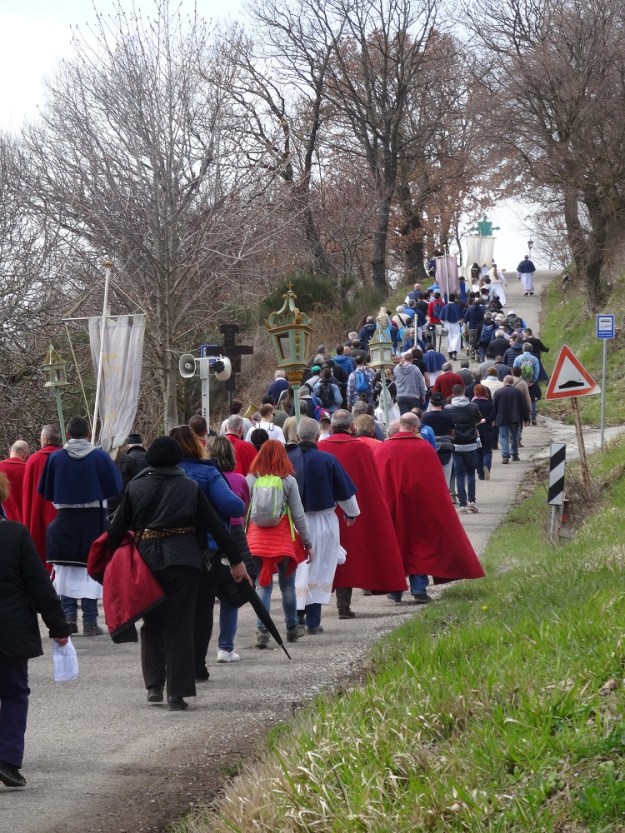
But all these celebrations have since disappeared. Even the village’s most famous – the day long Feast of the Madonna of Monte Camera celebrated on the Tuesday after Easter. Ironically enough, in 1647 when the pest was devastating the village population, the town dwellers who were well enough went in procession to this sanctuary (about 6 km away) to pray to the Madonna so that she might intercede on their behalf.

When they returned to their village, everyone who had been sick was miraculously cured. For 372 years, the villagers have returned in procession to this chapel – without fail – to commemorate the miracle. Every year… even during the last century’s World Wars, even during the time of Napoleon. Every year… except for the past two. Even though such a miracle is needed more than ever.

Personally during these past two years, I have witnessed many of the Italians I know tightly close ranks around their family life, walling themselves inside a circle of quiet desperation. Rarely does someone pause to chat with me anymore. What few smiles remain are hidden behind our masks. I am no longer invited in for a coffee and chat. All kisses are gone. The spontaneous touch of a hand is only a distant memory. We stand at a ‘safe’ distance, feeling unsafe.

An Open Door, An Open Heart

And then one afternoon, Maria Grazia[i] deeply touched me and my soul.

Maria Grazia is 91 years old. She grew up in the village, worked with her family on the land, married the village carpenter, had two children and now lives alone (her husband died three years ago). She is one of the few people whose attitude has not changed towards me. Always happy if I stop in to see her (along with my dog), Maria Grazia always insists on giving me something… creamy chocolates wrapped in shiny foil, a few fresh eggs from her chickens, and one time a small pot of honey from her son-in-law’s beehives.

Last week, I decided to pay her a visit. With all the fear that is running wild in the world, and despite her vulnerability, Maria Grazia attends to a quiet fearlessness. The key to her front door is always in the lock. As usual, I rang the bell and before any answer could come, I simply walked in. Maria Grazia was sitting next to her wood-burning stove, her legs up on a chair and covered with a blanket, rosary in hand. Despite my interrupting her quiet prayers of Hail Marys and Our Fathers, Maria Grazia welcomed me inside.

She did not quaver from my touch or worry about my wearing a mask or not. She was simply glad to see me. In fact, I often had to slide the mask to my chin and repeat myself, her slightly deaf ears unable to decipher my heavily accented Italian. We had met briefly the day before when I went to the mass for Saint Anthony Abate, the patron saint of domestic animals. As always, the villagers brought their animal feed to be blessed by the priest after the mass, and I too had attended with buckets of chicken feed, dog and cat food for the ritual sprinkling of holy water.

“I’m always so happy to see you in church,” was the first thing she said. I can’t remember when anybody told me that they were happy to see me anywhere! Slightly embarrassed to be caught with her legs up on a chair, Maria Grazia explained, “I have fibrosis in my legs.” She lifted up the blanket to show me her swollen, discolored calves and ankles, and then, despite my protests, insisted on getting up.

Hobbling to her cupboard while supporting herself against her kitchen table, she brought out a box of dates and insisted I take them with me. “But don’t you like them?” I asked.

“Oh yes, I like them. But I have another box,” she said. “And besides, I want you to have these.”

Maria Grazia put the box of dates into a plastic bag. I gratefully accepted them and thanked her. We kissed each other goodbye on both cheeks and I went on my way. As I was leaving, she sat down again by the warm stove. I offered to help her replace the blanket over her legs, but Maria Grazia insisted that she could do it herself.

The box of dates meant little to me, but her loving attitude of just being present, without terror in her eyes, without my having to feel awkward or afraid to be with her, was her true gift.  Nothing between us had changed, despite the world being so radically altered. It was a moment when everything felt normal… when human relationship once more felt peaceful… We were just two human beings – with all our limitations – together, acknowledging each other’s presence, the beauty of each other’s soul.


Artwork by Mary Beth Volpini. See more at drawntocolor.com

The Pandemic of Collective Fear

Assagioli writes how “waves of collective fear and panic” are like a widely diffused psychological poison or smog, he says:

“So often when we feel a sudden fear with no apparent reason, it is not ours at all. It is a psychic infection —like a virus.”

It can be encouraging to know that these virus-like fears are not ours, but energies that we are experiencing from the people and society around us. In order to deal with fear effectively, Assagioli urges us to eliminate or minimize the fear within ourselves. He also warns us of a vicious circle that can occur – our personal fear can open the door to the influence of external fear, and external fear feeds the inner one. Again he says:

“We have so much fear that is not ours. It’s stupid to let these fears invade and dominate our being!”

To break this vicious circle, we need to use our skillful will to withdraw our attention deliberately away from the psychological poison of fear. Assagioli suggests that we dis-identify from the fear by simply saying, “That’s not me.” At the same time we are dis-identifying from the fear, we need to not suppress it. Most importantly, we should not be afraid of the fear! Otherwise we can quickly descend into a vicious spiral of fear feeding fear.

Once we are able to release the energy that is holding and nurturing the fear, we can then redirect this new-found energy to do the most good in our lives. 

You might start today to consciously ‘vaccinate’ yourself against fear. Anytime your fear appears during the day, practice using skillful will to redirect your thoughts to something beautiful and positive that you recently experienced. You can also use the Evocative Word exercise, calling to mind the words: Calm, Tranquility, Fearlessness.

At the same time, try to face your own personal fears. They are the fears that we all must individually examine and exhume in their full force. Transmute and redeem to their full glory. Without being fully realized, personal fear bubbles over and is projected outside, contributing to the psychic poisons that are already whirling around us. 

Let’s face it. There are a million reasons to be fearful. The human condition hardly lends itself to fearlessness! But with patience and Love, along with the guidance of the Higher Self, the virus of fear can be cured.

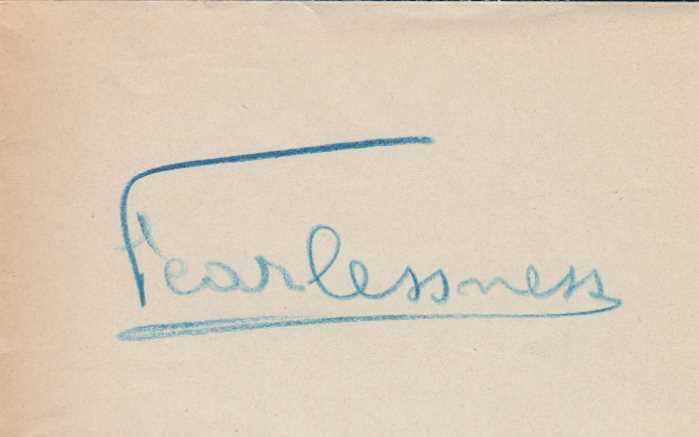
Assagioli’s note from his archives.

[i] Maria Grazia is a pseudonym.

————————————————-

To read about how two former clients overcame their personal fears, see Starve Your Fear! and The Healing Paradox.

Changing Judgments to Christmas Blessings

goodwill yellowAre you dreading this holiday season? The incessant music. Crowds of anxious consumers. The proliferation of plastic made in China? Unwanted gifts and the duty of buying gifts unwanted? The unreasonable pressure of a perfect Christmas dinner on the table. Forced encounters with others with whom you would rather not? Fake joy…

Rejoice! There is a simple way out. It’s called “Formulating Blessings.” Anyone can play and it’s absolutely free! Continue reading