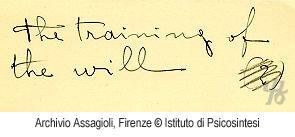
In April and May of 1929, on two different occasions, Assagioli experimented training his will. In his first experiment, he contemplated on the word ‘will’. But after the 4th session, it dawned on him that it was “useless to try and understand the nature of will by thinking about it. One must ‘feel’ one’s way to the heart of things.”
So during his next will experiment, Assagioli chose to stand relaxed and raise his arms sideways to the level of his shoulders in decided movements. He did this for 5 minutes while repeating “I will do this.” He did this for 10 days.
At first glance, this exercise of raising one’s arms up and down looks silly. But it actually is an example of what Assagioli refers to as ‘Will Gymnastics.’ Assagioli insists that the idea is simple. Muscles become stronger when we exercise, and so does the will. These will gymnastics work even better when you choose to do something you’d rather not do at all. In this way, ‘useless’ exercises, like raising your arms up and down everyday — with precision, regularity and persistence, become a deliberate act of training the will.
Assagioli’s Methodology and Observations
Assagioli’s brief observations of these two experiments performed on himself are rare insights into, not only his scientific method, but also his character. More than once, he writes about how while meditating on the word ‘will’ thoughts of “the stupidity of the task” would enter his awareness. With humor, he notes how he cannot pretend to have “the slightest enthusiasm” for the five-minute will exercise, but nevertheless, confirms that he is determined “to carry out my resolution whether it leads to any useful result or not.”
Regarding his methodology, first of all, these notes definitively show how Assagioli would practice psychosynthesis techniques on himself, something he stresses that all psychosynthesis guides do.
We can also see that he clearly conducts the experiments as a dis-identified Observer, using the terms “the mind,” “the attention,” “the personality” and “the performance” instead the first-person possessive pronoun of “my mind”, “my attention,” etc. For example, he laments how “the personality will not co-operate” but the next day notes how he “feels quite independent and refuses to be tyrannized by it.”
Lastly, we might wonder why Assagioli chose to have the notes typed (as opposed to handwritten) and in English (instead of Italian, German or French). Was this too part of his scientific methodology?
You can read Assagioli’s notes on his Will Experiments by clicking here.
Join Me in 10-days of Will Gymnastics
By the way, I have decided to perform this training of the will experiment of lifting my arms for 5 minutes everyday. Would you like to join me? I will start on Sunday 16 March and go until 26 March. Be sure to jot down your thoughts, feelings, and observations after each session. If you like, send me your comments, and we can share our experience together.
Keep in mind Assagioli’s caveat:
“Much of the value of the exercise is lost, unless the mind is also concentrated on the task. It should be done willingly, with interest, with precision, with style. Try always to improve the quality of the work, the clearness of introspection, the fidelity of the written account, and above all to develop the awareness and the energy of the will.
It’s good to compete with oneself; in other words, to assume, a ‘sporting attitude’ in the best sense of the word.”
Are you ready? Are you set? Well then, let’s raise those arms!
Good luck and enjoy!