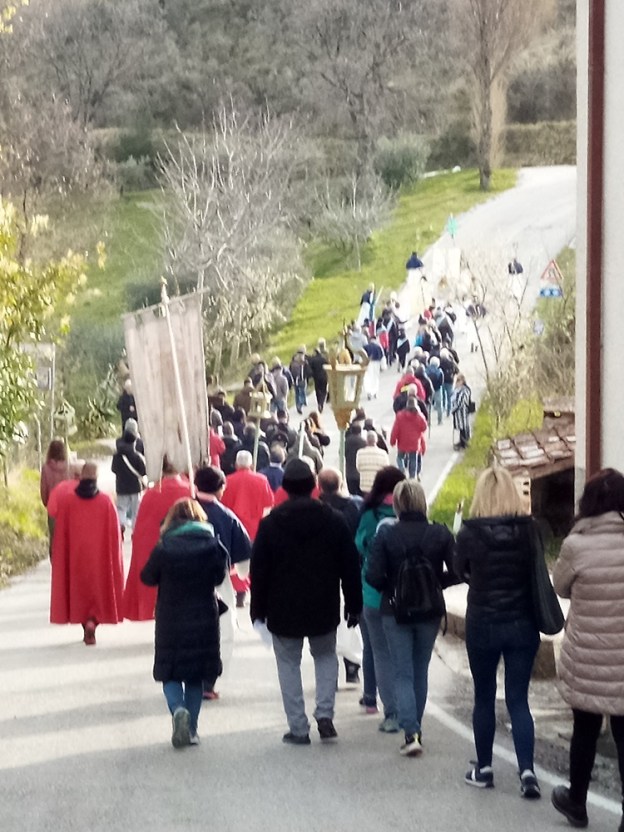
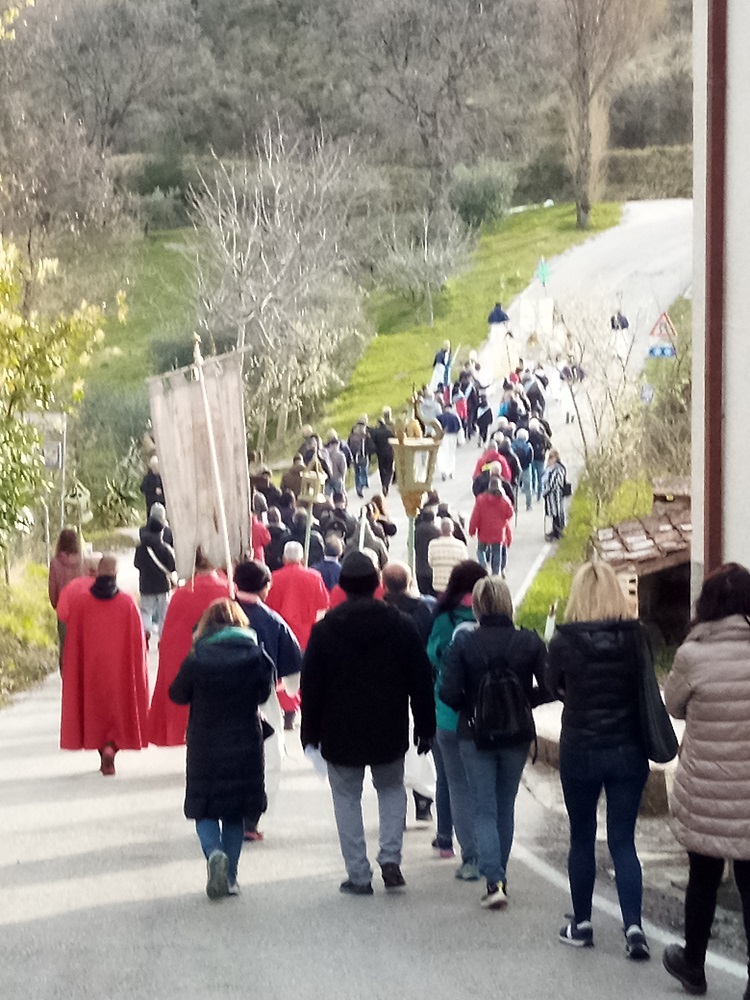
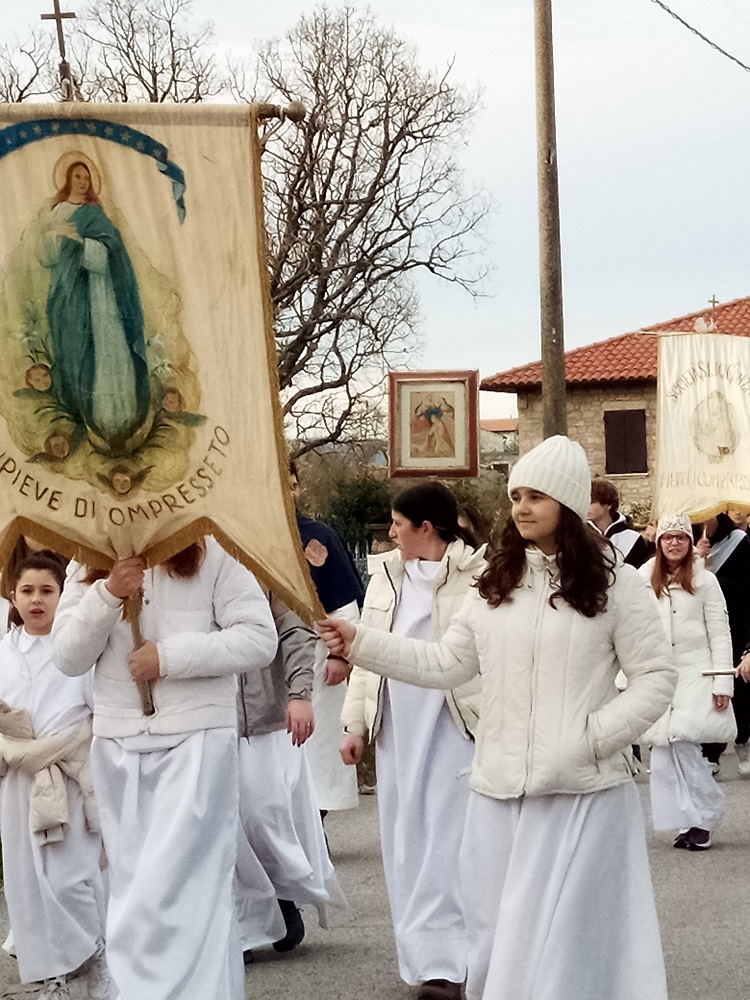
It was a cold, brisk April dawn as I entered the church. This was to be my fifth pilgrimage to Monte Camera Sanctuary from the Church of Santa Maria Assunta. Located in the hills, about five miles from the tiny Italian village of Pieve di Compresseto in Umbria, this sanctuary is devoted to Mary. Since 1647, the townspeople, full of faith and prayers, have been climbing to the tiny chapel to celebrate the Feast of the Madonna of Monte Camera every Tuesday after Easter.
The first pilgrimage took place 376 years ago when the bubonic plague was devastating the population. Those who were well enough went in procession to this sanctuary to pray to the Madonna, asking her to intercede on their behalf. When they returned, everyone who had been sick was miraculously cured. Since then, the villagers have returned every year in procession to this chapel to commemorate the miracle. This year was going to be different for me, as I was planning to carry a special prayer.
You can read more about my pilgrimage (which I hope to join next week as well) to this beautiful sanctuary and the prayer that I carried with me. This story was published as a “Spiritual Journey” by Unity Magazine (April/May 2024).
Feel free to enjoy and share “Sacred Journeys: Two Sisters Pilgrimage.” (Note that the graphic makes more sense if you open the pdf and view it in two pages!)
After graduating from the University of California Berkeley in 1987, I moved to Fukuyama, Japan—about 400 miles south of Tokyo—to teach English. People often ask why I decided to go to Japan, but the reality is that Japan chose me. At that time, I longed to take a year off and travel abroad. Having applied for English teaching positions in more than fifty countries, the school in Fukuyama was the one that invited me to come.
I arrived knowing only three words in Japanese: hajimashite (nice to meet you), arigatoo (thank you), and sayonara (goodbye), thanks to a Japanese friend who helped me learn some helpful phraes before I left. I practiced constantly.
The author at the Sanzen-in Temple in Kyoto in 1987.
I ended up staying two years in this beautiful country. I learned to speak Japanese and to read enough of the language to decipher grocery labels and train schedules, and I was blessed with making many Japanese friends, some of whom I am still in touch with 35 years later.
You can read more about my time in Japan and the transpersonal experience that I had while visiting Sanzen-in Temple in Kyoto. This story was published as a “Spiritual Journey” by Unity Magazine (September/October 2023).
Feel free to enjoy and share “A Glimpse of Infinity.” (Note that the graphic makes more sense if you open the pdf and view it in two pages!)
More than 100 years ago, Rabindranath Tagore, winner of the 1913 Nobel Prize for Literature, spent five months in the United States trying to raise money for his newly founded Visva-Bharati University. He was mostly unsuccessful, in part, because British officials in the USA were discreetly working against him, dissuading rich benefactors from donating. This subtle sabotage was mainly because, after the Amritsar massacre in 1919, Tagore had renounced his knighthood.
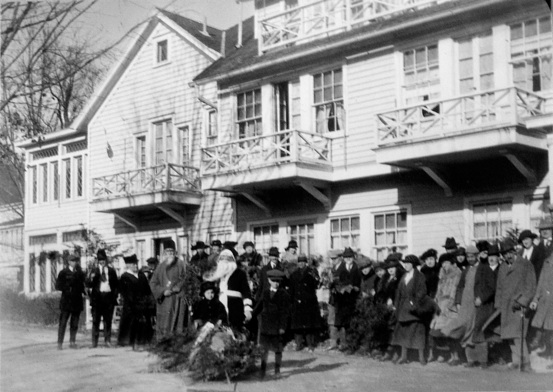
Christmas 1921 at Yama Farms Inn. You can clearly see Tagore who is standing tall, left of Santa, wearing a traditional robe and his real flowing white beard!
At Christmas Tagore happened to be staying as a guest at Yama Farms Inn in the Catskill Mountains north of New York City. Located on 1300 acres, Yama Farms Inn had 40 rooms. It was a kind of retreat hotel for industrialists who could go there and enjoy the company of intellectuals without any fuss about their millions. It was the kind of place where you could find Mr. Colgate, Mr. Eastman, and J.D. Rockefeller. Previous guests had been Thomas Edison and the naturalist John Burroughs.
While Tagore was there, he was outside the inn at the same time J.D. Rockefeller was waiting for his car. When Rockefeller saw Tagore, he gave him a dime. Later Rockefeller told the owner of Yama Farms that he had given a dime to “an old Negro.” Tagore is said to have later asked two Russian artists, “Isn’t it odd…Do I look like a tramp?”
Tagore wrote this pained letter to his friend and confident Charles Freer Andrews from Yama Farms on Christmas Day:
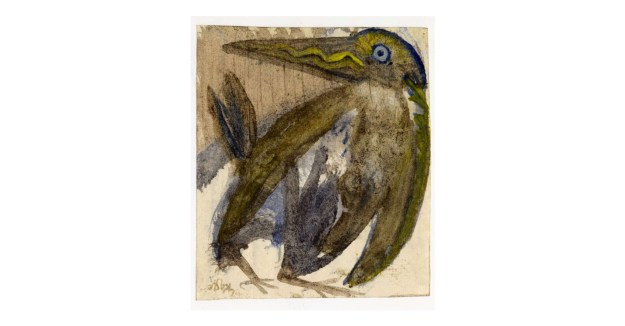
Bird painting by Tagore
Near New York, December 25th, 1921
To-day is Christmas Day. We are about forty-five guests gathered in this inn from different parts of the United States. It is a beautiful house, nestling in the heart of a wooded hill, with an invitation floating in the air of a brook broadening into a lake in the valley. It is a glorious morning, full of peace and sunlight, of the silence of the leafless forest untouched by bird songs or humming of bees.
But where is the spirit of Christmas in human hearts? The men and women are feeding themselves with extra dishes and laughing extra loud. But there is not the least touch of the eternal in the heart of their merriment, no luminous serenity of joy, no depth of devotion. How immensely different from the religious festivals of our country! These Western people have made their money but killed their poetry of life. Here life is like a river, that has heaped up gravel and sand and choked the perennial current of water that flows from an eternal source on the snowy height of an ancient hill. I have learnt since I came here to prize more than ever the infinite worth of the frugal life and simple faith. These Western people believe in their wealth, which can only multiply itself and attain nothing.
How to convince them of the utter vanity of their pursuits! They do not have the time to realize that they are not happy. They try to smother their leisure with rubbish of dissipation, lest they discover that they are the unhappiest of mortals. They deceive their souls with counterfeits, and then, in order to hide that fact from themselves, they artificially keep up the value of those false coins by an unceasing series of self-deceptions.
My heart feels like a wild-duck from the Himalayan lake lost in the endless desert of Sahara, where sands glitter with a fatal brilliance but the soul withers for want of the life-giving spring of water.
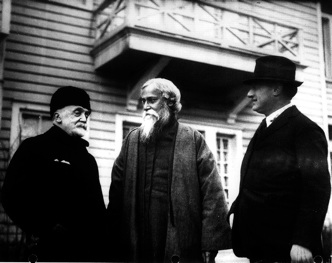
From left to right: Baron Roman Romanovitch Rosen, who served as the Russian ambassador to the United States and to Japan; Rabindranath Tagore; and Arthur Hamerschlag, first president of the Carnegie Mellon Institute of Technology, outside Yama Farms Inn.



 Love and Will