Category Archives: Moving Towards Joy

Crossing the Threshold into Old Age

Threshold

We cross many thresholds throughout our lifetime.

Tomorrow I will turn 60. What a surprise to softly land at this decade of life after so many turbulent years! I’m afraid that I cannot take any credit for it happening. My arrival has come all by itself with God’s grace.

I am happy to be on the threshold of old age. One of my friends recently said, “Oh, you are entering the age of wisdom.”

“I don’t know about wisdom,” I replied, pointing to my grey hair. “But I am certainly entering the age of whitedom, wrinkledom, and forgetfulness!” I understand this birthday as the beginning of another part of my life which is about to unravel.

As Brigitte Bardot said, “It’s sad to grow old, but it’s nice to ripen.” Old age may be the time when your body starts to fail in strength, energy, and functionality. But it is also the time when the soul starts to ripen. In old age you finally have the time and perspective to weave the various threads of your life into a more comprehensive understanding of yourself. Old age is the time to harvest all your experiences into a synthesis of Joy.

Continue reading

Playing with Dream Symbols

dreamsAssagioli wrote little about dreams or how to interpret them. Despite being a student of Freud’s and colleague of Jung’s, he felt that dreams reveal only a partial aspect of the human personality. He also believed that only part of the unconscious is able, or willing, to express itself through dreaming. He wrote that dreams that occur during the psychosynthesis process reveal the dreamer’s energetic forces, environment, and the inner world that birthed the dream.

In the last blog, I wrote about symbols and how we can consciously use them to further our personal and spiritual growth. We can also use the symbols that unconsciously appear to us in our dreams. Dreams are expressions of our life force, and the symbols that appear in them can be interpreted a multitude of ways from both a personal and collective perspective. Jung was once asked for advice from someone who had the idea of publishing a dictionary of symbols. His response was not to do it, since each symbol would require an entire book!

Jung’s general advice about how to look at a dream is:

“Treat every dream as though it were a totally unknown object. Look at it from all sides, take it in your hand, carry it about with you, let your imagination play around with it.”

Continue reading

Living a Symbolic Life

Orthodox Baptristy Jesus

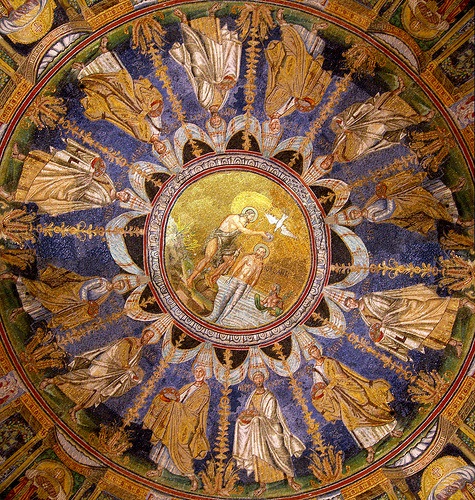
Ravenna is cold in February, but the sun still manages to warm the ancient stone archways. I place my cheek against a rough granite surface and feel the heat and energy collected over time. I have just spent the morning sitting in the Orthodox Baptistery, staring up at mosaics so carefully placed in the ceiling during the 4th and 5th centuries. The apostles march in procession above us, each carrying a triumphal laurel. In the center, John the Baptist is pouring the water from the River Jordan over the head of Jesus, who stands naked in the rippled pool. The Holy Spirit in the form of a dove dives into the blessing held aloft by John. To one side stands the pagan water god with a reed in one hand and a garment in another.

While admiring the intricate images, we are joined by two groups of Italian children. One school excursion after another quietly fills the domed building as a teacher explains the history and imagery that envelopes us. The octagonal room is relatively small and the space intimate. At one point a teacher asks, “Why did they use so many symbols in their art at that time?” Her answer: “Because the symbols conveyed la saggezza, the wisdom of that age.”

Continue reading