Tag Archives: wisdom

The Calendar is Round

A discarded ship container is recycled into a children's library.

A discarded ship container is recycled into a children’s library.

One of my friends in Japan emailed to wish me a happy birthday. “In Japan, turning 60 is a special birthday,” she wrote. “We call it “Calendar Round” or 還 暦  (kanreki).”

“More like Body Round!” I wrote back jokingly. But this idea of coming full circle intrigued me. Calendar Round comes from the sexagenary cycle of the Chinese calendar dating back to 2000 B.C. This calendar has 10 Heavenly Stems and 12 Earthly Branches. Since 60 is the first number that both 10 and 12 can divide, the cycle is considered complete after sixty years.

Continue reading

Crossing the Threshold into Old Age

Threshold

We cross many thresholds throughout our lifetime.

Tomorrow I will turn 60. What a surprise to softly land at this decade of life after so many turbulent years! I’m afraid that I cannot take any credit for it happening. My arrival has come all by itself with God’s grace.

I am happy to be on the threshold of old age. One of my friends recently said, “Oh, you are entering the age of wisdom.”

“I don’t know about wisdom,” I replied, pointing to my grey hair. “But I am certainly entering the age of whitedom, wrinkledom, and forgetfulness!” I understand this birthday as the beginning of another part of my life which is about to unravel.

As Brigitte Bardot said, “It’s sad to grow old, but it’s nice to ripen.” Old age may be the time when your body starts to fail in strength, energy, and functionality. But it is also the time when the soul starts to ripen. In old age you finally have the time and perspective to weave the various threads of your life into a more comprehensive understanding of yourself. Old age is the time to harvest all your experiences into a synthesis of Joy.

Continue reading

Living a Symbolic Life

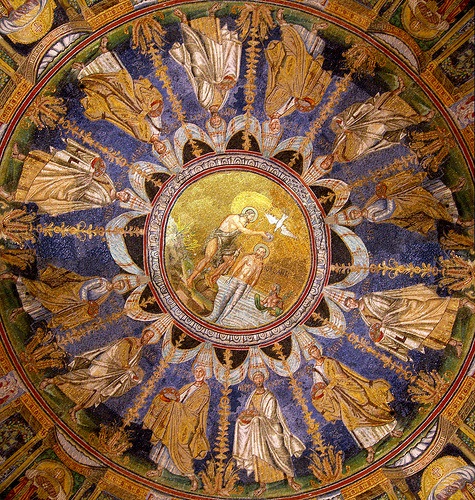
Orthodox Baptristy Jesus

Ravenna is cold in February, but the sun still manages to warm the ancient stone archways. I place my cheek against a rough granite surface and feel the heat and energy collected over time. I have just spent the morning sitting in the Orthodox Baptistery, staring up at mosaics so carefully placed in the ceiling during the 4th and 5th centuries. The apostles march in procession above us, each carrying a triumphal laurel. In the center, John the Baptist is pouring the water from the River Jordan over the head of Jesus, who stands naked in the rippled pool. The Holy Spirit in the form of a dove dives into the blessing held aloft by John. To one side stands the pagan water god with a reed in one hand and a garment in another.

While admiring the intricate images, we are joined by two groups of Italian children. One school excursion after another quietly fills the domed building as a teacher explains the history and imagery that envelopes us. The octagonal room is relatively small and the space intimate. At one point a teacher asks, “Why did they use so many symbols in their art at that time?” Her answer: “Because the symbols conveyed la saggezza, the wisdom of that age.”

Continue reading