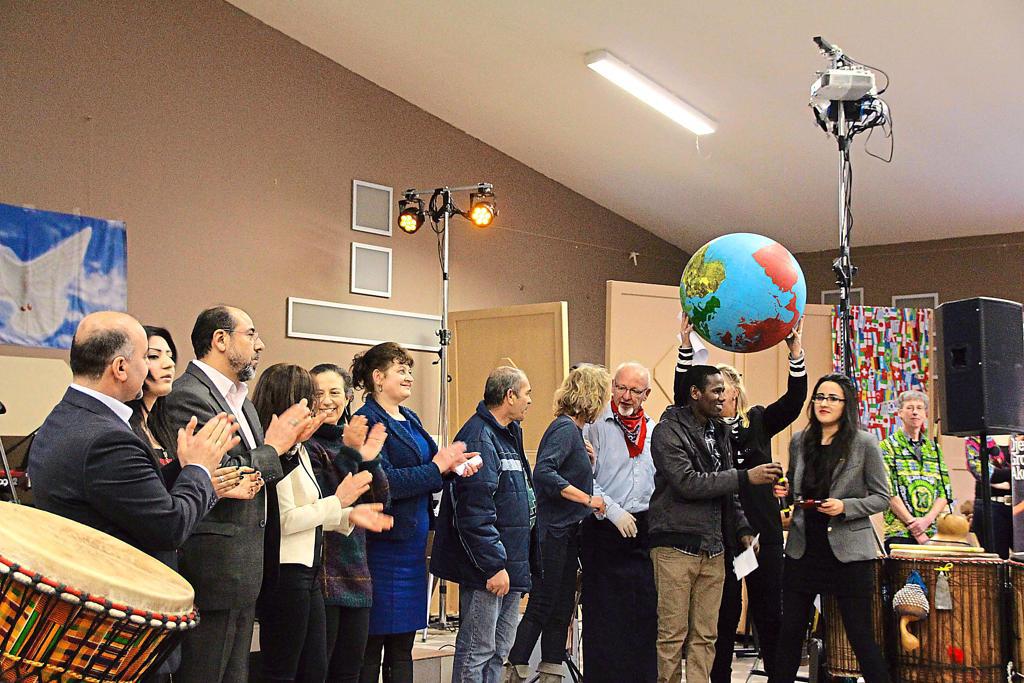
 Someone is holding a large plastic globe over my head while I stand in front of about 750 people and welcome them in English to the Friedensfest or Peace Festival. The afternoon has started with various citizens welcoming the crowd in German, Arabic, Turkish, Aramaic, Kurdish, Dutch, Russian, French and Persian. During the past year, 700 refugee families from Syria and Iraq have descended upon our small German town of Gronau, nestled against the eastern Dutch border. More than 90 languages are spoken among a population of 45,000. In stark contrast to the anti-immigration movement of Pegida in Eastern Germany, today we celebrate our differences as well as try to raise money for those left behind in Sengal and Kobane.
Outside in the drizzling rain, men from the Yazidi community are grilling meats while the women fill plates with cut tomatoes and onion salad. I am struck that ‘Yazidi’ is no longer an idea but suddenly a smiling human before me. Inside the hall, Turkish children are circle-dancing to traditional songs. Other children bob their heads to the music while folding paper into origami birds or dipping their hands into paint and printing their palms.


 Love and Will