Tag Archives: ecology

Brother Sun, Sister Moon and Nola

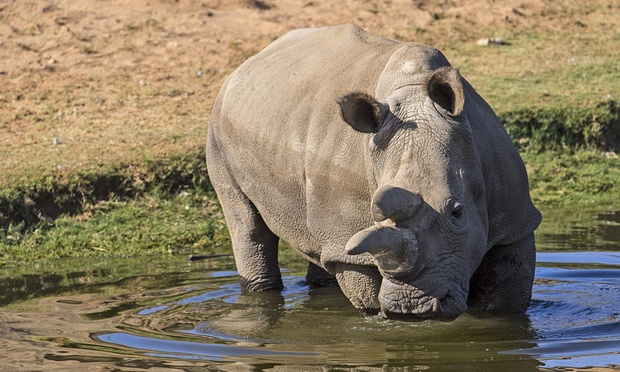
Nola the White Rhino (1974-2015)

Nola the White Rhino (1974-2015)

Perhaps you have already read the obituary for Nola the White Rhino (41) who recently died at the San Diego Zoo. She had arthritis and a painful bacterial infection, was a major park attraction and loved having her back scratched. Today only three white rhinos remain in the world.

The climate change conference in Paris has opened and millions of people across the globe are marching for a cleaner environment and protection for the animals and plants that share our home with us. I don’t need to reiterate all the reasons why we need to quickly transform our energy consumption into lives that gently walk on this planet. Unless we change along with the climate, our world is headed to become a silent and empty place. Like all animals on this planet, Nola has something unique to teach us about being more fully human.

Saint Francis preaching to the birds.

Saint Francis preaching to the birds.

Saint Francis of Assisi understood that by loving creatures, great and small, we learn more about God’s love for all of creation, including ourselves. The ascetic and mystic lived in the 13th century with a small group of like-minded followers, and together they were dedicated to helping lepers, the poor, and outcasts. They built themselves huts of branches and twigs to sleep in, wandered in pairs over the Umbrian countryside, dressed in the ordinary cloths of the peasants, and worked in the fields to earn their daily bread.

Continue reading

Soul Harvest – Part 1

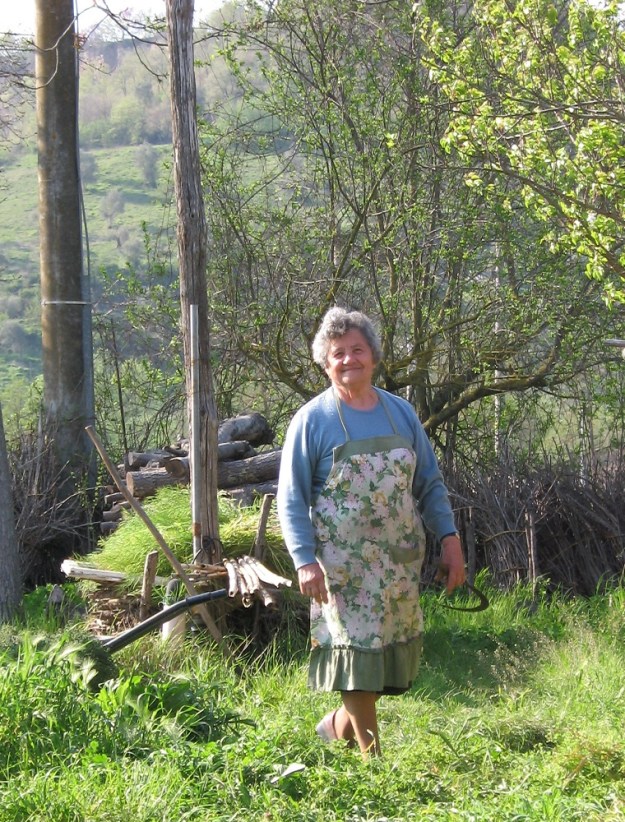
Signora Giuseppa in her Garden

Signora Giuseppa in her garden north of Rome.

It took me a long time and a good deal of sweat to understand it — just how much our Earth is a sanctuary for our souls. And this awareness evolved only thanks to Signora Giuseppa. Having worked the land for more than seventy years, Giuseppa quietly and wisely guided me towards this realization while we walked around her fields or campetto. Through her simple and daily vigil of being with, caring for, and depending upon the Earth, she initiated me into the profound experience of gardening and growing what one eats. For it is through this deeply experiential reality that we are best able to integrate the sacredness of the Earth with our own humanity.

Signora Giuseppa is a round but sturdy widow whose hands are small, yet broad and strong. Whenever she stands before you, her feet are firmly planted and her eyes steady upon you. She is eighty-two years old and one of the few people I have ever met that is really present to all that is around her. Every afternoon you can find her tending her two-acre campetto in the Italian countryside north of Rome. Since she was five years old, she has lived all her life (literally) off the fruits of her labor. From olive oil to fava beans to wine grapes and, of course, tomatoes, her harvest is as varied as it is delicious.

Whenever I visit, she chatters away in her Italian dialect as she heads out to feed her chickens with a bucket of soggy bread and milled corn in hand and an assortment of half-wild cats underfoot. She knows I don’t always understand, but what she seems to find more important is our time together. It is always a pleasure to visit her and see what she is sowing, planting, harvesting, gathering, drying, and feeding her chickens.

Only educated to the third grade (and only thanks to Mussolini insisting that all Italian children learn to read and write), Giuseppa has managed to integrate life’s lessons. For some time now, I have declared her farm “The University of Gardening” and she la professoressa. Whenever I say this in front of the many visitors and relatives that often drop by, Giuseppa beams proudly and quickly adds, “I was never much educated, but I do have some esperienza.”

It wasn’t until I too had this esperienza of hoeing, planting, composting, weeding, watering, and finally reaping the harvest of my own garden did I come to understand how holy the Earth really is. My education evolved mostly from my following Giuseppa around her campetto and simply watching. She used to tease me by telling everyone that I liked to come by and steal her secrets. Yet, while she showed me how far apart to plant tomatoes, when to harvest the garlic, and how to recognize a cauliflower that wouldn’t produce fruit, Giuseppa was also teaching me how to relate to the land, how to observe, care, tend, and support its needs, how to appreciate its bounty, receive its gifts, and surrender that which doesn’t survive.

Oh sure, I had been ecologically aware for years—bicycling to work, recycling my plastics, picking up tossed garbage left along the roadside, hanging up wash instead of using a dryer, and buying a fuel-efficient car. All these small conscious acts of conservation are vital to the planet’s ultimate survival. But until one actually works the Earth, one cannot appreciate the lessons it holds, nor how fundamentally attached we are to it, nor how much working on the land can actually help us to become fully human. As Gandhi once said, “To forget how to dig the earth and tend the soil is to forget ourselves.”

Note: This story was written while I was still living in Italy in 2007. It is the first part of a three part series to be continued next time…

Go to Soul Harvest – Part 2

Soul Harvest – Part 2

Signora Giuseppa and the author during the grape harvest in 2010.

Signora Giuseppa and the author during the grape harvest in 2010.

What makes gardening such a precise mirror for the soul? There are many biblical parables that invoke the imagery of the garden – the pruning of vines, sowing of seeds, and harvesting of grapes. Taoists believe that miniature gardens are the Earthly copy of Paradise. In Islam the four gardens of Paradise – Soul, Heart, Spirit, and Essence – symbolize the mystical journey of the soul. And then there’s my retired neighbor Angelo who once told me that gardening was the most humble of tasks. “Your head is always bowed and sometimes you have to go down on your knees.”

And as the gardener creates, so does the garden transform the inner life of its creator. The word ‘create’ actually derives from the Latin creare which means to produce, to make life. The garden’s cycle mirrors our own growth, complete with floods, heat, drought, infestation, dying, resurrecting, blossoming, blooming, maturing, rotting, bounty, beauty, and miracles. In our deeper psyche we tend to our life’s garden of sorrows and joys. We pull out, cut back, dig up, bury, sow, support, and nourish hoping one day to harvest our life’s experiences into wisdom. Without all this soul/gardening work, our spirits are swamped under the weeds, our creative gifts choked, our true selves unable to flourish.

As we relate to the Earth with hoe, shovel and watering can, the Earth begins to teach us about ourselves. Working the Earth is like dreaming, it can act as a medium between self and soul. When we take time to garden, we are allowing our souls to speak to our conscious selves, to display outwardly where in the soul process we really are.  And as we gain in awareness, we can equally influence the soul to move to its next necessary task by outwardly performing the chore in the garden.

Signora Giuseppa's village in Italy

Signora Giuseppa’s village.

There were days when I found myself tearing at weeds, only moments later to feel the fierce roots of long-buried anger and resentment clinging to my heart. Other days I was filled with joy, longing to spill seeds upon every patch of bare Earth. By gardening we unearth a place where our inner and outer worlds can merge. And in this space, with time and nourishment, we encourage the self closer to universal truths.

Continue reading