Category Archives: Feelings

Join the Magi – Embrace the Sublime

Often the Christmas story is left unfinished. We usually stop right after the three Wise Men offer their gifts of gold, frankincense and myrrh to the newborn Child. The part we tend to skip over is the Slaughter of the Innocents. This massacre of all boys two years and younger in and around Bethlehem is a horrific part of the story that doesn’t easily fit into the joy of Christmas.
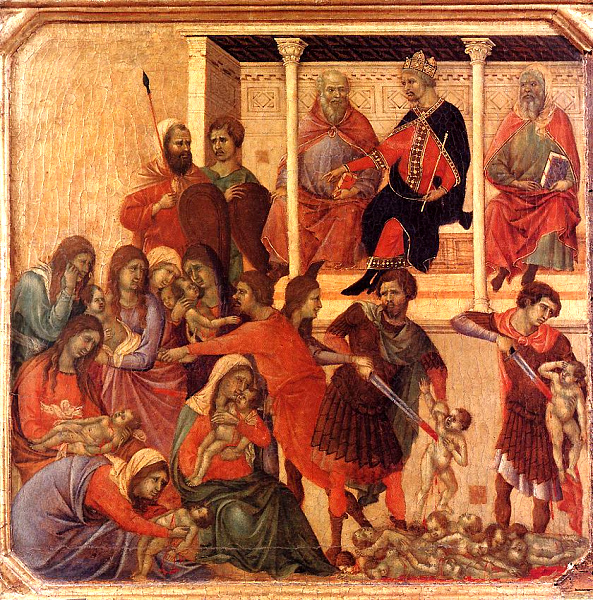
innocentsDuccio

The story goes like this: Following a rising star in the hopes of paying homage to the Child, the Wise Men from the East first stop to pay their respects to King Herod in Jerusalem. They ask if he knows where the infant king is. When King Herod hears about the Child, he is perturbed by the prospect of a competitor king, as are the chief priests and scribes. Herod asks the priests if they have any idea where the Child is to be born. They cite from the prophecies that the birthplace is Bethlehem. Herod then privately summons the Wise Men and sends them onto Bethlehem, telling them to “Go and find out all about the Child, and when you have found him, let me know, so that I too may go and pay him homage.”

After finding the Child and offering their gifts, the Wise Men are warned by an angel in their dreams not to return to King Herod, but to return home by another road. When Herod learns of their surreptitious departure, he is furious and decrees that all male infants must be indiscriminately killed, hoping that the Child will be among them. Meanwhile, an angel appears to Joseph in his sleep, telling him to leave immediately with Mary and Jesus to Egypt. The three become refugees and are spared from the experience of the slaughter.

The Slaughter of the Innocents is crucial to our understanding of the entire Christmas message. Once a vulnerable child full of Light and Love is born, a powerful leader feels threatened and wants him murdered. His evil desire extends not only to the child, but to many innocent children. What might this story reveal to us today?

Continue reading

Listen with the Ear of Your Heart

Ear of the HeartListen carefully. Obsculta is the first word of guidance written by St. Benedict, the 6th century mystic and Father of western monasticism. His Rules for Monks is still used today to direct the lives in Benedictine communities. St. Benedict immediately qualifies what kind of listening they, and we, need to do. Obsculta inclina aurem cordis tui – “Listen by inclining the ear of your heart.” What could he possibly mean? Our hearts have ears? If that is true, then how do they work?

St. Benedict’s poetic language is asking us to listen, not just with our ears, but with our hearts to all that comes our way. While we might hear the words with our actual ears, with our hearts we can deeply reflect, discern, and take action if necessary.

When we are an embryo, the sound perceiving mechanism of the ear is the first organ we develop. During the same time, our heart also starts to develop (5 weeks after conception). Imagine! At 18 weeks in the womb, one of our first sensations of life is the inner sound of our own and our mother’s heartbeat. Studies have shown that a baby will become agitated if its mother’s heartbeat beats faster than normal, suggesting its mother is under stress. We also begin life listening to the rise and fall of our mother’s breath, our parents’ muffled voices, the world outside.

Continue reading

Starve Your Fear!

Artwork by Mary Beth Volpini at drawntocolor.com.

Artwork by Mary Beth Volpini at drawntocolor.com

Let’s talk about fear. Inner fear. How elusive and arbitrary it can be. We sometimes struggle with fear over the simplest things – talking to our boss, having a routine visit to the doctor’s, or taking an exam. We might be fearful for our health, bank accounts, jobs, or kids. Of course, we can feel legitimate fear, but usually what we fear is not based on our outer reality but rather coming from within ourselves. Assagioli calls this fear a widely diffused psychological poison.

In order to deal with fear effectively, Assagioli urges us to eliminate or minimalize the fear within ourselves. He also warns us of a vicious circle that can occur – the fear within us can open the door to the influence of external fear, and external fear feeds the inner one.

To break this vicious circle, we need to use our skillful will to withdraw our attention deliberately from the psychological poison of fear. The energy that is holding and nurturing the fear will then be released. We can then redirect this new-found energy to do the most good in our lives.

Last year, Susan came to see me because she wasn’t able to become pregnant. She and her husband were both 30 years old and had been trying for one year without success. Susan had a doctorate in biochemistry and knew exactly all the ways the body functioned – and didn’t function. After two of her friends had died of cancer, she was terrified of the disease. She had spent hours visiting various doctors asking for multiple aggressive and invasive tests just to ensure herself that she did not have cancer.

Continue reading