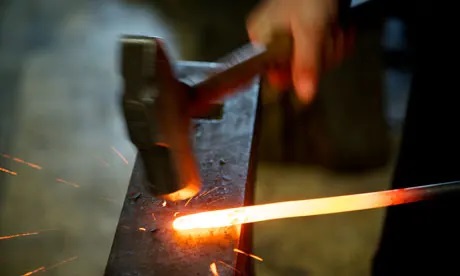
For those of you who attended my webinar “Forging and Arrow of Gold’ last year, I am happy to announce the publication of my article in the Journal of Critical Studies in Language and Literature along with my translation of Carducci’s poem ‘Il poeta’.
Below, you can download the article “Forging an Arrow of Gold: Translation and Analysis of Carducci’s ‘Il poeta’ from a Psychosynthesis Perspective”:
To remind everyone, in Creating Harmony in Life, Assagioli invites us to:
“Reread Giosuè Carducci’s poem ‘Il poeta’ (‘The Poet’) as it expresses in a wonderful way … through which the psychic elements are fused and shaped in an inner fire, producing works of beauty.”
Inspired by Assagioli’s suggestion, I searched the internet for the poem and found it in Italian along with a translation by G. L. Bickersteth published in 1913.[1] While Bickersteth’s translation is true to the meter and rhyme of Carducci’s poem, the language itself felt antiquated – for example, his use of ‘merry-andrew’ in the third line. So, I decided to attempt to translate Carducci’s poem myself from a more literal perspective.
In the article above, I show how psychosynthesis provides an additional approach to literary criticism beyond what psychoanalytical criticism and Jungian literary criticism can offer. Then I briefly describe my translation process of Carducci’s poem “Il poeta”. Finally, as both reader and translator, I examine the archetype of the blacksmith in “Il poeta” and then analyze the poem from a psychosynthesis literary perspective.
Giosuè Carducci (1835–1907) was a poet, writer, literary critic and teacher. During his lifetime, Carducci was regarded as the official national poet of modern Italy, and today he is studied by nearly all Italian students during high school. In 1906 he became the first Italian to receive the Nobel Prize in Literature “not only in consideration of his deep learning and critical research, but above all as a tribute to the creative energy, freshness of style, and lyrical force which characterize his poetic masterpieces.”[2]

References
[1] Bickersteth, Geoffrey Langdale (1913). Carducci. London: Longmans, Green.
[2] “Vita, opere e poetica di Giosuè Carducci” (in Italian). 13 June 2014. Retrieved 5 January 2022.
 Love and Will