Imagine All the People …

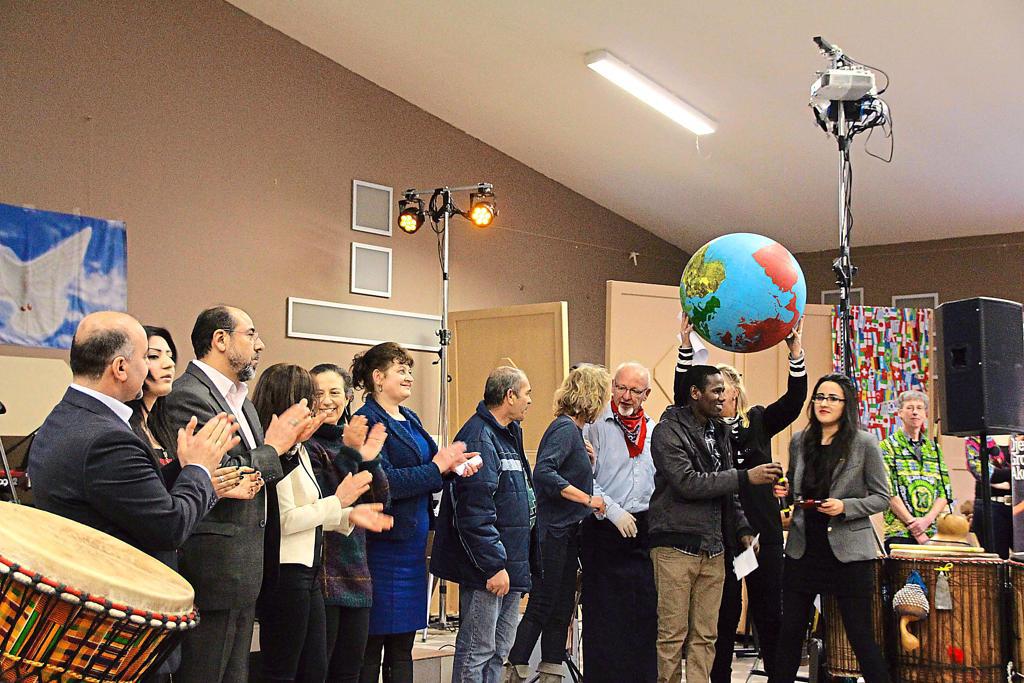
Plastic WorldSomeone is holding a large plastic globe over my head while I stand in front of about 750 people and welcome them in English to the Friedensfest or Peace Festival. The afternoon has started with various citizens welcoming the crowd in German, Arabic, Turkish, Aramaic, Kurdish, Dutch, Russian, French and Persian. During the past year, 700 refugee families from Syria and Iraq have descended upon our small German town of Gronau, nestled against the eastern Dutch border. More than 90 languages are spoken among a population of 45,000. In stark contrast to the anti-immigration movement of Pegida in Eastern Germany, today we celebrate our differences as well as try to raise money for those left behind in Sengal and Kobane.

Outside in the drizzling rain, men from the Yazidi community are grilling meats while the women fill plates with cut tomatoes and onion salad. I am struck that ‘Yazidi’ is no longer an idea but suddenly a smiling human before me. Inside the hall, Turkish children are circle-dancing to traditional songs. Other children bob their heads to the music while folding paper into origami birds or dipping their hands into paint and printing their palms.

Continue reading

When Spirit and Matter Converge – Synchronicity

IMG_2149Most of us have experienced two or more events that seemed to converge in our lives in a peculiar and perhaps disturbing, yet wondrous way. For example, you might be thinking of someone you’ve lost touch with years ago, and suddenly she contacts you. Jung, along with the physicist Pauli, defined such instances as synchronistic events, a series of meaningful coincidences of events that go beyond the probability of them actually happening.

Jung and Assagioli had a long-term professional and friendly relationship that began in 1907 and lasted until Jung’s death in 1961. Assagioli acknowledges Jung’s term ‘synchronicity’ in his unpublished notes found in his archive. He mentions synchronicity as a way to understand the “correspondence between the date of the positions of the stars [astrology] and the psychological characteristics” of a person.[1]

Jung, along with the physicist Pauli,   developed the idea of synchronicity.

Jung, along with the physicist Pauli,developed the idea of synchronicity.

While counseling clients, I have often experienced synchronistic events and have come to understand them as spirit seeking matter. Many people believe that spirit and matter are dualistic in nature – that spirit is ‘higher’ than matter, which throughout various cultures and time has inevitably led humankind to identify matter with evil. From my own experience, I believe that spirit actually needs matter to express itself, and the two are best when joined together in a higher revelation of universal life meaning. Synchronicity is one form of that higher expression, as are symbols and symbolic thought. Continue reading

The Passion of Everyday

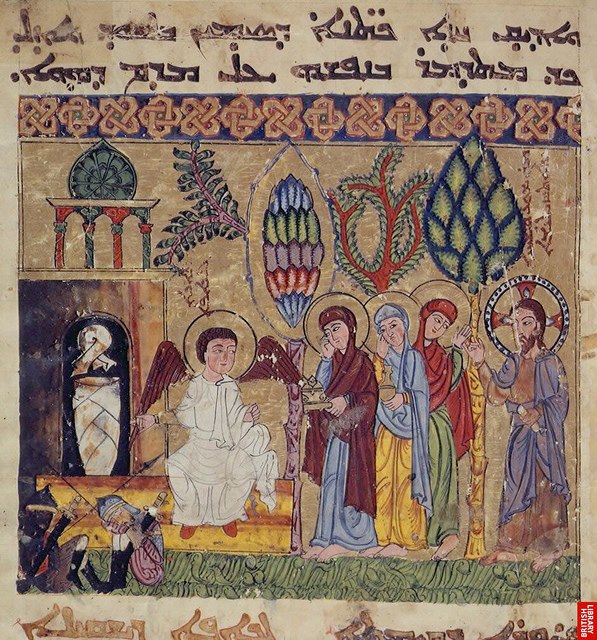
Women at the Tomb from a Syriac Gospel, Northern Iraq

For Western Christians around the world, this is Passion Week. (Eastern Christians celebrate next week.) Believers commemorate Jesus’ entry into Jerusalem, the Passover meal, his crucifixion, death and resurrection. In Spain, there are elaborate and nightlong processions of masked penitents heaving gigantic statues depicting the suffering of Jesus and Mary. When I was living in Italy, I once had a friend visiting me who, after a day of sightseeing in Rome, said quite candidly, “I’m tired of every time I go into a church, I have to look at statue of a man being tortured and nailed to a cross.”

What might we understand from this disturbing image that seems to simultaneously fascinate and repel? First of all, it’s important to see the complete picture of the Passion. The story does not end with the crucifixion, but actually starts there. The Passion is only complete with the resurrection, but we tend to ignore this essential part of the story, preferring to dwell on the murderous nature of Jesus’ death. Does this sound familiar? Isn’t this just what the media does? Burying the good news until it’s impossible to see?

Continue reading