Holy Saturday, the day between the crucifixion and resurrection
I wrote and published this poem last year, and I am greatly sadden to republish it.
Good Friday 2024
Democracy died in Gaza. Buried under the rubble alongside the children their homes bombed dreams shattered. Love crucified.
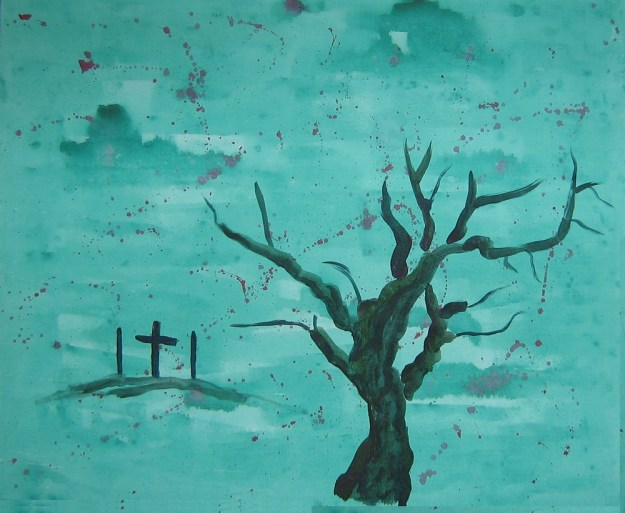
International law died in Gaza. Nailed to the cross alongside human rights women’s rights children’s rights. Starved to death with the children shell-shocked and orphaned.
Justice died in Gaza. Buried under the rubble underneath the relentless bombardment of propaganda and blatant lies. Wearing a crown of thorns. A mockery of righteousness.
A sword pierces the heart of humanity. To quench our thirst — Nothing but a raised sponge of vinegar.
Dice are rolled to split seaside property over dead bodies of children. Women at the feet of the cross can only weep. Pull their hair. Swoon.
Humanity died in Gaza. We lie buried under the rubble. Our voices for peace unheeded, unheard despite our desperate screams… Stop. Stop. Please stop this brutal madness.
A sign nailed at the foot of the cross in all languages… “Here lies our human dignity.” And the sky darkens all over the Earth.
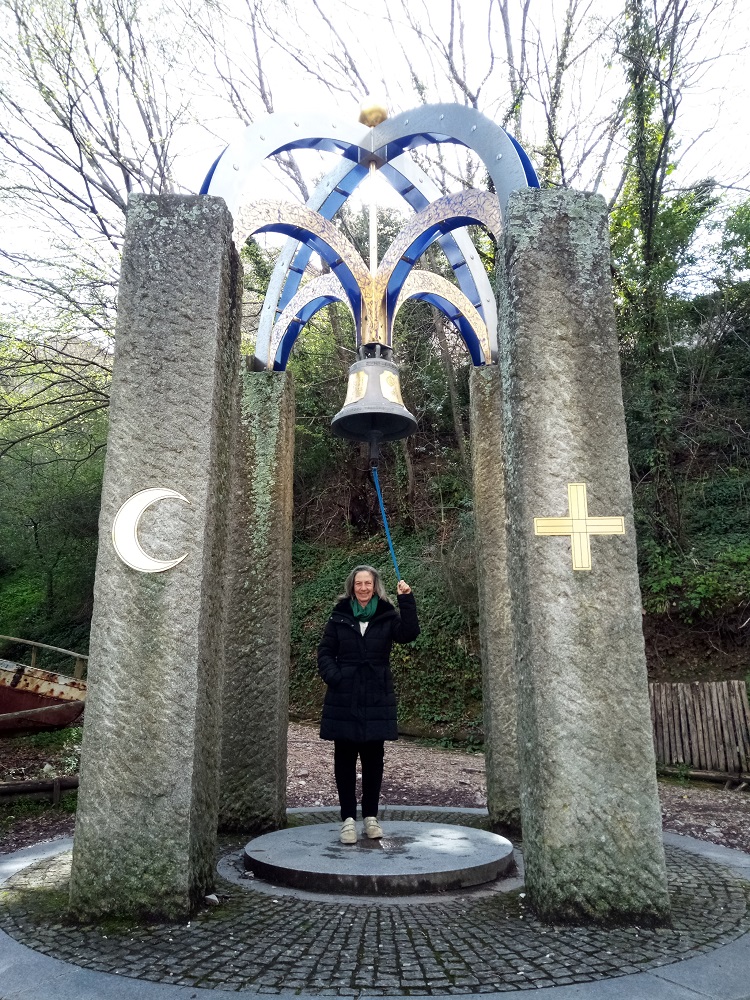
When I journeyed to Assisi only to find its iconic Peace Bell silenced, I became determined to hear it ring again.
At one point a few years ago, I felt as if there was a hole in my heart. The news seemed to be only of war, and our political leaders only seemed ready to confront conflict with military madness. Longing for peace, I decided to go to Assisi (a short trip from my home in Italy) to ring the Peace Bell. I felt called to do this symbolic act of hope. Somebody, I thought, has to go and ring that Peace Bell!
So on a fall day, I drove along a quiet, hilly back road, full of curves and beautiful views of the Apennine mountains. The fields were dotted with olive groves and vineyards interlaced with woodlands and bed-and-breakfast inns, and the autumn light glowed soft and warm, unlike the torrid summer sun that pricks one’s skin.
Assisi, also known as the City of Peace, is the birthplace of Saint Francis. The town feels as if it is piled up upon itself, stone upon stone, shining like rose quartz and nestled into the hillside above the valley of Spoleto. As I approached the city that day, I first caught site of the Rocca Maggiore, a fortress dating to 1174. Soon afterward, the spectacular 13th-century Basilica of San Francesco came into view.
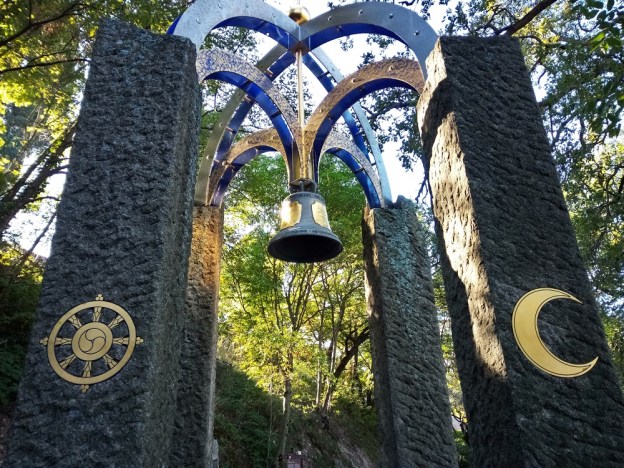
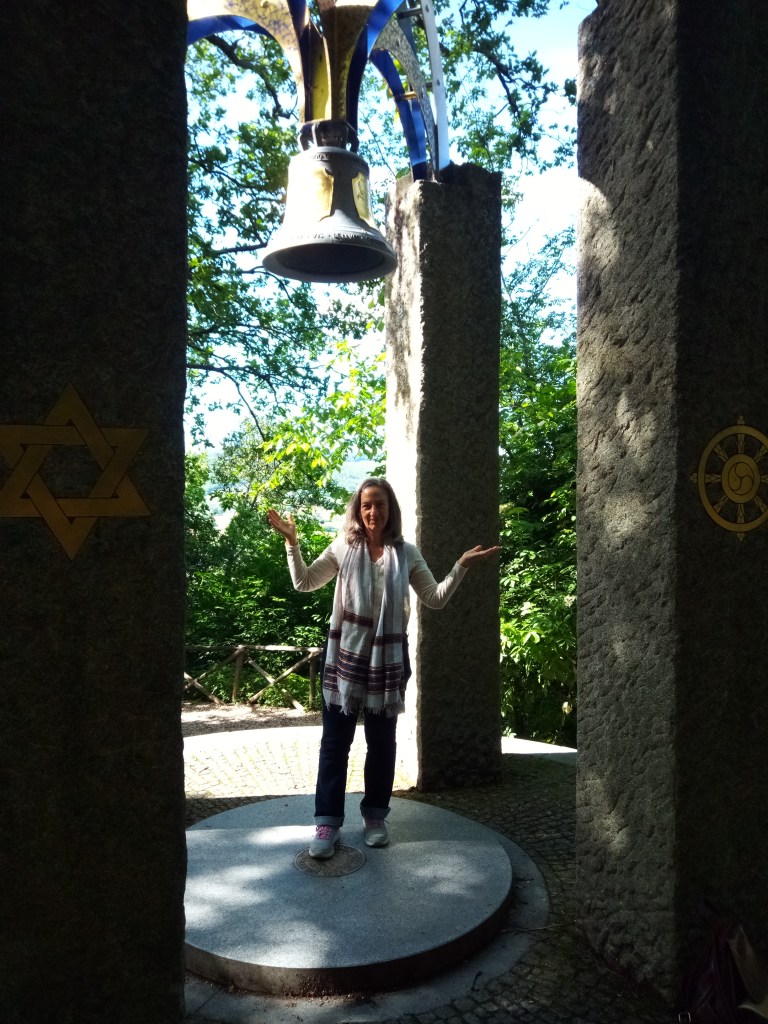
The Peace Bell is outside of the old walls of the city, not far from the basilica. It is supported by four granite columns, each representing a different religion: Christianity, Judaism, Islam, and Buddhism. Designed by German artist Gerhard Kadletz, the bell is named Regina Pacis (Queen of Peace), and it is meant to unite the four religions to announce peace with one voice.
You can read more about my journey to ring the Peace Bell below. This story was published as a “Spiritual Journey” by Spirituality & Health Magazine (April/May 2025).
Feel free to share “Sacred Journeys: The Bell that Peals for Peace.” We sure do need more than ever to hear it ring!
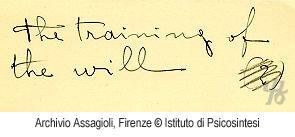
In April and May of 1929, on two different occasions, Assagioli experimented training his will. In his first experiment, he contemplated on the word ‘will’. But after the 4th session, it dawned on him that it was “useless to try and understand the nature of will by thinking about it. One must ‘feel’ one’s way to the heart of things.”
So during his next will experiment, Assagioli chose to stand relaxed and raise his arms sideways to the level of his shoulders in decided movements. He did this for 5 minutes while repeating “I will do this.” He did this for 10 days.
At first glance, this exercise of raising one’s arms up and down looks silly. But it actually is an example of what Assagioli refers to as ‘Will Gymnastics.’ Assagioli insists that the idea is simple. Muscles become stronger when we exercise, and so does the will. These will gymnastics work even better when you choose to do something you’d rather not do at all. In this way, ‘useless’ exercises, like raising your arms up and down everyday — with precision, regularity and persistence, become a deliberate act of training the will.
Assagioli’s Methodology and Observations
Assagioli’s brief observations of these two experiments performed on himself are rare insights into, not only his scientific method, but also his character. More than once, he writes about how while meditating on the word ‘will’ thoughts of “the stupidity of the task” would enter his awareness. With humor, he notes how he cannot pretend to have “the slightest enthusiasm” for the five-minute will exercise, but nevertheless, confirms that he is determined “to carry out my resolution whether it leads to any useful result or not.”
Regarding his methodology, first of all, these notes definitively show how Assagioli would practice psychosynthesis techniques on himself, something he stresses that all psychosynthesis guides do.
We can also see that he clearly conducts the experiments as a dis-identified Observer, using the terms “the mind,” “the attention,” “the personality” and “the performance” instead the first-person possessive pronoun of “my mind”, “my attention,” etc. For example, he laments how “the personality will not co-operate” but the next day notes how he “feels quite independent and refuses to be tyrannized by it.”
Lastly, we might wonder why Assagioli chose to have the notes typed (as opposed to handwritten) and in English (instead of Italian, German or French). Was this too part of his scientific methodology?
By the way, I have decided to perform this training of the will experiment of lifting my arms for 5 minutes everyday. Would you like to join me? I will start on Sunday 16 March and go until 26 March. Be sure to jot down your thoughts, feelings, and observations after each session. If you like, send me your comments, and we can share our experience together.
Keep in mind Assagioli’s caveat:
“Much of the value of the exercise is lost, unless the mind is also concentrated on the task. It should be done willingly, with interest, with precision, with style. Try always to improve the quality of the work, the clearness of introspection, the fidelity of the written account, and above all to develop the awareness and the energy of the will.
It’s good to compete with oneself; in other words, to assume, a ‘sporting attitude’ in the best sense of the word.”
Are you ready? Are you set? Well then, let’s raise those arms!


 Love and Will