
Tag Archives: wisdom

“A Hymn to Inner Freedom”

soloFRONTERoberto Assagioli’s “prison diary” Freedom in Jail is an autobiographical account of the month he spent in prison under the fascist regime in 1940. His conclusion is entitled “A Hymn to Inner Freedom” where he writes about every man and woman’s power to inwardly free themselves.

One does not need to be incarcerated to feel imprisoned. Part of the human condition, at different points in our lives, is to find ourselves enslaved by some uncontrollable situation to which we feel bound. Freedom in Jail shows us that no matter what our condition – be it catastrophe, ill health, old age, and even pending death – we always remain free and responsible for choosing how we actively accept the situation and what attitude we take. The mystery is that these circumstances can also lead us to our Higher Self.
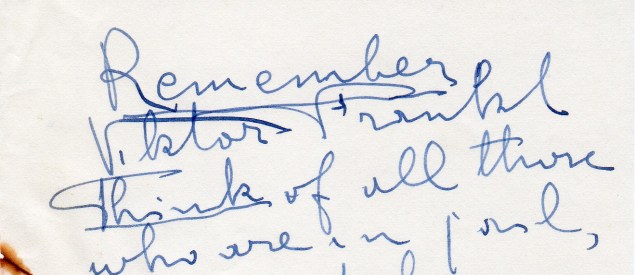
Think of Viktor

Assagioli’s note: “Remember Viktor Frankl. Think of all those who are in jail,…” (Archivio Assagioli, Firenze, © Istituto di Psiconsintesi).

Continue reading

The Stars are Living Beings

olive tree flower

In the garden at Casa Assagioli in Florence, the olive trees are flowering and bees are humming around the acacia tree. Recently, I and ten other guests had the opportunity to spend one afternoon with Piero Ferrucci, author, philiospher, and psychosynthesis psychotherapist, asking him questions about the five years he spent with Assagioli as a student from 1969 to 1974.

After Assagioli’s death, Ferrucci was the first person to work with Assagioli’s material, and he spent two years compiling stacks of paper into what is now part of Assagioli’s  archives. Ferrucci recalled sitting at two tables in the kitchen of Assagioli’s home, surrounded by many folders. Many were in a mess. While working his way through them, Ferrucci sensed Assagioli’s presence and energy. He said that he could feel Assagioli blessing each small piece of paper, each a separate, distinct insight.

Continue reading

Walking the Labyrinth of Your Soul

labyrinthgeneral

A labyrinth has often been used as a metaphor for a soul’s spiritual journey. Unlike a maze, labyrinths are usually circular in shape and have one, and only one, continuous meandering path that eventually leads to the center. This single path threads itself over the maximum amount of ground, without treading the same trail twice. There are no dead-ends, no intersections.

Labyrinths can be found in almost every religious tradition around the world. The design is mysterious and mythic, its origins unknown, yet primordial. It is an archetypical design, appearing across continents and cultures. The Hopi medicine wheel, Tibetan sand paintings, Troy dances, and the Tree of Life, found in the Jewish mystical tradition of the Kabbala, are all examples of labyrinths.  Even DNA, which encodes the genetic inheritance that defines our unique identity, could be viewed as a labyrinth, the double-helix strands spiraling around each other.

Continue reading