We are less than ten days before Christmas and the 2025 is nearly finished. Here are some past Christmas posts that you might like to read between all that you need/should/ought/want/and don’t want to do. During this time of year full of darkness, I hope you can find a moment to reflect on the beauty, light, and love that is also in our midst.
More than 100 years ago, Rabindranath Tagore, winner of the 1913 Nobel Prize for Literature, spent five months in the United States trying to raise money for his newly founded Visva-Bharati University. He was mostly unsuccessful, in part, because British officials in the USA were discreetly working against him, dissuading rich benefactors from donating. This subtle sabotage was mainly because, after the Amritsar massacre in 1919, Tagore had renounced his knighthood.
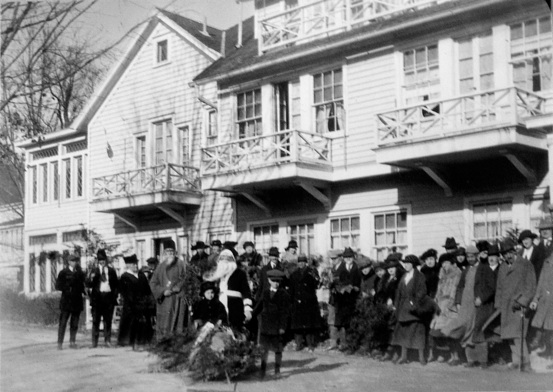
Christmas 1921 at Yama Farms Inn. You can clearly see Tagore who is standing tall, left of Santa, wearing a traditional robe and his real flowing white beard!
At Christmas Tagore happened to be staying as a guest at Yama Farms Inn in the Catskill Mountains north of New York City. Located on 1300 acres, Yama Farms Inn had 40 rooms. It was a kind of retreat hotel for industrialists who could go there and enjoy the company of intellectuals without any fuss about their millions. It was the kind of place where you could find Mr. Colgate, Mr. Eastman, and J.D. Rockefeller. Previous guests had been Thomas Edison and the naturalist John Burroughs.
While Tagore was there, he was outside the inn at the same time J.D. Rockefeller was waiting for his car. When Rockefeller saw Tagore, he gave him a dime. Later Rockefeller told the owner of Yama Farms that he had given a dime to “an old Negro.” Tagore is said to have later asked two Russian artists, “Isn’t it odd…Do I look like a tramp?”
Tagore wrote this pained letter to his friend and confident Charles Freer Andrews from Yama Farms on Christmas Day:
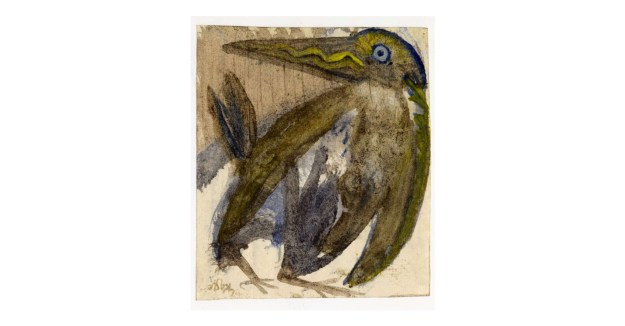
Bird painting by Tagore
Near New York, December 25th, 1921
To-day is Christmas Day. We are about forty-five guests gathered in this inn from different parts of the United States. It is a beautiful house, nestling in the heart of a wooded hill, with an invitation floating in the air of a brook broadening into a lake in the valley. It is a glorious morning, full of peace and sunlight, of the silence of the leafless forest untouched by bird songs or humming of bees.
But where is the spirit of Christmas in human hearts? The men and women are feeding themselves with extra dishes and laughing extra loud. But there is not the least touch of the eternal in the heart of their merriment, no luminous serenity of joy, no depth of devotion. How immensely different from the religious festivals of our country! These Western people have made their money but killed their poetry of life. Here life is like a river, that has heaped up gravel and sand and choked the perennial current of water that flows from an eternal source on the snowy height of an ancient hill. I have learnt since I came here to prize more than ever the infinite worth of the frugal life and simple faith. These Western people believe in their wealth, which can only multiply itself and attain nothing.
How to convince them of the utter vanity of their pursuits! They do not have the time to realize that they are not happy. They try to smother their leisure with rubbish of dissipation, lest they discover that they are the unhappiest of mortals. They deceive their souls with counterfeits, and then, in order to hide that fact from themselves, they artificially keep up the value of those false coins by an unceasing series of self-deceptions.
My heart feels like a wild-duck from the Himalayan lake lost in the endless desert of Sahara, where sands glitter with a fatal brilliance but the soul withers for want of the life-giving spring of water.
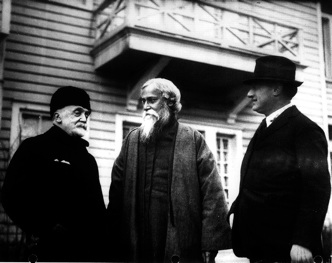
From left to right: Baron Roman Romanovitch Rosen, who served as the Russian ambassador to the United States and to Japan; Rabindranath Tagore; and Arthur Hamerschlag, first president of the Carnegie Mellon Institute of Technology, outside Yama Farms Inn.
Thirty-five years ago while living in Japan, I was invited by Japanese friends to visit the Hiroshima Peace Memorial. Upon our arrival to the city, I was immediately struck by how lively and ‘normal’ it felt. Cars were zooming by, people on bicycle were rushing to their destinations, skyscrapers filled the landscape. It was difficult to imagine the horrible disaster of a nuclear bomb on the city and its 255,000 innocent inhabitants. We soon arrived to the Memorial Park, an open space with various monuments, including an eternal flame burning for peace on Earth, all beautifully decorated with long strings of origami cranes.
While I contemplated these sites, many profoundly sorrowful feelings emerged. Then suddenly a middle-aged Japanese man swooped in and was screaming in my face. Not understanding any Japanese at the time, I asked my friends to translate. Embarrassed, they roughly yet very politely urged him to go away. He was screaming at me for dropping the atomic bomb on August 6, 1945.
During the start of the Iraq War, I found myself in a Beirut convent eating dinner with an Iraqi couple. We were all there for a conference on the Syriac language, my husband’s expertise. I could hardly look at this couple for all the shame I felt about my country invading theirs. “I’m so sorry,” I said as soon as the opportunity arose, “for what my country is doing to yours. I hardly know what to say to you.”
“Oh, that’s okay,” the woman assured me. “We know just how you feel. We were having dinner with Kuwaiti friends when our country invaded theirs.”
A month after the 9/11 attacks, I and my husband returned to Egypt after visiting my family in California. We had been living in Giza for the past year and were happy to return. Initially, I was afraid to even say I was American, but no one seemed to show any animosity. Except quietly behind closed doors. My neighbor was not ashamed to tell me how happy she had been to see the Twin Towers fall. For her, Osama bin Laden had successfully brought the schoolyard bully to its knees and fear to its land. “But,” she admitted, “as an architectural student, it saddened me to see the buildings fall.”
Slavic Goddess Berehynia
It is a beautiful spring day, and I am with my husband and another couple visiting a small medieval village in Tuscany. We were standing in a piazza, enjoying the surrounding architecture, and trying to decide where to have lunch. Suddenly we hear an older man’s voice demanding an answer: “Do you think this is beautiful? Do you? Do you think this is beautiful?” We all turned to him and nodded dumbly. “During the war there was nothing here but malaria and famine.” He nearly spat out the words. “Malaria and famine. Take that bellezza home with you.”
Peace for Ukraine, painting by Mona Shafer Edwards
One final story. I am just six years old. It is 1962 and the Cuban missile crisis is looming. Our kindergarten class has been lined up into single file and brought to the gymnasium. This is not our normal routine. We are told to sit down together on the floor. All the other elementary school kids are also there. A teacher I don’t know is talking. She is telling us how if there is a bomb, we will all gather in the gym like this and stay together. No one will be able to go home. When the bomb is dropped, we will sleep here and wait for our parents to come. We might have to wait days. I don’t understand. This all feels like a dumb thing to do. I raise my hand and wait to be called on. “Why are adults doing this?” I ask. The teacher doesn’t answer. She just looks at me.
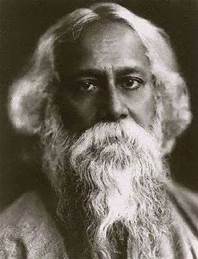
Rabindranath Tagore
All these strong experiences have taught me the need to overcome nationalism and, above all else, hold fast to the moral spirit of humanity. Given what is happening in Europe today, we would do well to heed the words of Rabindranath Tagore, poet and Nobel Prize winner of Literature. Soon after WWI, Tagore wrote and lectured worldwide against nationalism, calling on all of us to recognize our greater humanity. In his book Nationalism, he clearly states:
“Nationalism is a great menace… the time has come, for the sake of the whole outraged world. Europe should fully know in her own person the terrible absurdity of this thing called the Nation.”[1]
Tagore did not shirk from pointing out how nationalism was prevalent in his own country, causing him to meet with scorn from every side. In 1917, Tagore began speaking openly against the British Raj.[2] To the average British official, he was considered a non-cooperator who refused to ‘play the game’ of Anglo-Indian back-scratching. To the average Indian nationalist, he was un-patriotic. As his biographers note: “By not joining any group, and refusing to temper his criticisms, Tagore had become the target of all groups.”[3] In fact, he was nearly assassinated during a visit to San Francisco by Indian nationalists.
Tagore distained blind nationalism and fanaticism where “machine must be pitted against machine, and nation against nation, in an endless bullfight of politics.”[4] What he proposed instead was universal humanism, global cooperation and harmony. Tagore’s core ideas included the need for self-determination, strengthening society from below, universal man and the need for education transcending borders.[5]
Yurii Sheliazhenko
For the rest of his life, Tagore called on all peoples to create a “more human order, a finer science of life, and a spiritual republic behind world politics.”[6]
We may wonder how Tagore’s words of 100 years ago might have any relevance to us today. But nationalism is still playing a major role in the more than 20 wars ranging worldwide. One’s national identity is causing fractures even inside countries like the USA and the EU. The attitude of ‘us’ vs ‘them’ is a nationalist one.
To hear another prophetic voice like Tagore’s, I suggest going this link and listening to Yurii Sheliazhenko, the executive secretary of the Ukrainian Pacifist Movement and a board member of the European Bureau of Conscientious Objection. He says:
“Instead of breaking the last bonds of humanity out of rage, we need more than ever to preserve and strengthen venues of communication and cooperation between all people on Earth.”









 Love and Will