I stand here ironing t-shirts a green dress your shirt for work. And think how absurd with a genocide not miles away.
An endless litany of words drained of all meaning and force. Genocide, ethnic cleansing, displacement, occupation, hostage and liberation. Under siege and mass atrocities.
Words without context. Terrorist. Nazi. Zionist. Fascist. Hamas. Antisemitic. Jew. Christian. Moslem. Massacre and holocaust.
Slippery collective shadow ruthlessly reckless. Animal. Beast. Less than human. Savages.
I ease the iron across a tablecloth as the numbers move before my eyes. 2.3 million, hundreds of thousands. 1400 dead… 3000 dead… 5000 dead… 8000 dead. 732 entire families dead. Under the rubble dead.
Non-stop bombardment. Whispering within the sliver of silence not one word. Peace.
Only the voice of a Jewish grandmother. Turns to her captor, shakes his hand, “Shalom.” Only the voice of a Palestinian grandmother learns her daughter dead, her granddaughter dead, “Please come to me in my dreams. Because I cannot live without you.”
I stand and iron your handkerchiefs, my white summer dress to hang in closets and place in drawers. But how to wash and iron this epic human tragedy? And in what drawer do I place it?
Please come to me in my dreams. Because I cannot live without you. God’s mercy. God’s charity. Love and kindness. Justice. Empathy and compassion. But most of all Peace.
To celebrate World Psychosynthesis Day, I thought I would share a document that I found a few years ago while working in Assagioli’s archives. It is a review by Lama Anagarika Govinda (1898-1985) of Roberto Assagioli’s book The Act of Will. Govinda’s review starts out with this very powerful statement, which can apply today as much as it did more than 50 years ago:
The world is said to be in the grip of a “power crisis”, but few people realize that this is true in a much deeper sense than that of a mere economic problem. Power has become a human obsession and a self-destructive principle. At the same time it has resulted in a psychological revolt against the very root of power, namely the intellect and the human will, which have led to the domination and misuse of the forces of nature and may result in the gradual destruction of our planet’s ecology and the human race.
Lama Anagarika Govinda
About the Document
On the top margin of the first page of this typewritten review you can see a handwritten note by Lama Govinda to Assagioli: “With kindest regards and best wishes! Lama Govinda”
On the bottom margin of the last page, there is the following handwritten note:
“Copy sent to the Editor Psychosynthesis Journal, San Francisco”
Then in Italian:
Spero che Lei ha ricevuto le fotografie che mia moglie ha fatto durante il nostro soggiorno Castiglioncello. LG. (I hope you received the photographs that my wife took during our stay Castiglioncello. LG)
Govinda and Assagioli’s Meeting
In his autobiography, Piero Ferrucci writes about the two men’s meeting which took place in Castiglioncello, Tuscany, in August 1972. Here is a brief excerpt:
“At one time Assagioli achieved a degree of fame overseas, far more than in Italy, and various people came to meet him. Lama Govinda came while Assagioli was spending a few days at Castiglioncello on the Tirrenian coast. Lama Govinda had written books on Tibetan Buddhism, and had made available to the public its forgotten teachings. Assagioli and Lama Govinda were puny, frail old men with white beards and an air of wisdom about them.
“His meeting with Assagioli was a great piece of theatre. Lama Govinda was slowly climbing a staircase with friends, Assagioli was waiting at the top and began going down the stairs to meet him. He had asked me: “Should I greet him the Oriental way, with hands clasped, or the Western way, with a handshake?” A fair question, seeing as Lama Govinda was actually a German scholar transplanted in the East. I said he should greet him with hands clasped. When the meeting took place, Assagioli gave him the Oriental greeting, but Lama Govinda extended his hand. So Assagioli started to give him his hand, but meanwhile Lama Govinda had decided to greet with hands clasped. It looked like a strange ritual: East meets West.
“The conversation began and Lama Govinda pointed out that the concept of will in psychosynthesis was similar to that of the Buddhist virya, inner strength. After a while the two asked to be left alone… Sometime later the two of them came back looking radiant and resembling each other even more.”
Piero Ferrucci
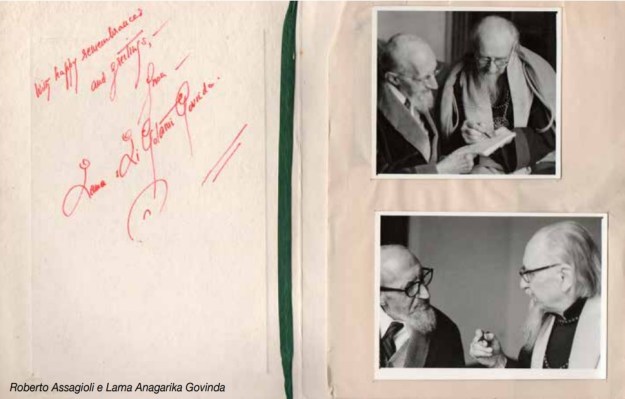
Above are two photos of the two “puny, frail men with white beards.” I am not certain, but perhaps these photos are the ones mentioned by Lama Govinda. You can see the note written by him: “With happy remembrances and greetings – from – Lama and Li Gotami Govinda. Li Gotami Govinda (1906-1988) was his wife. More about her below.
Lama Govinda and Li Gotami Govinda
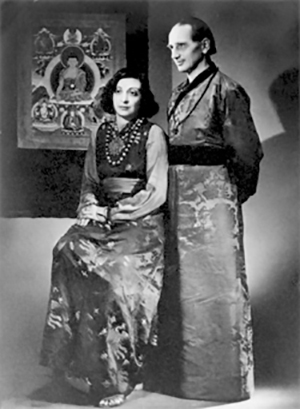
The Govindas in 1947 at one of their four wedding ceremonies.
One life event that Govinda and Assagioli shared was during World War II. While Assagioli spent one month in prison, followed by his time under house arrest and then more than a year in hiding, Govinda spent three years in a British internment camp at Dehra Dun, India.
Govinda and his wife Li Gotami were married after the war in 1947 and soon afterwards undertook research expeditions to Tibet, making a large number of drawings and photographs of Buddhist art and architecture. Govinda described these expeditions in his popular book The Way of the White Clouds and Li Gotami’s photographs appear in her book Tibet in Pictures.
Perhaps what delighted me most while preparing this short reflection was Govinda’s connection to Rabindranath Tagore. Govinda taught at Rabindranath Tagore’s Vishva-Bharati University in Shantiniketan and that is where he met his wife. Li Gotami Govinda was Parsi, born in Bombay, and a famous photographer and painter in India. At the time she was studying at the university. Their encounter took place when she was making her way to the hostel where Lama Govinda was staying, as described below:
“A door opened and out strolled this handsome, smiling foreigner dressed in the burgundy robes of a monk. She recalled asking herself who this “bright merry person” might be, and in retrospect (at least on her part) remembered the incident as very romantic.”
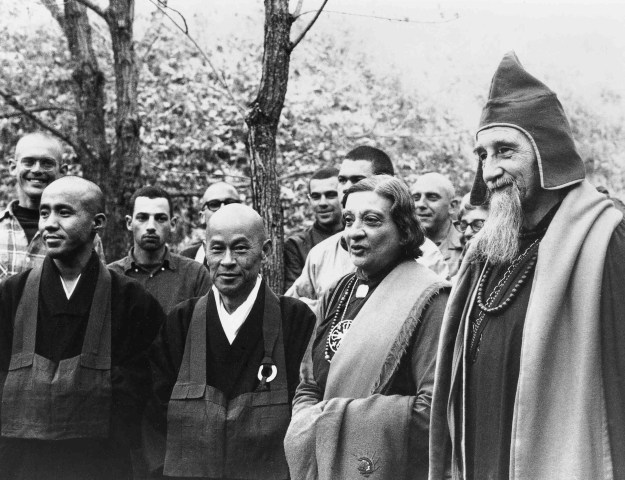
Suzuki Roshi, Li Gotami, and Lama Govinda.
Lama Govinda’s Review of The Act of Will
Unfortunately, this review by Govinda was never published by the Psychosynthesis Journal. However, a slightly edited version was published posthumously in The Lost Teachings of Lama Govinda: Living Wisdom from a Modern Tibetan Master, edited by Richard Power, foreword by Lama Surya Das. Quest Books, 2007.
What I found most interesting are Govinda’s definitions of the Transpersonal Will and Universal Will.
“Transpersonal Will (which is the urge to find a meaning in life, the urge towards highest realization [Sanskrit: Dharma-chanda]) and the Universal Will (in which the human will is in perfect harmony with the universal law [Dharma]).”