Tag Archives: psychosynthesis

Intuition and the Angel Highway

Most of us felt some relief saying goodbye to 2014; the news never seemed worse. Now barely two weeks into 2015, the news seems even grimmer. We can easily fall into despair about the state of the world. But recently I listened to a discussion about the physics of angels, and, to balance the horrors we see everyday in the news, I want to bring angels into the conversation.
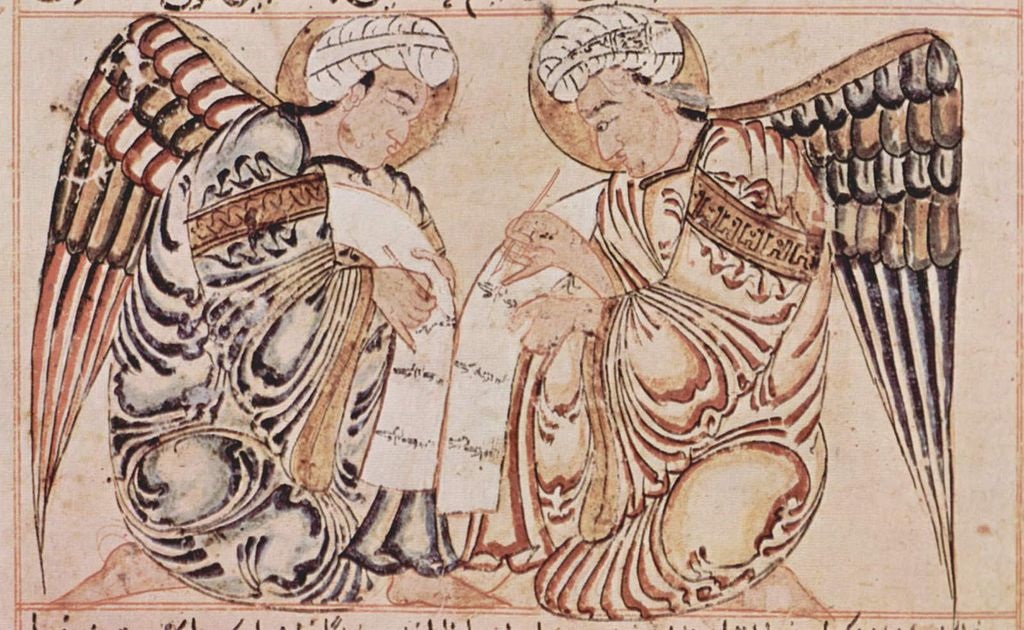
Two Islamic angels write in the Book of Life, suggesting angels' ongoing and attentive interest in human affairs (1280 A.D., Iraq)

Two Islamic angels write in the Book of Life, suggesting angels’ ongoing and attentive interest in human affairs (1280 A.D., Iraq)

During the month of Advent, I decided to paint angels that are connected with the Christmas story. I believe they do exist and are waiting for us to listen to them. The name angel derives from the Greek angelos meaning “messenger.” Angels are agents ready to guide, creatively inspire, aid, and teach us, and they have stirred the imagination of artists, writers, mystics, and ordinary persons throughout the ages, across cultures and belief. More than 80% of Americans believe in angels.

Angels approach us through dreams, visions, and meditative states and can appear in the form of voices, human or animal shapes, as male or female or androgynous beings, or as stars or light. Beings without matter, their wings are a symbol of their great spiritual energy. We delight in their cherub cuteness, but, in reality, they can also be fierce and terrifying.
Continue reading

Join the Magi – Embrace the Sublime

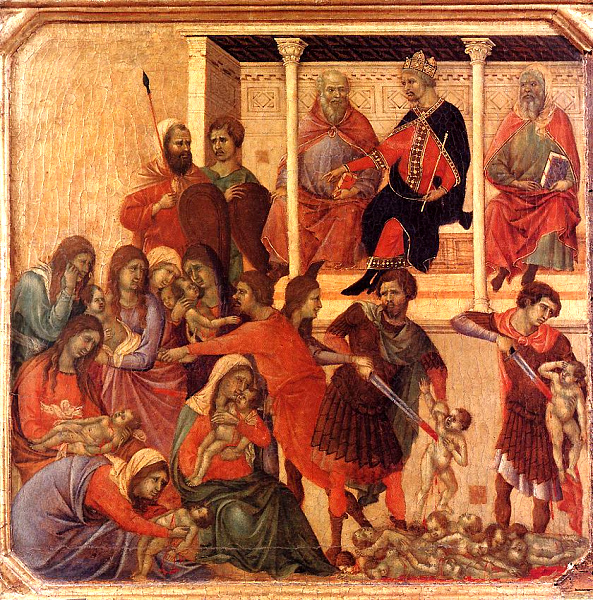
Often the Christmas story is left unfinished. We usually stop right after the three Wise Men offer their gifts of gold, frankincense and myrrh to the newborn Child. The part we tend to skip over is the Slaughter of the Innocents. This massacre of all boys two years and younger in and around Bethlehem is a horrific part of the story that doesn’t easily fit into the joy of Christmas.

innocentsDuccio

The story goes like this: Following a rising star in the hopes of paying homage to the Child, the Wise Men from the East first stop to pay their respects to King Herod in Jerusalem. They ask if he knows where the infant king is. When King Herod hears about the Child, he is perturbed by the prospect of a competitor king, as are the chief priests and scribes. Herod asks the priests if they have any idea where the Child is to be born. They cite from the prophecies that the birthplace is Bethlehem. Herod then privately summons the Wise Men and sends them onto Bethlehem, telling them to “Go and find out all about the Child, and when you have found him, let me know, so that I too may go and pay him homage.”

After finding the Child and offering their gifts, the Wise Men are warned by an angel in their dreams not to return to King Herod, but to return home by another road. When Herod learns of their surreptitious departure, he is furious and decrees that all male infants must be indiscriminately killed, hoping that the Child will be among them. Meanwhile, an angel appears to Joseph in his sleep, telling him to leave immediately with Mary and Jesus to Egypt. The three become refugees and are spared from the experience of the slaughter.

The Slaughter of the Innocents is crucial to our understanding of the entire Christmas message. Once a vulnerable child full of Light and Love is born, a powerful leader feels threatened and wants him murdered. His evil desire extends not only to the child, but to many innocent children. What might this story reveal to us today?

Continue reading

Playing Christmas

1980-01-01 00.04.39

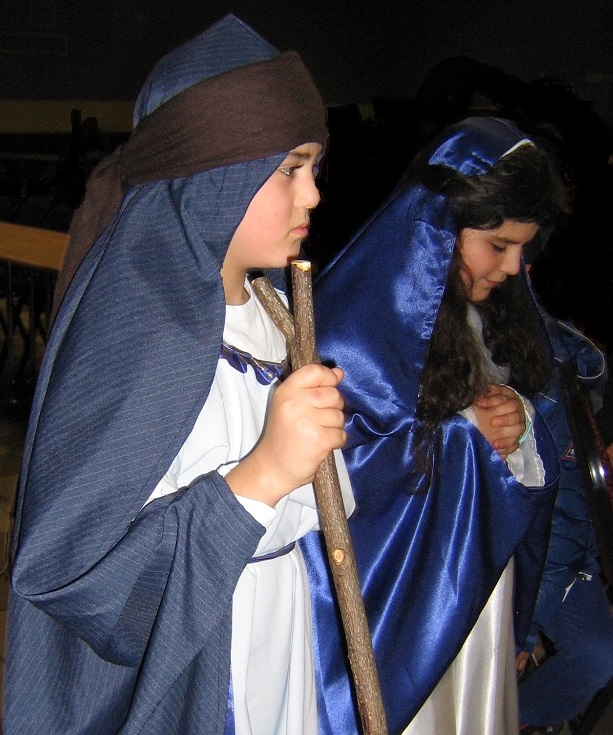
The children are running around like crazy while mothers sort through white robes and gold-tinsel halos to dress the choir of angels. Ayfer, the director of the Christmas play, is showing Mary how to knee, stand up and walk backwards without tripping over her blue veil. Somebody has decided to give the boys who are playing the shepherds each a long stick as shepherds’ hooks. This is a bad idea. Four boys waiting around to be scared by an angel plus four long sticks only mean trouble. They are twirling and jabbing and thrusting the sticks at each other. I go over and tell them (in basic and bad German) that the sticks are not toys. They calm down for about two minutes and then jump up again.

We are rehearsing for the second annual Weihnachtstheater performed by the Sunday school children of St. Jesaja Syrian Orthodox Church in Gronau, Germany. Ayfer, who is a tiny yet formidable presence, lassoed me into helping with the Sunday school about two years ago. My goal was to support the mothers, marginalized within their own community, who try to offer the children a respite from the two-hour Sunday mass every week.

Continue reading