Tag Archives: psychosynthesis

When Spider Webs Combine

Faith in the Future Conference. Photo by ARC

Faith leaders representing 24 world religions gathered at Bristol, England, this month and committed to helping the world’s poorest people. Photo by ARC.

One of my favorite Assagioli quotes, which I actually have printed on my business card, is as follows:

“When spiritual light is focused on the most complex of individual or collective problems, it produces solutions…and spares us much suffering.”

These words resonate with the news that the UN is now actively inviting spiritual leaders to become involved in 17 sustainability commitments for the next 15 years. On 25 September, world leaders will gather at the United Nations in New York to adopt the 2030 Agenda for Sustainable Development. These commitments include a worldwide end to poverty and hunger, full employment across the globe, and gender equality in every country.

Continue reading

The Healing Paradox

Are you like Ava and afraid of falling? Then try to fall!

Are you like Ava and afraid of falling? Then try to fall!

Ava came to see me because she had been suffering with extreme vertigo for the past three years. Uncompensated labyrintis occurs when the inner ear becomes damaged and does not heal after eight weeks. Basically, the brain must then relearn how to correct the faulty signals that are coming from the sufferer’s damaged inner ear. Until then, you can experience dizziness, imbalance, and fatigue.

Ava’s brain was taking a long time to learn how to reinterpret the signals coming from her inner ear. Hence her continual bouts of vertigo which were unpredictable and could last for days. The strange part is that dizziness is actually part of the healing process as it shows that your brain is trying to correct the faulty signals.

Despite all this, Ava kept insisting that her life, in general, was happy and that she was happy. But still there were things she missed doing like skiing and dancing. Ava (30) was married and also wanted to start having children, but she was constantly afraid of falling down and didn’t dare have a baby for fear of falling while carrying the child.

Underneath her presenting issue of vertigo, however, was another story. When Ava was 18 and just beginning university, 200 km away from home, one morning, she spoke to her mother on the phone. Later that day she received a call that her mother had died in a car accident. This tragedy was particular difficult for her for many reasons, not to mention, the accident being so unexpected and her mother’s death so sudden. Ava was an only child. And finding herself far from home, without any real friends at the new school, she had no one to go to for immediate comfort.

Continue reading

Inside Out Turned Outside In

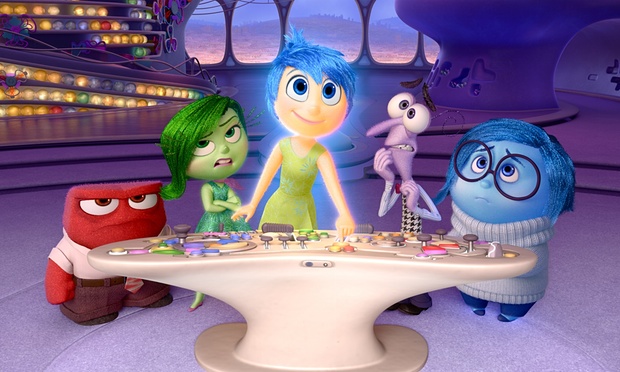
Inside Riley's Headquarters. From right to left: Anger, Disgust, Joy, Fear, Sadness. Photo by Pixar.

At the controls in Riley’s  brain Headquarters. From right to left: Anger, Disgust, Joy, Fear, Sadness. Photo by Pixar.

Yesterday I went to see the new Pixar movie Inside Out. It is an intelligent 3D-animated feature about 11-year-old Riley who moves with her family from Minnesota to San Francisco. But the real stars of the film are her five emotions, Joy, Sadness, Anger, Disgust and Fear, who are busy operating Riley’s outer behavior from her brain Headquarters. I will not go into details about the story, but I did find it entertaining, fun, and thought provoking. The movie has received rave reviews and is topping all kinds of records for ticket sales.

Today in the Guardian newspaper, one movie critic has warned shrinks to stay away from the movie. (Oops! Too late!) Psychology professionals (along with some parenting forums) are reportedly outraged that Sadness is shown as fat, frumpy and unattractive, and Joy is slim, pretty and smart. What is the film saying? That fat people are sad and thin people are full of Joy?

Actually, from a psychosynthesis perspective, this discrepancy could have easily been explained (and the movie would have been much richer) if the five emotions had actually been five different subpersonalities. Like our subpersonalities, in the movie each emotion not only has feelings but also a body and mind as well. All are embodied in a type of human form. Sadness is the color blue and, okay, let’s say full-bodied, while Joy is a slender and an adorable version of Tinkerbell. In addition, all five emotions have cognitive functioning, that is, they all contemplate, calculate, make decisions, and integrate new ideas and experiences, especially when they have to find a way to reconnect to Riley.

Continue reading