Tag Archives: meditation

A Glimpse of Infinity

After graduating from the University of California Berkeley in 1987, I moved to Fukuyama, Japan—about 400 miles south of Tokyo—to teach English. People often ask why I decided to go to Japan, but the reality is that Japan chose me. At that time, I longed to take a year off and travel abroad. Having applied for English teaching positions in more than fifty countries, the school in Fukuyama was the one that invited me to come.

I arrived knowing only three words in Japanese: hajimashite (nice to meet you), arigatoo (thank you), and sayonara (goodbye), thanks to a Japanese friend who helped me learn some helpful phraes before I left. I practiced constantly.

The author at the Sanzen-in Temple in Kyoto in 1987.

I ended up staying two years in this beautiful country. I learned to speak Japanese and to read enough of the language to decipher grocery labels and train schedules, and I was blessed with making many Japanese friends, some of whom I am still in touch with 35 years later.

You can read more about my time in Japan and the transpersonal experience that I had while visiting Sanzen-in Temple in Kyoto. This story was published as a “Spiritual Journey” by Unity Magazine (September/October 2023).

Feel free to enjoy and share “A Glimpse of Infinity.” (Note that the graphic makes more sense if you open the pdf and view it in two pages!)


Lama Govinda Reviews “The Act of Will”

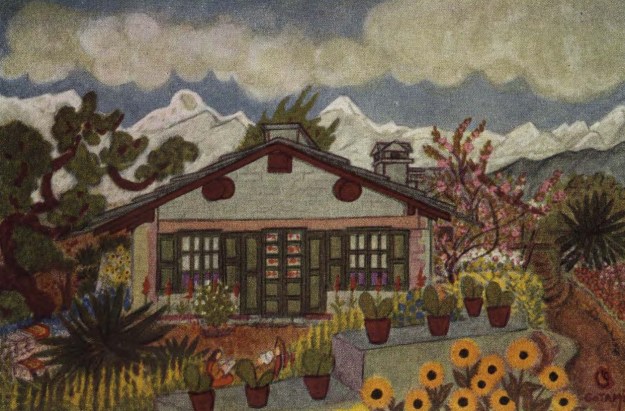
Painting by Li Gotami Govinda

To celebrate World Psychosynthesis Day, I thought I would share a document that I found a few years ago while working in Assagioli’s archives. It is a review by Lama Anagarika Govinda (1898-1985) of Roberto Assagioli’s book The Act of Will. Govinda’s review starts out with this very powerful statement, which can apply today as much as it did more than 50 years ago:

The world is said to be in the grip of a “power crisis”, but few people realize that this is true in a much deeper sense than that of a mere economic problem. Power has become a human obsession and a self-destructive principle. At the same time it has resulted in a psychological revolt against the very root of power, namely the intellect and the human will, which have led to the domination and misuse of the forces of nature and may result in the gradual destruction of our planet’s ecology and the human race.

Lama Anagarika Govinda

About the Document

On the top margin of the first page of this typewritten review you can see a handwritten note by Lama Govinda to Assagioli: “With kindest regards and best wishes! Lama Govinda”

On the bottom margin of the last page, there is the following handwritten note:

“Copy sent to the Editor Psychosynthesis Journal, San Francisco”

Then in Italian:

Spero che Lei ha ricevuto le fotografie che mia moglie ha fatto durante il nostro soggiorno Castiglioncello. LG. (I hope you received the photographs that my wife took during our stay Castiglioncello. LG)

Govinda and Assagioli’s Meeting

In his autobiography, Piero Ferrucci writes about the two men’s meeting which took place in Castiglioncello, Tuscany, in August 1972. Here is a brief excerpt:

“At one time Assagioli achieved a degree of fame overseas, far more than in Italy, and various people came to meet him. Lama Govinda came while Assagioli was spending a few days at Castiglioncello on the Tirrenian coast. Lama Govinda had written books on Tibetan Buddhism, and had made available to the public its forgotten teachings. Assagioli and Lama Govinda were puny, frail old men with white beards and an air of wisdom about them.

“His meeting with Assagioli was a great piece of theatre. Lama Govinda was slowly climbing a staircase with friends, Assagioli was waiting at the top and began going down the stairs to meet him. He had asked me: “Should I greet him the Oriental way, with hands clasped, or the Western way, with a handshake?” A fair question, seeing as Lama Govinda was actually a German scholar transplanted in the East. I said he should greet him with hands clasped. When the meeting took place, Assagioli gave him the Oriental greeting, but Lama Govinda extended his hand. So Assagioli started to give him his hand, but meanwhile Lama Govinda had decided to greet with hands clasped. It looked like a strange ritual: East meets West.

“The conversation began and Lama Govinda pointed out that the concept of will in psychosynthesis was similar to that of the Buddhist virya, inner strength. After a while the two asked to be left alone… Sometime later the two of them came back looking radiant and resembling each other even more.”

Piero Ferrucci

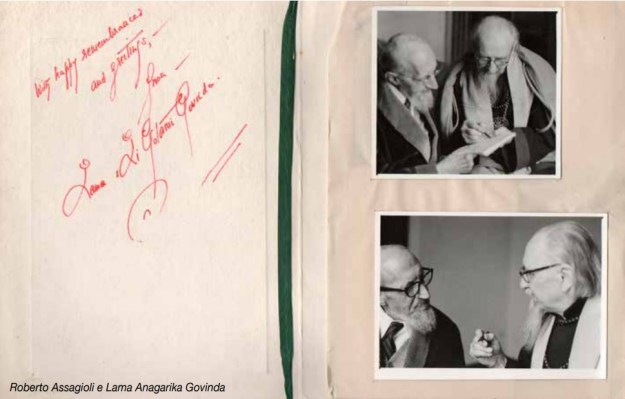
Above are two photos of the two “puny, frail men with white beards.”  I am not certain, but perhaps these photos are the ones mentioned by Lama Govinda. You can see the note written by him: “With happy remembrances and greetings – from – Lama and Li Gotami Govinda. Li Gotami Govinda (1906-1988) was his wife. More about her below.

Lama Govinda and Li Gotami Govinda

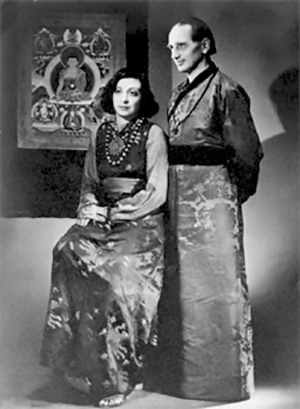
The Govindas in 1947 at one of their four wedding ceremonies.

One life event that Govinda and Assagioli shared was during World War II. While Assagioli spent one month in prison, followed by his time under house arrest and then more than a year in hiding, Govinda spent three years in a British internment camp at Dehra Dun, India.

Govinda and his wife Li Gotami were married after the war in 1947 and soon afterwards undertook research expeditions to Tibet, making a large number of drawings and photographs of Buddhist art and architecture. Govinda described these expeditions in his popular book The Way of the White Clouds and Li Gotami’s photographs appear in her book Tibet in Pictures.

Perhaps what delighted me most while preparing this short reflection was Govinda’s connection to Rabindranath Tagore. Govinda taught at Rabindranath Tagore’s Vishva-Bharati University in Shantiniketan and that is where he met his wife. Li Gotami Govinda was Parsi, born in Bombay, and a famous photographer and painter in India. At the time she was studying at the university. Their encounter took place when she was making her way to the hostel where Lama Govinda was staying, as described below:

“A door opened and out strolled this handsome, smiling foreigner dressed in the burgundy robes of a monk. She recalled asking herself who this “bright merry person” might be, and in retrospect (at least on her part) remembered the incident as very romantic.”

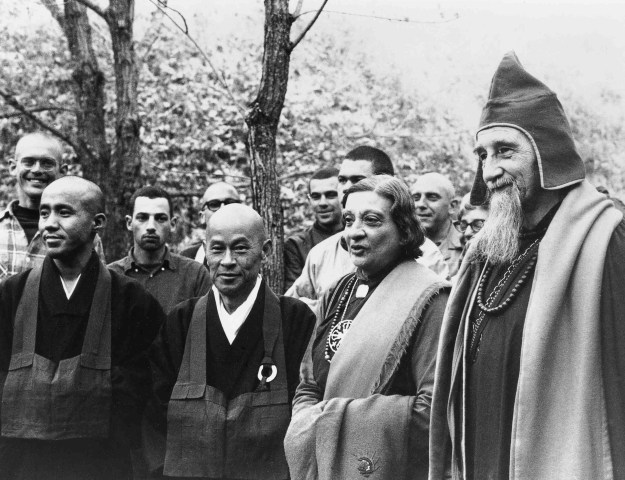
Suzuki Roshi, Li Gotami, and Lama Govinda.

Lama Govinda’s Review of The Act of Will

Unfortunately, this review by Govinda was never published by the Psychosynthesis Journal. However, a slightly edited version was published posthumously in The Lost Teachings of Lama Govinda: Living Wisdom from a Modern Tibetan Master, edited by Richard Power, foreword by Lama Surya Das.
Quest Books, 2007. 

What I found most interesting are Govinda’s definitions of the Transpersonal Will and Universal Will.

“Transpersonal Will (which is the urge to find a meaning in life, the urge towards highest realization [Sanskrit: Dharma-chanda]) and the Universal Will (in which the human will is in perfect harmony with the universal law [Dharma]).”


References

To learn more about Lama Govinda, you can visit:

Lama Anagarika Govinda: The Pioneer Who Introduced Tibetan Buddhism to the World

Lama A. Govinda: The founder of the Arya Maitreya Mandala

To learn more about Li Gotami Govinda, visit:

Ratti Petit: Li Gotami – The Woman Who Dedicated Her Life to the Arts


Balancing Silent Night with the Roar of Nightly News

Light in the darknessIn northern Europe the days are growing shorter. Except for the oak trees with their withered sienna-brown leaves, most of the trees are bare against a bleak landscape and gray skies laden with cold, damp winds. The Dutch have a saying for this time of year: De donkere dagen voor Kerstmis. The dark days before Christmas. Indeed, every day is shorter and the nights seem to stretch out like a long, endless dream.

We are in the season of Advent, which mark the days before Christmas. Advent comes from the Latin word adventus meaning arrival. We freely use the word advent to simply mean “to come into being.”  This is the time of year that we await the arrival of light when the Earth will once again begin to tilt towards our sun. The days can then slowly “come into being,” promising their full splendor of sunshine and warmth at the summer solstice. For Christians, this is the time during which they await the birth of Jesus, when the Divine comes into being.

Darkness Inside

For most of us, these days are more than just physically dark. We can also become lost and overwhelmed in all the expectations of the season. The shopping, planning, cooking, baking, wrapping, cards, music, school plays, church concerts. The running and stress, travel and traffic, not to mention all the money worries.

Typically, we are expected to spend time with our families, with the idea that everyone should be happily singing songs around a piano or opening perfect presents or eating gourmet meals. But our reality may actually lead us to feeling only more lonely and unsatisfied. Under pressure by the media and our own unreal expectations, many of us become depressed this time of year and some of us may even feel suicidal.
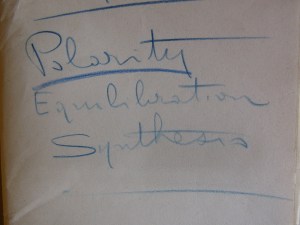
Assagioli's notes on polarities.

Assagioli’s notes on polarities.

Darker still are the constant reminders, between the tinsel and flashing lights, of the pain and suffering in the world. Not to mention, of course, our own pain and suffering. How can we possibly feel Joy? The entire season can feel like a sham. Bah Humbug! Where is the Higher Self in all this tragic mess?

Balancing Darkness with Light

Simon and Garfunkel once recorded a song called “7:00 News/Silent Night,” in which the familiar carol is quietly and beautiful sung. At first dimly, then more clearly and loudly, we simultaneously hear the voice of a newscaster dispassionately announcing the kind of violent and terrible news we are all too familiar with. Even though, at the end, the voice of the announcer seems to overwhelm the song, the tender voices unceasingly sing – they are not even faintly shaken.

One could experience this song as another symbol of despair – the submergence once again of peace and joy in the harsh violence of our day. But when listened to in its wholeness, the song expresses the reality that light does shine in the darkness. If we tune into the song of peace, we will be able to hear its still small voice singing clearly under the din of the crowd.

Light and dark. Joy and hatred. These are two of the many polarities that exist in the world. Our job is to learn to live with their tension in order to transform and synthesize their energies into a higher reality. Assagioli says that this process is analogous to a chemical combination when two elements are absorbed into a higher unity endowed with qualities different from what each individual element has.

Transforming Opposites into a Synthesis

The idea is to balance these opposites, hold their creative tension, and give space for a completely new and higher entity to be born. You do this by first being with the violent darkness but not identify with it. Then be with the joyful light and not identify with it either. Finally, we need to be with all that is and hold an objective understanding of the tensions between them in order to creatively seek wholeness.

Assagioli insisted that the mid-way point between two opposites is not static inside us, but rather in “a state of continuous oscillation.” We can actually experience this oscillation between Darkness and Light when we listen to the song “7:00 News/Silent Night.”

Once we can hold onto this mid-way point, then psychosynthesis can occur. It is a wise person who can play with opposites and watch with awe as they awaken and manifest into a complete formed higher quality.

So during these dark days before Christmas, practice hanging on and letting go. Hang onto the dark, and then let it go. Then hang onto the light, and let it go. Try to stand in the mid-way point by expressing Human Affection during this season. Then wait quietly and patiently for the advent of Spiritual Love that is quietly, calming, and ceaselessly singing in the world’s chaos.