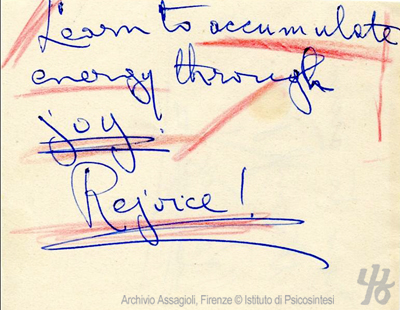
Roberto Assagioli, the visionary founder of psychosynthesis, left a treasure trove of thoughts when he died in 1974 at the age of 86. A great scholar, linguist, educator, and philosopher, Assagioli’s creative ideas compelled him to handwrite his reflections onto small pieces of paper, including the back of concert tickets! Often he would stuff these pieces of paper into a drawer and then ask a student to put them into some kind of order. Other times he himself would organize them into “packets” under titles such as “Freedom”, “Joy”, “The Self”.
As part of the Istituto di Psicosintesi in Florence, Gruppo Alle Fonti (The Group at the Well Spring) has dedicated years to making Assagioli’s notes available online. In 2015, they launched the website www.archivioassagioli.org. This month they recently added the printed publications of Assagioli’s writings, typescripts of lectures and conferences, and drafts of articles and books. Everyone can register to access this archive for free and, with the aid of an excellent search engine, delve into Assagioli’s fascinating, invigorating, and moving archived papers.
Approximately 19,000 documents have been scanned, transcribed, and sometimes translated, and each one is a source of insight into Assagioli’s heart and mind. His notes and manuscripts appear in Italian, English, French, or German.
Today the archive includes thousands of original manuscripts, typescripts, books, pamphlets, newspaper clippings, photos, correspondence, and personal documents accumulated over the years. But when he died, most of this material was inaccessible, tucked away in the attic of his home or kept in a damp cellar where it remained for years.
Part of these manuscripts caught the immediate attention of Piero Ferrucci, a student and close collaborator of Assagioli. In 1974 Ferrucci assumed the daunting task of cataloging and distributing these documents in specially created folders. In 2006, Gruppo Alle Fonti, an international group of devoted volunteers, continued to systematically reorganize, sort, and catalogue the material. We have them to thank for online access to these documents.
In the words of Gruppo Alle Fonti:
“Access to the archive is not only an educative and cognitive opportunity, but a deep and intimate experience leading to an expansion of consciousness.”
I urge everyone to visit the online archive and spend some time with Assagioli and his “unburdened thoughts.” You will definitely find a rich psychosynthesis legacy and have the opportunity to personally touch Assagioli’s deep humanity.
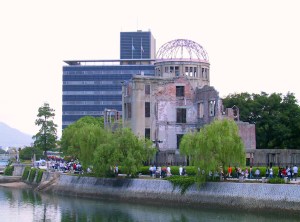
Thirty-five years ago while living in Japan, I was invited by Japanese friends to visit the Hiroshima Peace Memorial. Upon our arrival to the city, I was immediately struck by how lively and ‘normal’ it felt. Cars were zooming by, people on bicycle were rushing to their destinations, skyscrapers filled the landscape. It was difficult to imagine the horrible disaster of a nuclear bomb on the city and its 255,000 innocent inhabitants. We soon arrived to the Memorial Park, an open space with various monuments, including an eternal flame burning for peace on Earth, all beautifully decorated with long strings of origami cranes.
While I contemplated these sites, many profoundly sorrowful feelings emerged. Then suddenly a middle-aged Japanese man swooped in and was screaming in my face. Not understanding any Japanese at the time, I asked my friends to translate. Embarrassed, they roughly yet very politely urged him to go away. He was screaming at me for dropping the atomic bomb on August 6, 1945.
During the start of the Iraq War, I found myself in a Beirut convent eating dinner with an Iraqi couple. We were all there for a conference on the Syriac language, my husband’s expertise. I could hardly look at this couple for all the shame I felt about my country invading theirs. “I’m so sorry,” I said as soon as the opportunity arose, “for what my country is doing to yours. I hardly know what to say to you.”
“Oh, that’s okay,” the woman assured me. “We know just how you feel. We were having dinner with Kuwaiti friends when our country invaded theirs.”
A month after the 9/11 attacks, I and my husband returned to Egypt after visiting my family in California. We had been living in Giza for the past year and were happy to return. Initially, I was afraid to even say I was American, but no one seemed to show any animosity. Except quietly behind closed doors. My neighbor was not ashamed to tell me how happy she had been to see the Twin Towers fall. For her, Osama bin Laden had successfully brought the schoolyard bully to its knees and fear to its land. “But,” she admitted, “as an architectural student, it saddened me to see the buildings fall.”
Slavic Goddess Berehynia
It is a beautiful spring day, and I am with my husband and another couple visiting a small medieval village in Tuscany. We were standing in a piazza, enjoying the surrounding architecture, and trying to decide where to have lunch. Suddenly we hear an older man’s voice demanding an answer: “Do you think this is beautiful? Do you? Do you think this is beautiful?” We all turned to him and nodded dumbly. “During the war there was nothing here but malaria and famine.” He nearly spat out the words. “Malaria and famine. Take that bellezza home with you.”
Peace for Ukraine, painting by Mona Shafer Edwards
One final story. I am just six years old. It is 1962 and the Cuban missile crisis is looming. Our kindergarten class has been lined up into single file and brought to the gymnasium. This is not our normal routine. We are told to sit down together on the floor. All the other elementary school kids are also there. A teacher I don’t know is talking. She is telling us how if there is a bomb, we will all gather in the gym like this and stay together. No one will be able to go home. When the bomb is dropped, we will sleep here and wait for our parents to come. We might have to wait days. I don’t understand. This all feels like a dumb thing to do. I raise my hand and wait to be called on. “Why are adults doing this?” I ask. The teacher doesn’t answer. She just looks at me.
Rabindranath Tagore
All these strong experiences have taught me the need to overcome nationalism and, above all else, hold fast to the moral spirit of humanity. Given what is happening in Europe today, we would do well to heed the words of Rabindranath Tagore, poet and Nobel Prize winner of Literature. Soon after WWI, Tagore wrote and lectured worldwide against nationalism, calling on all of us to recognize our greater humanity. In his book Nationalism, he clearly states:
“Nationalism is a great menace… the time has come, for the sake of the whole outraged world. Europe should fully know in her own person the terrible absurdity of this thing called the Nation.”[1]
Tagore did not shirk from pointing out how nationalism was prevalent in his own country, causing him to meet with scorn from every side. In 1917, Tagore began speaking openly against the British Raj.[2] To the average British official, he was considered a non-cooperator who refused to ‘play the game’ of Anglo-Indian back-scratching. To the average Indian nationalist, he was un-patriotic. As his biographers note: “By not joining any group, and refusing to temper his criticisms, Tagore had become the target of all groups.”[3] In fact, he was nearly assassinated during a visit to San Francisco by Indian nationalists.
Tagore distained blind nationalism and fanaticism where “machine must be pitted against machine, and nation against nation, in an endless bullfight of politics.”[4] What he proposed instead was universal humanism, global cooperation and harmony. Tagore’s core ideas included the need for self-determination, strengthening society from below, universal man and the need for education transcending borders.[5]
Yurii Sheliazhenko
For the rest of his life, Tagore called on all peoples to create a “more human order, a finer science of life, and a spiritual republic behind world politics.”[6]
We may wonder how Tagore’s words of 100 years ago might have any relevance to us today. But nationalism is still playing a major role in the more than 20 wars ranging worldwide. One’s national identity is causing fractures even inside countries like the USA and the EU. The attitude of ‘us’ vs ‘them’ is a nationalist one.
To hear another prophetic voice like Tagore’s, I suggest going this link and listening to Yurii Sheliazhenko, the executive secretary of the Ukrainian Pacifist Movement and a board member of the European Bureau of Conscientious Objection. He says:
“Instead of breaking the last bonds of humanity out of rage, we need more than ever to preserve and strengthen venues of communication and cooperation between all people on Earth.”
Yesterday was the World Day of Psychosynthesis and more than 150 people interested in Roberto Assagioli’s vision of psychosynthesis celebrated in an event hosted by two Swedish groups, Psykosyntesföreningen and Psykosyntesförbundet along with the European Psychosynthesis Association (EPA).
The day is meant to establish a spiritual connection between everyone who is generating and working with psychosynthesis concepts and techniques. Each of us is encouraged to take time during the day to reflect on how psychosynthesis is a living, evolving idea that can be successfully applied through many formats and in various contexts.
This day was inspired by a note that Assagioli wrote. What is special about this particular note is that it is dated, something relatively rare to find on his thousands of archived notes. A copy of the Assagioli’s original note appears below along with its transcription. Continue reading →






 Yesterday was the World Day of Psychosynthesis and more than 150 people interested in Roberto Assagioli’s vision of psychosynthesis celebrated in an event hosted by two Swedish groups, Psykosyntesföreningen and Psykosyntesförbundet along with the European Psychosynthesis Association (EPA).
 Love and Will