We are less than ten days before Christmas and the 2025 is nearly finished. Here are some past Christmas posts that you might like to read between all that you need/should/ought/want/and don’t want to do. During this time of year full of darkness, I hope you can find a moment to reflect on the beauty, light, and love that is also in our midst.
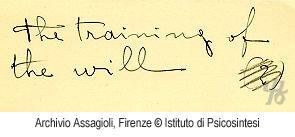
In April and May of 1929, on two different occasions, Assagioli experimented training his will. In his first experiment, he contemplated on the word ‘will’. But after the 4th session, it dawned on him that it was “useless to try and understand the nature of will by thinking about it. One must ‘feel’ one’s way to the heart of things.”
So during his next will experiment, Assagioli chose to stand relaxed and raise his arms sideways to the level of his shoulders in decided movements. He did this for 5 minutes while repeating “I will do this.” He did this for 10 days.
At first glance, this exercise of raising one’s arms up and down looks silly. But it actually is an example of what Assagioli refers to as ‘Will Gymnastics.’ Assagioli insists that the idea is simple. Muscles become stronger when we exercise, and so does the will. These will gymnastics work even better when you choose to do something you’d rather not do at all. In this way, ‘useless’ exercises, like raising your arms up and down everyday — with precision, regularity and persistence, become a deliberate act of training the will.
Assagioli’s Methodology and Observations
Assagioli’s brief observations of these two experiments performed on himself are rare insights into, not only his scientific method, but also his character. More than once, he writes about how while meditating on the word ‘will’ thoughts of “the stupidity of the task” would enter his awareness. With humor, he notes how he cannot pretend to have “the slightest enthusiasm” for the five-minute will exercise, but nevertheless, confirms that he is determined “to carry out my resolution whether it leads to any useful result or not.”
Regarding his methodology, first of all, these notes definitively show how Assagioli would practice psychosynthesis techniques on himself, something he stresses that all psychosynthesis guides do.
We can also see that he clearly conducts the experiments as a dis-identified Observer, using the terms “the mind,” “the attention,” “the personality” and “the performance” instead the first-person possessive pronoun of “my mind”, “my attention,” etc. For example, he laments how “the personality will not co-operate” but the next day notes how he “feels quite independent and refuses to be tyrannized by it.”
Lastly, we might wonder why Assagioli chose to have the notes typed (as opposed to handwritten) and in English (instead of Italian, German or French). Was this too part of his scientific methodology?
By the way, I have decided to perform this training of the will experiment of lifting my arms for 5 minutes everyday. Would you like to join me? I will start on Sunday 16 March and go until 26 March. Be sure to jot down your thoughts, feelings, and observations after each session. If you like, send me your comments, and we can share our experience together.
Keep in mind Assagioli’s caveat:
“Much of the value of the exercise is lost, unless the mind is also concentrated on the task. It should be done willingly, with interest, with precision, with style. Try always to improve the quality of the work, the clearness of introspection, the fidelity of the written account, and above all to develop the awareness and the energy of the will.
It’s good to compete with oneself; in other words, to assume, a ‘sporting attitude’ in the best sense of the word.”
Are you ready? Are you set? Well then, let’s raise those arms!
To celebrate World Psychosynthesis Day, I thought I would share a document that I found a few years ago while working in Assagioli’s archives. It is a review by Lama Anagarika Govinda (1898-1985) of Roberto Assagioli’s book The Act of Will. Govinda’s review starts out with this very powerful statement, which can apply today as much as it did more than 50 years ago:
The world is said to be in the grip of a “power crisis”, but few people realize that this is true in a much deeper sense than that of a mere economic problem. Power has become a human obsession and a self-destructive principle. At the same time it has resulted in a psychological revolt against the very root of power, namely the intellect and the human will, which have led to the domination and misuse of the forces of nature and may result in the gradual destruction of our planet’s ecology and the human race.
Lama Anagarika Govinda
About the Document
On the top margin of the first page of this typewritten review you can see a handwritten note by Lama Govinda to Assagioli: “With kindest regards and best wishes! Lama Govinda”
On the bottom margin of the last page, there is the following handwritten note:
“Copy sent to the Editor Psychosynthesis Journal, San Francisco”
Then in Italian:
Spero che Lei ha ricevuto le fotografie che mia moglie ha fatto durante il nostro soggiorno Castiglioncello. LG. (I hope you received the photographs that my wife took during our stay Castiglioncello. LG)
Govinda and Assagioli’s Meeting
In his autobiography, Piero Ferrucci writes about the two men’s meeting which took place in Castiglioncello, Tuscany, in August 1972. Here is a brief excerpt:
“At one time Assagioli achieved a degree of fame overseas, far more than in Italy, and various people came to meet him. Lama Govinda came while Assagioli was spending a few days at Castiglioncello on the Tirrenian coast. Lama Govinda had written books on Tibetan Buddhism, and had made available to the public its forgotten teachings. Assagioli and Lama Govinda were puny, frail old men with white beards and an air of wisdom about them.
“His meeting with Assagioli was a great piece of theatre. Lama Govinda was slowly climbing a staircase with friends, Assagioli was waiting at the top and began going down the stairs to meet him. He had asked me: “Should I greet him the Oriental way, with hands clasped, or the Western way, with a handshake?” A fair question, seeing as Lama Govinda was actually a German scholar transplanted in the East. I said he should greet him with hands clasped. When the meeting took place, Assagioli gave him the Oriental greeting, but Lama Govinda extended his hand. So Assagioli started to give him his hand, but meanwhile Lama Govinda had decided to greet with hands clasped. It looked like a strange ritual: East meets West.
“The conversation began and Lama Govinda pointed out that the concept of will in psychosynthesis was similar to that of the Buddhist virya, inner strength. After a while the two asked to be left alone… Sometime later the two of them came back looking radiant and resembling each other even more.”
Piero Ferrucci
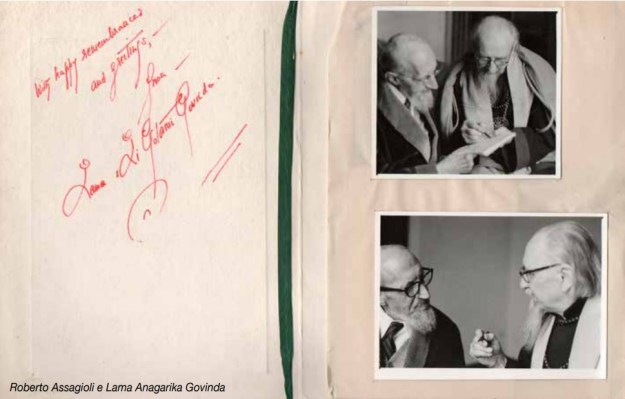
Above are two photos of the two “puny, frail men with white beards.” I am not certain, but perhaps these photos are the ones mentioned by Lama Govinda. You can see the note written by him: “With happy remembrances and greetings – from – Lama and Li Gotami Govinda. Li Gotami Govinda (1906-1988) was his wife. More about her below.
Lama Govinda and Li Gotami Govinda
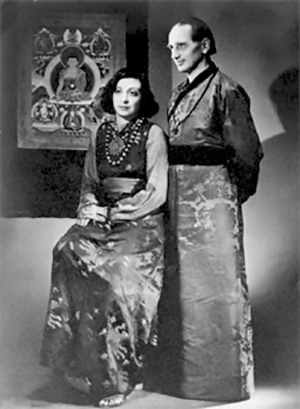
The Govindas in 1947 at one of their four wedding ceremonies.
One life event that Govinda and Assagioli shared was during World War II. While Assagioli spent one month in prison, followed by his time under house arrest and then more than a year in hiding, Govinda spent three years in a British internment camp at Dehra Dun, India.
Govinda and his wife Li Gotami were married after the war in 1947 and soon afterwards undertook research expeditions to Tibet, making a large number of drawings and photographs of Buddhist art and architecture. Govinda described these expeditions in his popular book The Way of the White Clouds and Li Gotami’s photographs appear in her book Tibet in Pictures.
Perhaps what delighted me most while preparing this short reflection was Govinda’s connection to Rabindranath Tagore. Govinda taught at Rabindranath Tagore’s Vishva-Bharati University in Shantiniketan and that is where he met his wife. Li Gotami Govinda was Parsi, born in Bombay, and a famous photographer and painter in India. At the time she was studying at the university. Their encounter took place when she was making her way to the hostel where Lama Govinda was staying, as described below:
“A door opened and out strolled this handsome, smiling foreigner dressed in the burgundy robes of a monk. She recalled asking herself who this “bright merry person” might be, and in retrospect (at least on her part) remembered the incident as very romantic.”
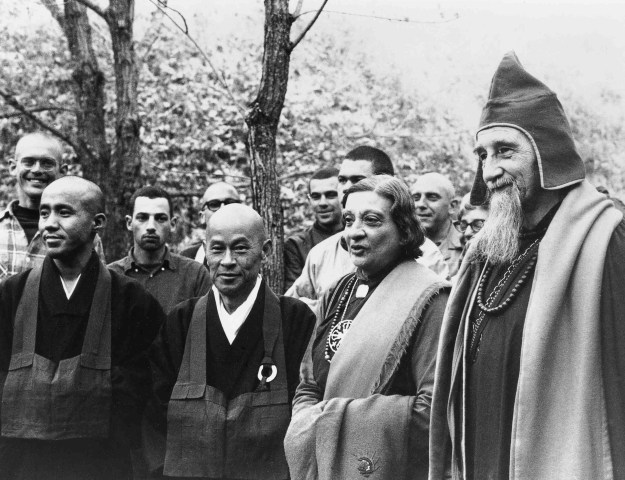
Suzuki Roshi, Li Gotami, and Lama Govinda.
Lama Govinda’s Review of The Act of Will
Unfortunately, this review by Govinda was never published by the Psychosynthesis Journal. However, a slightly edited version was published posthumously in The Lost Teachings of Lama Govinda: Living Wisdom from a Modern Tibetan Master, edited by Richard Power, foreword by Lama Surya Das. Quest Books, 2007.
What I found most interesting are Govinda’s definitions of the Transpersonal Will and Universal Will.
“Transpersonal Will (which is the urge to find a meaning in life, the urge towards highest realization [Sanskrit: Dharma-chanda]) and the Universal Will (in which the human will is in perfect harmony with the universal law [Dharma]).”




 Love and Will