Category Archives: The Higher Self

An Understanding Light of Welcome

A refugee child seeking asylum in Gronau.

A refugee child seeking asylum in Gronau, Germany.

News headlines have recently been shouting about the refugee crisis and Germany’s prominent role in welcoming them. Estimates are that more than 1.5 million refugees will enter the country by the end of the year, mostly from Syria, Afghanistan and Iraq. Since I live in a small town in Germany, I thought I might share my personal experience and reflections.

The town where I live is a poor one by German standards and a rich one by world standards. Gronau has a beautiful heated community swimming pool, a Jazz Festival every May, and a well-stocked public library. But the town also has many boarded up factories with smashed windows. Gronau was once a boom town centered around the textile industry. But by the 1970s, all the jobs disappeared, first to Eastern Europe and then to China.

Continue reading

Visions of God, the Cosmos and Humanity

Hild vision only

Hildegard von Bingen receives her divine visions and writes them with wax tablet and stylus while the monk Volmar inscribes her visions on vellum.

Recently I found myself with a group of pilgrims in the Land of Hildegard von Bingen (1098-1179), near the Middle Rheine in Germany. Most of travelers were transpersonal and/or Jungian psychologists who had traveled all the way from South Korea in search of the wisdom of this saint, prophet, poet, dramatist, physician, abbess, preacher and Doctor of the Roman Catholic Church. A visionary in every sense of the word, Hildegard is perhaps best known for the hymns and canticles that she specifically wrote for the nuns of her own convent.

As a child, Hildegard saw and heard visions, but it wasn’t until she was “42 years and seven months old” that she received a disturbing vision from God commanding her to, “Write what you see and hear,” in order to spread news of God’s words and ways. Thus she began work on her first book, Scivias (Know the Ways). Written over a period of ten years, the book describes a total of 26 visions on the subjects of creation, redemption, and sanctification.

It would take a lifetime of scholarly pursuit to fully explore and come to some understanding of Hildegard’s theology. Nevertheless, I am going to boldly describe one of my first impressions, from a psychosynthesis point of view. What particularly struck me was the remarkable similarity between her third vision, called “God, Cosmos, and Humanity,” described in the first part of Scivias, and Assagioli’s model of the human personality. Perhaps, you also will intuitively recognize some similarities, but here are just a few that appeared before me.

Continue reading

Inside Out Turned Outside In

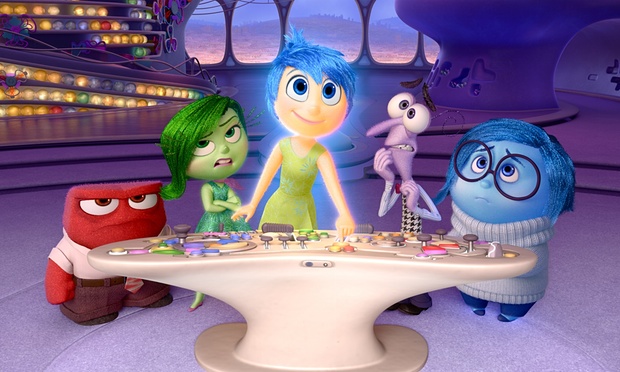
Inside Riley's Headquarters. From right to left: Anger, Disgust, Joy, Fear, Sadness. Photo by Pixar.

At the controls in Riley’s  brain Headquarters. From right to left: Anger, Disgust, Joy, Fear, Sadness. Photo by Pixar.

Yesterday I went to see the new Pixar movie Inside Out. It is an intelligent 3D-animated feature about 11-year-old Riley who moves with her family from Minnesota to San Francisco. But the real stars of the film are her five emotions, Joy, Sadness, Anger, Disgust and Fear, who are busy operating Riley’s outer behavior from her brain Headquarters. I will not go into details about the story, but I did find it entertaining, fun, and thought provoking. The movie has received rave reviews and is topping all kinds of records for ticket sales.

Today in the Guardian newspaper, one movie critic has warned shrinks to stay away from the movie. (Oops! Too late!) Psychology professionals (along with some parenting forums) are reportedly outraged that Sadness is shown as fat, frumpy and unattractive, and Joy is slim, pretty and smart. What is the film saying? That fat people are sad and thin people are full of Joy?

Actually, from a psychosynthesis perspective, this discrepancy could have easily been explained (and the movie would have been much richer) if the five emotions had actually been five different subpersonalities. Like our subpersonalities, in the movie each emotion not only has feelings but also a body and mind as well. All are embodied in a type of human form. Sadness is the color blue and, okay, let’s say full-bodied, while Joy is a slender and an adorable version of Tinkerbell. In addition, all five emotions have cognitive functioning, that is, they all contemplate, calculate, make decisions, and integrate new ideas and experiences, especially when they have to find a way to reconnect to Riley.

Continue reading