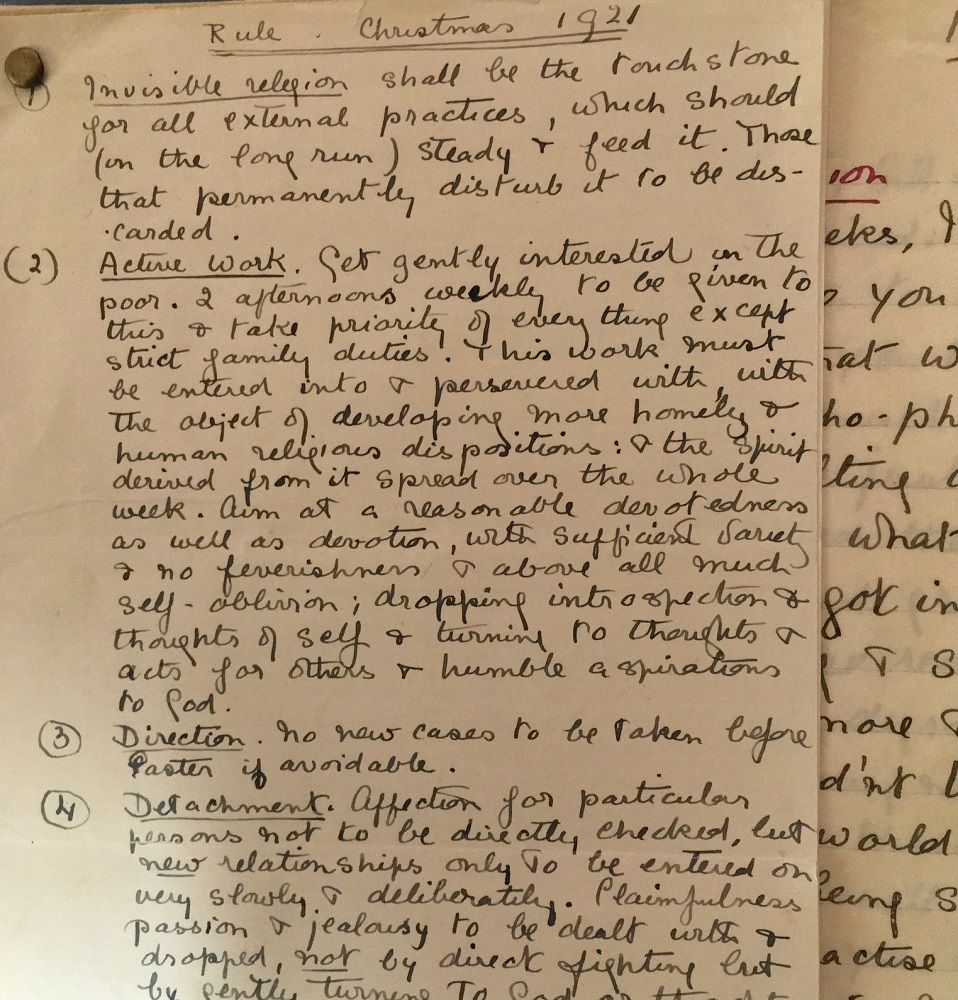
Evelyn Underhill’s notes from the King’s College Archives.
Most of us are familiar with writing Christmas Lists. As children we might have been encouraged by our parents to write to Santa Claus, sending him our list of desired gifts. We might have also been told that Santa Claus kept his own “list of who’s naughty and nice.” As we became adults enmeshed in the frenetic holiday craziness, our Christmas lists probably became more numerous and less imaginative – lists of things to do, presents to buy, and greeting cards to send.
The Christian mystic and writer Evelyn Underhill (1875-1941) also wrote a Christmas list – but a kind I had never seen before. In the archives of King’s College London, you can read three pages of her own notes which she entitled “Rule. Christmas 1921.” Her handwriting is evenly spaced and full of sensuous loops and curves. Like Assagioli, she occasionally underlines, and even double underlines words for emphasis. Underhill’s Christmas list contains her spiritual goals for leading a Christian life, to be tested and practiced by herself for six months – “quietly and steadily, with a disposition to find them true even where uncongenial.”

Evelyn Underhill
I have transcribed her Rule for you to read; you can download it here. Underhill wrote this list ten years after her best-selling book Mysticism: A Study in Nature and Development of Spiritual Consciousness (which Assagioli studied extensively) had been published. She had just returned to practicing her Anglican faith and was starting to conduct retreats.
In all likelihood, Underhill wrote the list under the guidance of her own spiritual director Baron Friedrich von Hügel, whom she said was “the most wonderful personality … so saintly, truthful, sane and tolerant.” He encouraged her to engage in more charitable, down-to-earth activities, which is evident in her list where she dedicates two days a week to working with the poor (#2 in the list) and fixes a time for “daily, deliberate prayer” (#5).
Rule vs Rules
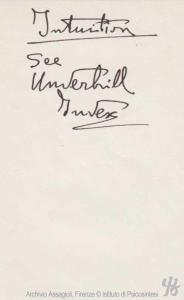
Assagioli’s note referencing Underhill.
The first thing that I noticed is that Underhill called her list a “Rule.” Not a list of “rules” but a Rule, similarly to what is known as The Rule of Saint Benedict. When she visited Sorella Maria in Italy, she referred to the community as:
“… a little group of women who are trying to bring back to modern existence the homely, deeply supernatural and quite unmonastic ideal of the Primitive Rule.”
This use of the word “Rule” instead of “rules” seems to be a more open, discriminatory way of dealing with life as opposed to hard, fast rules that don’t allow for unforeseen conditions and our human frailty.
Try Writing Your Own Rule Christmas 2023
Upon studying Underhill’s Rule, I was impressed with the number of items on her list. Three pages full is a lot! Naturally, it inspired me to write my own “Rule. Christmas 2023” and I hope it inspires you as well. Here’s a few suggestions:
1. Prepare the space. Make sure you have enough time and a quiet space to work in.
2. Prepare yourself. Before starting to write, take time in prayer or meditation to quiet your mind and heart.
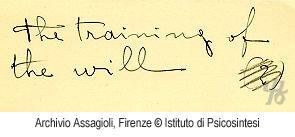
3. Use pen and paper. I know it sounds soooo old-fashion, but it works. Assagioli explains that while writing by hand, you allow other thoughts and feelings that you were not yet aware of to spontaneously emerge. It is as if the pen were to “take control of your hand.” But in reality, it is not the “pen” that is taking control but the unconscious.
4. Be honest and gentle. Try to come up with a list of items to be “dealt with”, as Underhill writes, “not by direct fighting but by gently turning to God or thoughts of serenely loving Saints.”
Just write. It doesn’t have to be perfect, wise, or entertaining. Just write without any judgment. Tell that judge inside you to go away! You know, that one who keeps insisting: “Oh! This is so stupid/a waste of time. I’m a terrible writer. Look at my handwriting. What a mess!”
Don’t make the list too long. Up to five items is enough for now…
5. Be grateful. Afterwards, extend your thanks to God/the Universe and yourself, especially the part that really did not want to write this Rule!
6. Be diligent, persistence, and patient. Put the Rule away somewhere safe, but keep it in your heart. Check periodically with yourself to affirm what you are doing well and what you might need to continue to work on.
7. Celebrate. In June 2024, at the Summer Solstice, reopen the Rule and assess your progress. Know that any movement forward is great spiritual success. Be Joyful!







 Love and Will