Tag Archives: will

Intuition and the Angel Highway

Most of us felt some relief saying goodbye to 2014; the news never seemed worse. Now barely two weeks into 2015, the news seems even grimmer. We can easily fall into despair about the state of the world. But recently I listened to a discussion about the physics of angels, and, to balance the horrors we see everyday in the news, I want to bring angels into the conversation.
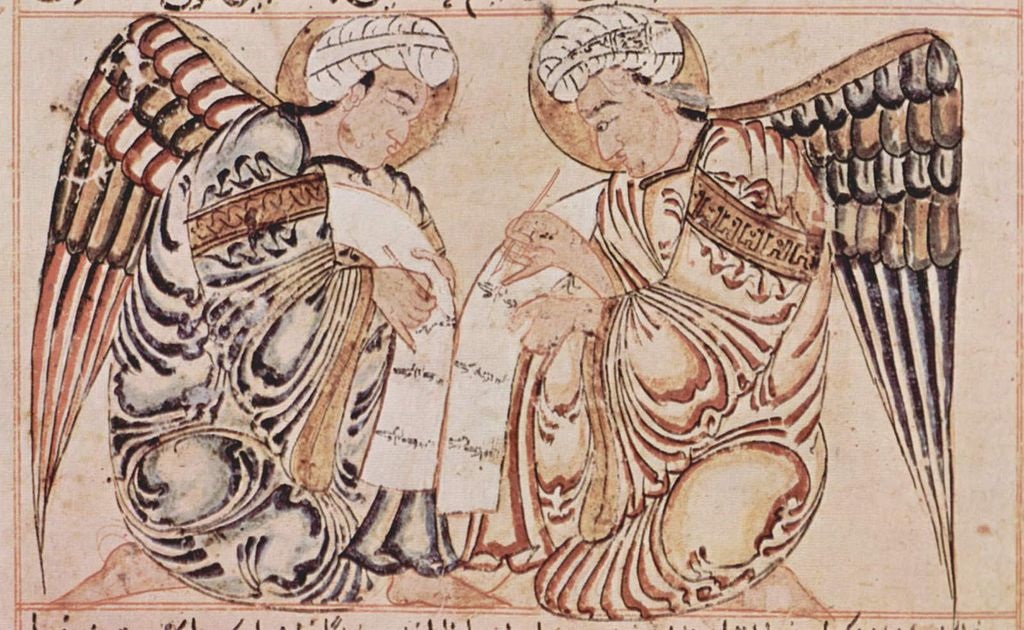
Two Islamic angels write in the Book of Life, suggesting angels' ongoing and attentive interest in human affairs (1280 A.D., Iraq)

Two Islamic angels write in the Book of Life, suggesting angels’ ongoing and attentive interest in human affairs (1280 A.D., Iraq)

During the month of Advent, I decided to paint angels that are connected with the Christmas story. I believe they do exist and are waiting for us to listen to them. The name angel derives from the Greek angelos meaning “messenger.” Angels are agents ready to guide, creatively inspire, aid, and teach us, and they have stirred the imagination of artists, writers, mystics, and ordinary persons throughout the ages, across cultures and belief. More than 80% of Americans believe in angels.

Angels approach us through dreams, visions, and meditative states and can appear in the form of voices, human or animal shapes, as male or female or androgynous beings, or as stars or light. Beings without matter, their wings are a symbol of their great spiritual energy. We delight in their cherub cuteness, but, in reality, they can also be fierce and terrifying.
Continue reading

Listen with the Ear of Your Heart

Ear of the HeartListen carefully. Obsculta is the first word of guidance written by St. Benedict, the 6th century mystic and Father of western monasticism. His Rules for Monks is still used today to direct the lives in Benedictine communities. St. Benedict immediately qualifies what kind of listening they, and we, need to do. Obsculta inclina aurem cordis tui – “Listen by inclining the ear of your heart.” What could he possibly mean? Our hearts have ears? If that is true, then how do they work?

St. Benedict’s poetic language is asking us to listen, not just with our ears, but with our hearts to all that comes our way. While we might hear the words with our actual ears, with our hearts we can deeply reflect, discern, and take action if necessary.

When we are an embryo, the sound perceiving mechanism of the ear is the first organ we develop. During the same time, our heart also starts to develop (5 weeks after conception). Imagine! At 18 weeks in the womb, one of our first sensations of life is the inner sound of our own and our mother’s heartbeat. Studies have shown that a baby will become agitated if its mother’s heartbeat beats faster than normal, suggesting its mother is under stress. We also begin life listening to the rise and fall of our mother’s breath, our parents’ muffled voices, the world outside.

Continue reading

Starve Your Fear!

Artwork by Mary Beth Volpini at drawntocolor.com.

Artwork by Mary Beth Volpini at drawntocolor.com

Let’s talk about fear. Inner fear. How elusive and arbitrary it can be. We sometimes struggle with fear over the simplest things – talking to our boss, having a routine visit to the doctor’s, or taking an exam. We might be fearful for our health, bank accounts, jobs, or kids. Of course, we can feel legitimate fear, but usually what we fear is not based on our outer reality but rather coming from within ourselves. Assagioli calls this fear a widely diffused psychological poison.

In order to deal with fear effectively, Assagioli urges us to eliminate or minimalize the fear within ourselves. He also warns us of a vicious circle that can occur – the fear within us can open the door to the influence of external fear, and external fear feeds the inner one.

To break this vicious circle, we need to use our skillful will to withdraw our attention deliberately from the psychological poison of fear. The energy that is holding and nurturing the fear will then be released. We can then redirect this new-found energy to do the most good in our lives.

Last year, Susan came to see me because she wasn’t able to become pregnant. She and her husband were both 30 years old and had been trying for one year without success. Susan had a doctorate in biochemistry and knew exactly all the ways the body functioned – and didn’t function. After two of her friends had died of cancer, she was terrified of the disease. She had spent hours visiting various doctors asking for multiple aggressive and invasive tests just to ensure herself that she did not have cancer.

Continue reading