There is talk of a ceasefire, humanitarian pause, resolutions, and emergency joint summits. But Peace? Where is the Peace?
I have been searching for peace for a long time. Both inside and out. Longing for peace, I sometimes to go to Assisi, also known as the City of Peace (near my home), just to ring the Peace Bell.
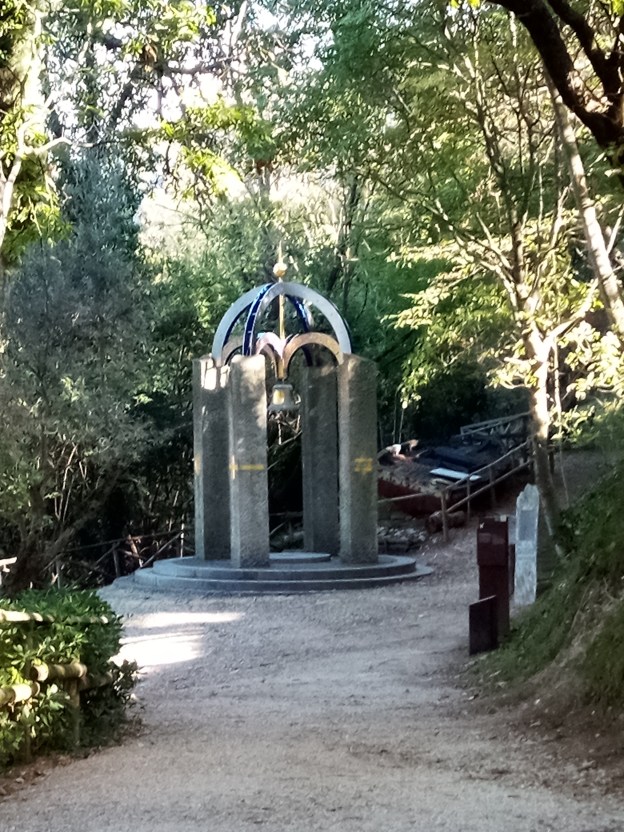
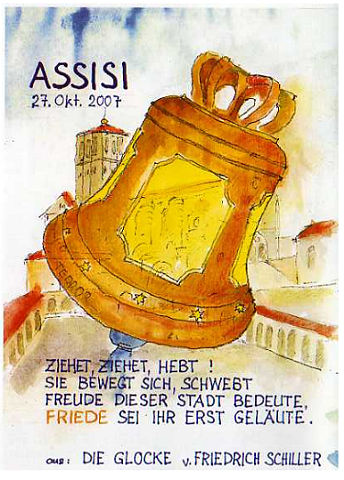
Not far from the Basilica of San Francesco, the Peace Bell is outside of the old walls of the city in the nearby woods. The bell is held aloft by four granite columns, each representing a different religion: Christianity, Judaism, Islam, and Buddhism. Designed by German artist Gerhard Kadletz, the bell is named Regina Pacis (Queen of Peace) and it unites the four religions to announce peace with one voice.
Inaugurated in 2007, the Peace Bell’s official song is “Numquam. Renascantum. Uis. Bellum. Terror.” (Never again violence. Never again war. Never again terror.) This declaration is inscribed on the lower edge of the bell along with the signatures of four religious leaders: Cardinal Ratzinger who later became Pope Benedict XVI; His Holiness the 14th Dalai Lama; Ali Gomaa, the Gran Mufti of Egypt; and Chief Rabbi of Israel, Jona Metzger.
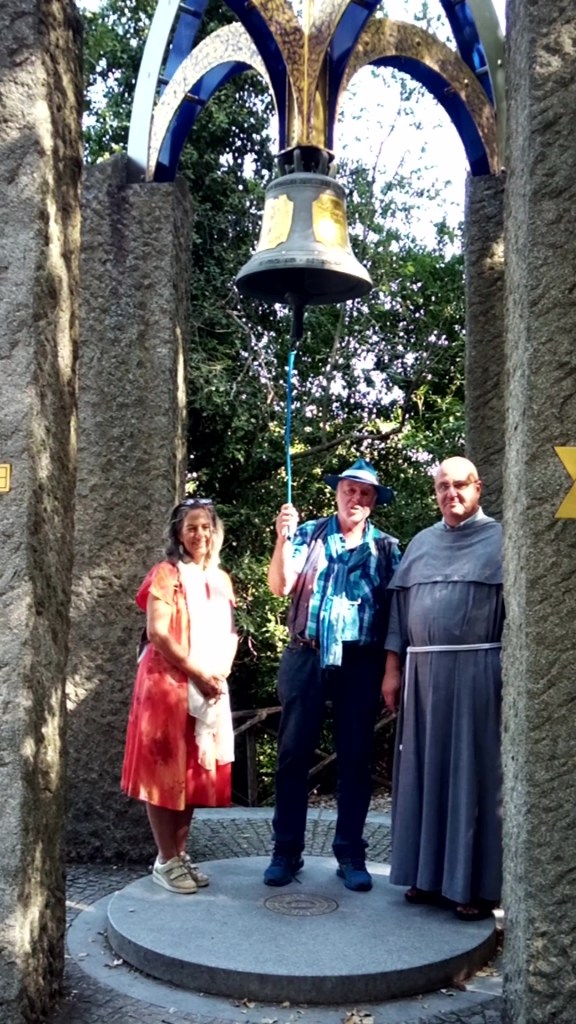
The Author rings the bell with artist Gerhard Kadletz and Brother Thomas.
When rung, the sweet message of the Peace Bell resounds across the town and out into the world.
This Peace Bell should be ringing 24/7!
Unbind our Hearts to Ring Out Peace
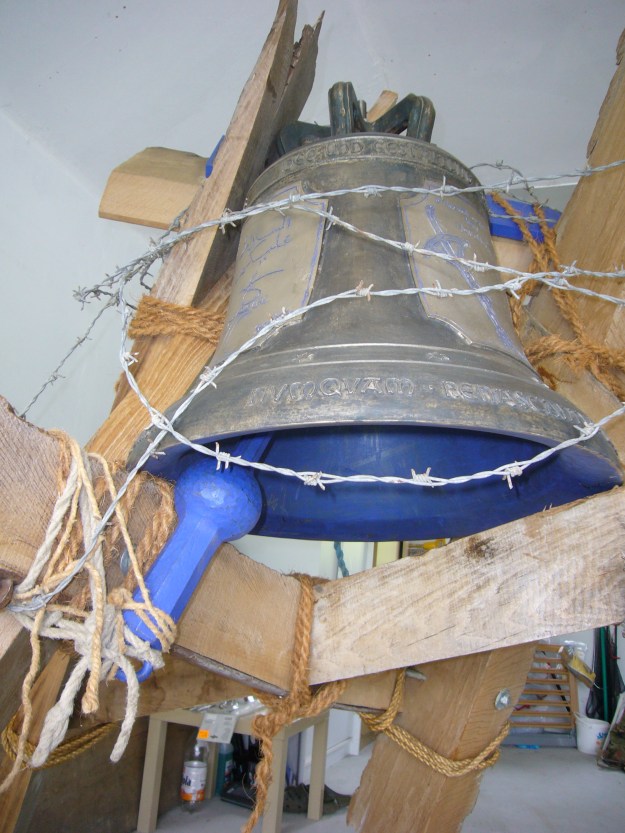
Gerhard Kadletz, the artist who created the Peace Bell, recently completed another work, entitled Wo ist der Frieden? (Where is the Peace?).
Mr. Kadletz’s new bell is an exact replica of the Peace Bell in Assisi. However, he has deliberately silenced his new bell. This bell is tightly wound with barbed wire from the Ganacker concentration camp in Germany. The bell itself precariously hangs on a 10,000-year-old bog oak that is partially charred. And the clapper is tightly tied with rope so the bell can not be rung.
May this work of art remind us of our responsibility to radiate and be disciples of peace. Peace doesn’t just happen. It requires us to engage with it, to be in relationship with it. Just as we have to pull the cord to ring the Peace Bell, so must we pull the cords of our broken heartstrings and work towards peace within. We must unwrap the barbed wire entwined around the our inner Peace Bell and unbind the rope that holds fast our clapper from connecting with the bell.
Angels are Waiting to Help Us
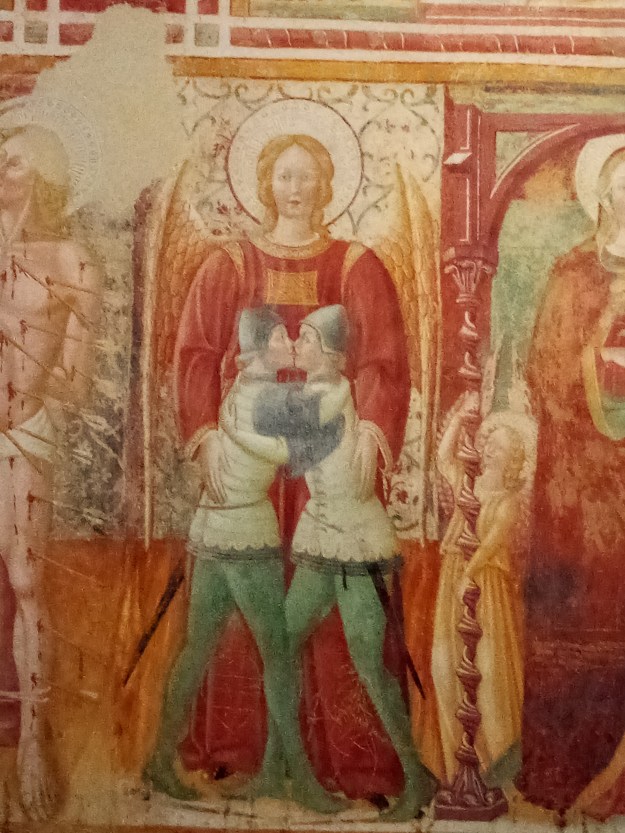
We can call on the multitude of angels around to help us. They are often hanging about, just waiting for us to ask for their assistance. In a Umbrian sanctuary near my home is a beautiful 15th-century fresco of the Archangel Saint Michael. He is the only angel mentioned by name in the Torah (Judaism), Bible (Christianity), and Qur’an (Islam). In all of three faiths, believers consider Michael an angel who fights evil with the power of good. Hence he is often depicted with a sword. During the time this sanctuary was built, the Archangel Saint Michael would have been seen as a protector of soldiers, as the angel that accompanies their souls to heaven, and as a healer. In fact, the sanctuary is built near a spring and its waters are said to have therapeutic properties.
In this fresco, we see the Archangel Saint Michael with his wings over two armed soldiers. The Archangel unites them in a gentle embrace, as they, in turn, embrace and kiss each other in reconciliation. It is said that centuries ago, one day a year, nearby warring factions would come to this sanctuary to reconcile their differences.
Let us Arrive at a Fruitful, Dynamic and Constructive Peace
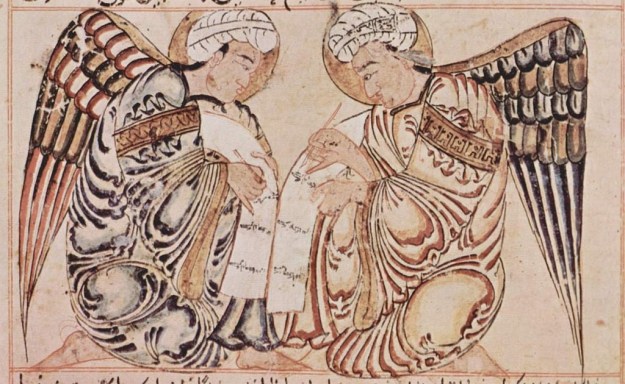
Two Islamic angels write in the Book of Life, suggesting angels’ ongoing and attentive interest in human affairs (1280 A.D., Iraq)
“The Angel of Peace wraps the whole world in its big white wings…
“Some people may be helped along by the image of a big Angel, with white wings, which emanates streams of peace, spreading waves of Peace throughout ourselves, our country, the whole Earth, the human race.
“Real Peace is a peak to climb, an ideal to conquer, a point of arrival.
“True Peace has to remain steadfast before evil, in times of pain, during emotional reactions, in the midst of any kind of assault, in the face of any loss, defeat or separation.
“True Peace coexists with inner personal suffering. It is not a mood of joyfulness and delight; it produces a double life inside ourselves, till the moment when our personality appears completely regenerated, so that the inner Peace will become incarnated and the whole being permeated through PEACE, transformed into PEACE.”
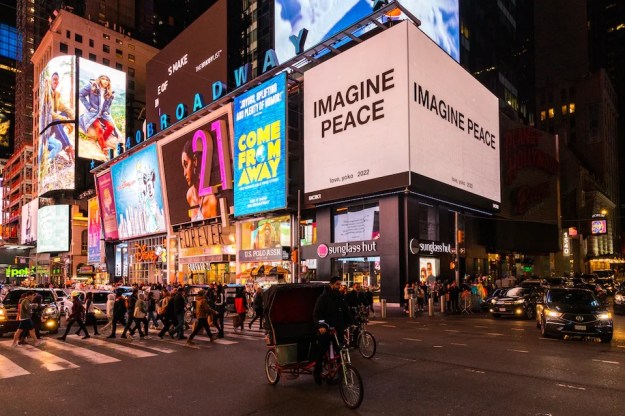
Yoko Ono displayed her message “Imagine Peace” in London, Berlin, Los Angeles, Melbourne, Milan, New York and Seoul (2022).
I stand here ironing t-shirts a green dress your shirt for work. And think how absurd with a genocide not miles away.
An endless litany of words drained of all meaning and force. Genocide, ethnic cleansing, displacement, occupation, hostage and liberation. Under siege and mass atrocities.
Words without context. Terrorist. Nazi. Zionist. Fascist. Hamas. Antisemitic. Jew. Christian. Moslem. Massacre and holocaust.
Slippery collective shadow ruthlessly reckless. Animal. Beast. Less than human. Savages.
I ease the iron across a tablecloth as the numbers move before my eyes. 2.3 million, hundreds of thousands. 1400 dead… 3000 dead… 5000 dead… 8000 dead. 732 entire families dead. Under the rubble dead.
Non-stop bombardment. Whispering within the sliver of silence not one word. Peace.
Only the voice of a Jewish grandmother. Turns to her captor, shakes his hand, “Shalom.” Only the voice of a Palestinian grandmother learns her daughter dead, her granddaughter dead, “Please come to me in my dreams. Because I cannot live without you.”
I stand and iron your handkerchiefs, my white summer dress to hang in closets and place in drawers. But how to wash and iron this epic human tragedy? And in what drawer do I place it?
Please come to me in my dreams. Because I cannot live without you. God’s mercy. God’s charity. Love and kindness. Justice. Empathy and compassion. But most of all Peace.
It’s been eight years that I’ve been sharing these reflections with you and that’s a long time to be together. In his book Psicosintesi: Per l’armonia della vita, Roberto Assagioli writes that it is better to concentrate on a large project rather than many smaller ones. His words made me pause. I’ve been thinking about leaving this writing space for a while and this day of the full moon in May feels like the right time …
Yoko Ono displayed her message “Imagine Peace” in London, Berlin, Los Angeles, Melbourne, Milan, New York and Seoul.
They say ‘never say never’, so I won’t. Who knows when I’ll be back? Perhaps when my heart is burning with something I need to say. Hopefully to announce the completion of my ‘large project’. But for now, I will say thank you to all my readers over the years, especially those who reached out to me with appreciation and encouragement.
I close with a reflection on three peacemakers – an Italian, an Indian, and an Austrian – two women, one man. All three happen to be writers. All three have been marginalized or forgotten, despite their ardent striving towards peace. I believe they have something to offer us today…
Prof. Ornella Mariani – Activist for Truth
Recently I watched a video (in Italian) of Prof. Dr. Ornella Mariani, accompanied by a number of other Italian women including journalist Gloria Callarelli, being interviewed after they paid a visit to the Russian Embassy in Rome on April 27th.
“Our government has a lack of will towards any peace, so we took it upon ourselves to visit the First Counselor to the Russian Ambassador,” said Mariani. “Italy has banned any communication with Russian delegates. This situation feels very grave to me.
Ornella Mariani, Essayist
“Obviously, we don’t feel represented by a government that doesn’t understand the value of peace, and only wants to send arms. If we really want peace, we shouldn’t be sending arms. Article 11 of our Constitution repudiates war, so we should all be doing everything we can to diplomatically find a solution, a peaceful solution to this terrible conflict.”
“We represent the Italian people, not the politicians. We hope to open doors,” said Callerelli. “to help build a bridge in whatever way we can, between the popolo italiano and the popolo russo.”
Three days later at 7 a.m., the DIGOS or Italian Special Operating Division, who are in charge of investigating terrorism and organized crime, arrived at Mariani’s apartment to tell her that she was under investigation for contempt of Italian State institutions. Her apartment and person was to be searched. “Obviously, I did not consent to this,” she said in a video posted afterwards. They ended up taking her phone, but leaving its SIM card.
“We will not lose courage,” she said. “We are stronger than they are.”
Rabindranath Tagore – Prophet of War, Prophet of Peace
Rabindranath Tagore (1861-1941) poet, novelist, dramatist, musician, artist and Nobel Prize winner of literature, devoted much of his life to working towards peace, both in his own country of India as well as internationally. However, he was realist and his words from nearly 100 years ago are eerily prophetic for us today.
Tagore believed that until the powerful nations, aided by their superiority and vast technological advancement, ceased their desire for territorial expansion and control over the smaller nations, world peace could never be achieved.
In a visit to Japan during the middle of World War I, Tagore declared:
Rabindranath Tagore
“When, with the help of science, a nation’s power begins to grow and brings in harvests of wealth, then it crosses its boundaries with amazing rapidity. For then it goads all its neighboring societies with greed of material prosperity, and consequent mutual jealousy, and by the fear of each other’s growth into powerfulness. The time comes when it can stop no longer, for the competition grows keener, organization grows vaster, and selfishness attains supremacy. Trading upon the greed and fear of man, it occupies more and more space in society and at last becomes its ruling force.”
Tagore’s answer to ending this progression towards world destruction was a bondage of love and spirituality. “All imperialism – except for the imperialism of love – is wrong,” he said. According to Tagore, peace was not a non-war situation, but could only occur when all peoples could evolve into their unique selves, and then join into a singular united bond. He wrote in a letter to a his close friend Charles Andrews:
“When the spiritual ideal is lost, when the human relationship is completely broken up, then individuals freed from the creative bond of wholeness find a fearful joy in destruction.”
In 1938, as he watched the unfolding of World War II, Tagore wrote his famous poem:
Those crushed and trodden lives of the meek and the weak which are sacrificed as food offerings for the mighties. Those human flesh-eaters, snatching and scrambling, tearing the gut, scattering everywhere pieces of flesh bitten by sharp teeth, Stained the lap of the mother earth with the muddy blood. From the thrust of that fierce destruction one day, peace will emerge in the end with a great power. We will not fear, overcoming the distress, victory for us at the end.
To read more about Tagore’s ideas on world peace, click here to download an article “Rabindranath Tagore and World Peace” by Kalyan Kundu.
Bertha von Suttner – First Woman to Win the Nobel Peace Prize
Bertha von Suttner (1843-1914) was an Austrian baroness with a fascinating life story who became a renowned novelist. She also greatly influenced Alfred Nobel to establish the Nobel Prizes. In 1889 she became world famous for her brutally realistic depiction of war in her antiwar novel Die Waffen Nieder! (Lay Down Your Arms!, translated and published in 1905).
Von Suttner had personally lived through four wars herself – in 1859 (Italy and Austria), 1865 (the German states and Denmark), 1866 (Austria and Prussia), and 1870-71 (France and Prussia). In addition to using her own experiences for the novel, she interviewed veterans and read government documents. Publishers kept rejecting the novel, insisting that it was impossible to sell “in our military state.”
Die Waffen Nieder! became an instant success and was translated into eight languages. Von Suttner took advantage of the book’s popularity by establishing an Austrian peace society in 1891. She believed that military weapons always seem to acquire new lives, and their only purpose is to cause death.
For the rest of her life, von Suttner was a celebrated speaker at international conferences and peace meetings, and became heavily involved in a variety of peace organizations, including: the International Arbitration and Peace Society in London; the War and Peace Museum in Lucerne, Switzerland; the Berne Peace Congress in 1892; and the Inter-planetary Union. She and her husband also founded a pacifist journal. While touring the US, she said in no uncertain terms:
“War, all war is hell. Your Secretary of War is a Secretary of Hell. And your War Department is a Department of Hell. Your great generals and military men are all Hell Lords, perpetuating barbarism.”
Von Sutter received the Nobel Peace Prize in 1905, making her even more famous. The Carnegie Peace Foundation awarded her a lifelong pension for her work towards peace. As World War I approached, she grew more alarmed by the arms race in Europe and militarization of the air. She lamented:
“They are fighting like beasts about who is the worst beast. And they don’t see that the beast itself is war.”
She died four weeks before the start of the first World War. It is said that her final words on her deathbed were:
“Lay down your arms! Tell it to all!”
Overview of pledged and/or delivered weapons for Ukraine
Australia: missiles and weapons – AUD $70 million ($51.6 million)
Belgium: 200 anti-tank weapons and 5,000 automatic rifles/machine guns
Canada: 8 armored vehicles, M777 howitzers, 4500 M72 rocket launchers and up to 7500 hand grenades, as well as $1 million dollars for the purchase of commercial satellite high resolution and modern imagery, machine guns, pistols, carbines, 1.5 million rounds of ammunition, sniper rifles, and various related equipment ($7.8 million), plus additional $20 million in military aid (CAD $25 million – details undisclosed)– CAD $118 million total (as of April 22)
Croatia: rifles and machine guns, protective equipment valued at 124 million kuna (€16.5 million)
Czech Republic: T-72 tanks and infantry fighting vehicles;400 million koruna ($18.23 million) of non-light weapons, including 160 shoulder-fired MANPADS systems (probably 9K32 Strela-2), 20 light machine guns, 132 assault rifles, 70 submachine guns, 108,000 bullets, 1,000 tactical gloves, all worth 17 million crowns ($756,000), and an earlier 188 million koruna ($8.6 million) worth of 4,000 mortars, 30,000 pistols, 7,000 assault rifles, 3,000 machine guns, a number of sniper rifles, and one million bullets.
Denmark: 2,700 anti-tank weapons, 300 Stinger missiles (returned to United States to be made operational), protective vests
Estonia: Javelin anti-tank missiles; nine howitzers (with German permission)
European Union: other weapons (unspecified- €500 million) [originally included fighter jets, which currently appears no longer true]
Finland: 2,500 assault rifles and 150,000 cartridges for them, 1,500 single-shot anti-tank weapons, and combat ration packages
France: MILAN anti-tank guided missile systems and CAESAR artillery howitzers, plus “additional defense equipment”
Germany: 50 Cheetah anti-aircraft systems, 56 PbV-501 IFVs, 1,000 anti-tank weapons and 500 Stinger anti-aircraft defense system, plus permission for select other countries to send weapons controlled by Germany
Greece: portable rocket launchers, ammunition, and Kalashnikov rifles
Ireland: 200 units of body armor, medical supplies, fuel, and other non-lethal aid
Italy: Cabinet approved transfer of military equipment, pending Parliamentary approval.- reported to include Stinger surface-to-air missiles, anti-tank weapons, heavy machine guns, MG-type light machine guns and counter-IED systems
Japan: bulletproof vests, helmets, and other non-lethal military aid
Latvia: scheduled to deliver Stinger anti-aircraft missiles
Lithuania: Stinger anti-aircraft missile systems and ammunition
Luxembourg: 100 NLAW (Next Generation Light Anti-Tank Weapon), Jeep Wrangler 4×4 vehicles, 15 military tents, and additional non-lethal equipment
Netherlands: 200 Stinger missiles, 3000 combat helmets and 2000 fragmentation vests with accompanying armor plates, one hundred sniper rifles with 30,000 pieces of ammunition, plus other equipment; 400 rocket-propelled grenade launchers (with German permission)
North Macedonia: unspecified military equipment
Norway: 4,000 anti-tank weapons, helmets, bulletproof vests, other protection equipment
Poland: 200+ T-72 tanks, other approved delivery of Piorun (Thunderbolt) short-range, man-portable air defense (MANPAD) systems and munition; Defense Minister expressed readiness to supply several dozen thousand rounds of ammunition and artillery ammunition, air defense systems, light mortars, and reconnaissance drones
Portugal: grenades and ammunition, G3 automatic rifles, and other non-lethal equipment
Romania: €3 million of fuel, bulletproof vests, helmets, ammunition, military equipment, and medical treatment
Slovakia: S-300 air defense system
Slovenia: T-72 tanks (reported), undisclosed amount of Kalashnikov rifles, helmets, and ammunition
Spain: 1,370 anti-tank grenade launchers, 700,000 rifle and machine-gun rounds, and light machine guns, 20 tons of medical supplies, defensive, and personal protective equipment composing of helmets, flak jackets, and NBC (nuclear-biological-chemical) protection waistcoats
Sweden: 10,000 AT4 anti-tank weapons, helmets, and body shields
Turkey: co-production of Bakar Bayraktar TB2 armed drones
United Kingdom: anti-aircraft capabilities (Stormer), 10,000 short-range and anti-tank missiles (including NLAWs and Javelins), Saxon armored vehicles, Starstreak air defence systems, loitering munitions — with aid at £200 million, to rise to as high as £500m – see April 25 (note: on April 8, reports indicated aid already at £350 million)
United States: Howitzers and artillery rounds; laser-guided rocket systems; Switchblade, Puma, and Counter-Unmannered Aerial systems; counter-artillery radars; Stinger and Javelin missiles; anti-armor systems, small arms and various munitions; more than 50 millions rounds of ammunition; body armor ($3.6 billion since invasion began);; five Mi-17 helicopters, 70 High Mobility Multipurpose Wheeled Vehicles (HMMWVs) (pre-invasion)


 Love and Will