
Tag Archives: Assagioli

Visions of God, the Cosmos and Humanity

Hild vision only

Hildegard von Bingen receives her divine visions and writes them with wax tablet and stylus while the monk Volmar inscribes her visions on vellum.

Recently I found myself with a group of pilgrims in the Land of Hildegard von Bingen (1098-1179), near the Middle Rheine in Germany. Most of travelers were transpersonal and/or Jungian psychologists who had traveled all the way from South Korea in search of the wisdom of this saint, prophet, poet, dramatist, physician, abbess, preacher and Doctor of the Roman Catholic Church. A visionary in every sense of the word, Hildegard is perhaps best known for the hymns and canticles that she specifically wrote for the nuns of her own convent.

As a child, Hildegard saw and heard visions, but it wasn’t until she was “42 years and seven months old” that she received a disturbing vision from God commanding her to, “Write what you see and hear,” in order to spread news of God’s words and ways. Thus she began work on her first book, Scivias (Know the Ways). Written over a period of ten years, the book describes a total of 26 visions on the subjects of creation, redemption, and sanctification.

It would take a lifetime of scholarly pursuit to fully explore and come to some understanding of Hildegard’s theology. Nevertheless, I am going to boldly describe one of my first impressions, from a psychosynthesis point of view. What particularly struck me was the remarkable similarity between her third vision, called “God, Cosmos, and Humanity,” described in the first part of Scivias, and Assagioli’s model of the human personality. Perhaps, you also will intuitively recognize some similarities, but here are just a few that appeared before me.

Continue reading

The Healing Paradox

Are you like Ava and afraid of falling? Then try to fall!

Are you like Ava and afraid of falling? Then try to fall!

Ava came to see me because she had been suffering with extreme vertigo for the past three years. Uncompensated labyrintis occurs when the inner ear becomes damaged and does not heal after eight weeks. Basically, the brain must then relearn how to correct the faulty signals that are coming from the sufferer’s damaged inner ear. Until then, you can experience dizziness, imbalance, and fatigue.

Ava’s brain was taking a long time to learn how to reinterpret the signals coming from her inner ear. Hence her continual bouts of vertigo which were unpredictable and could last for days. The strange part is that dizziness is actually part of the healing process as it shows that your brain is trying to correct the faulty signals.

Despite all this, Ava kept insisting that her life, in general, was happy and that she was happy. But still there were things she missed doing like skiing and dancing. Ava (30) was married and also wanted to start having children, but she was constantly afraid of falling down and didn’t dare have a baby for fear of falling while carrying the child.

Underneath her presenting issue of vertigo, however, was another story. When Ava was 18 and just beginning university, 200 km away from home, one morning, she spoke to her mother on the phone. Later that day she received a call that her mother had died in a car accident. This tragedy was particular difficult for her for many reasons, not to mention, the accident being so unexpected and her mother’s death so sudden. Ava was an only child. And finding herself far from home, without any real friends at the new school, she had no one to go to for immediate comfort.

Continue reading

Meeting at the Well Spring – Part II

Assagioli’s archives – accumulators of energy

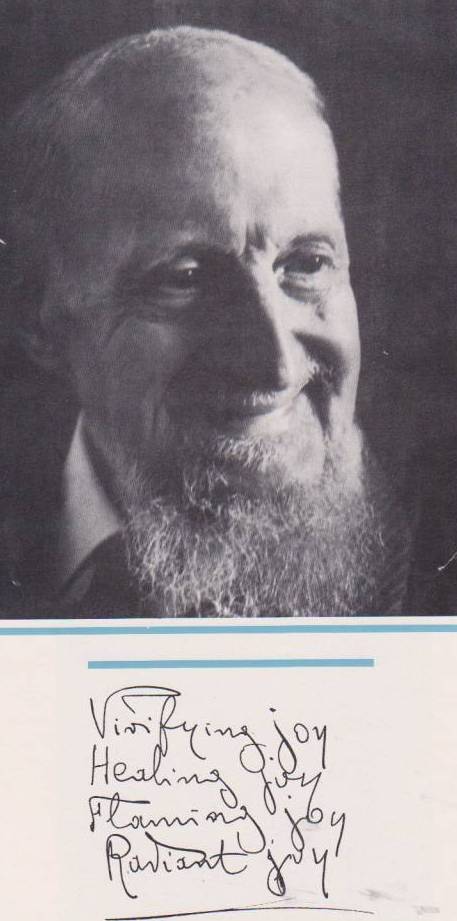
Roberto AssagioliThick blue boxes wait for us at various tables throughout the villa where Assagioli once lived, worked, and studied. Some of us move to rooms where he and his wife once slept, ate, or received guests. Windows are open and dry hot breezes waif in from the street and neighboring courtyard. At first, we buzz with excitement along with a touch of anxiety, dividing ourselves amongst the boxes like kids in a candy shop or at the school library.

Boxes labeled: “The Will—Italiano,” “Transpersonal Self—English,” “Writings of others,” “Handwritten Notes of Assagioli—English” call to us. Without much thought, I sit in front of the first free box I find, one labeled “Superconscious Material—English.” I unsnap the box’s clip, unwind the protective blue cover, and discover folders and folders of material.

Reverently I open each folder. Staring back through time are onion-skinned papers lined with typed quotations, handwritten notes, various pamphlets and letters all concerning superconscious material. Suddenly I stop shifting through these pages, frozen by a simple note of Assagioli’s: “The Will of God.” It is paper-clipped to a small book on prayer written by an American minister. The book’s margins are full of penciled notes. Double vertical lines run along the edge of a paragraph he once noted, some words in the text are underlined for emphasis. The Will of God. I shudder and cry.
It is all so much, so I stop, climb the stairs to the apartment where his principal collaborator, secretary, and the first president of the Institute of Psychosynthesis after his death, Ida Palombi, once lived with her cats. I sip black coffee, ease myself into a chair on the terrace and breathe in the room’s empty silence.
Continue reading