To celebrate World Psychosynthesis Day, I thought I would share a document that I found a few years ago while working in Assagioli’s archives. It is a review by Lama Anagarika Govinda (1898-1985) of Roberto Assagioli’s book The Act of Will. Govinda’s review starts out with this very powerful statement, which can apply today as much as it did more than 50 years ago:
The world is said to be in the grip of a “power crisis”, but few people realize that this is true in a much deeper sense than that of a mere economic problem. Power has become a human obsession and a self-destructive principle. At the same time it has resulted in a psychological revolt against the very root of power, namely the intellect and the human will, which have led to the domination and misuse of the forces of nature and may result in the gradual destruction of our planet’s ecology and the human race.
Lama Anagarika Govinda
About the Document
On the top margin of the first page of this typewritten review you can see a handwritten note by Lama Govinda to Assagioli: “With kindest regards and best wishes! Lama Govinda”
On the bottom margin of the last page, there is the following handwritten note:
“Copy sent to the Editor Psychosynthesis Journal, San Francisco”
Then in Italian:
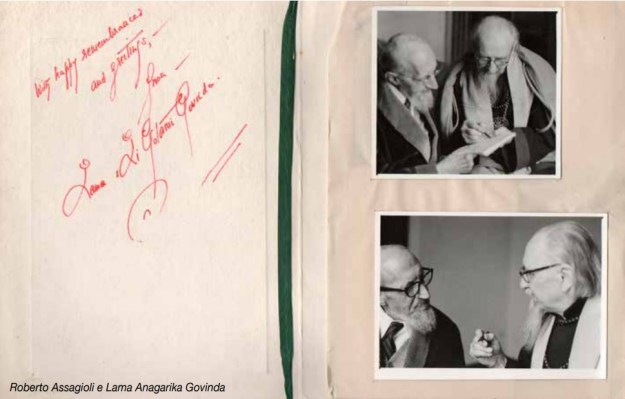
Spero che Lei ha ricevuto le fotografie che mia moglie ha fatto durante il nostro soggiorno Castiglioncello. LG. (I hope you received the photographs that my wife took during our stay Castiglioncello. LG)
Govinda and Assagioli’s Meeting
In his autobiography, Piero Ferrucci writes about the two men’s meeting which took place in Castiglioncello, Tuscany, in August 1972. Here is a brief excerpt:
“At one time Assagioli achieved a degree of fame overseas, far more than in Italy, and various people came to meet him. Lama Govinda came while Assagioli was spending a few days at Castiglioncello on the Tirrenian coast. Lama Govinda had written books on Tibetan Buddhism, and had made available to the public its forgotten teachings. Assagioli and Lama Govinda were puny, frail old men with white beards and an air of wisdom about them.
“His meeting with Assagioli was a great piece of theatre. Lama Govinda was slowly climbing a staircase with friends, Assagioli was waiting at the top and began going down the stairs to meet him. He had asked me: “Should I greet him the Oriental way, with hands clasped, or the Western way, with a handshake?” A fair question, seeing as Lama Govinda was actually a German scholar transplanted in the East. I said he should greet him with hands clasped. When the meeting took place, Assagioli gave him the Oriental greeting, but Lama Govinda extended his hand. So Assagioli started to give him his hand, but meanwhile Lama Govinda had decided to greet with hands clasped. It looked like a strange ritual: East meets West.
“The conversation began and Lama Govinda pointed out that the concept of will in psychosynthesis was similar to that of the Buddhist virya, inner strength. After a while the two asked to be left alone… Sometime later the two of them came back looking radiant and resembling each other even more.”
Piero Ferrucci
Above are two photos of the two “puny, frail men with white beards.” I am not certain, but perhaps these photos are the ones mentioned by Lama Govinda. You can see the note written by him: “With happy remembrances and greetings – from – Lama and Li Gotami Govinda. Li Gotami Govinda (1906-1988) was his wife. More about her below.
Lama Govinda and Li Gotami Govinda
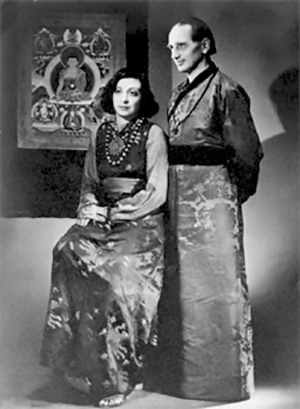
The Govindas in 1947 at one of their four wedding ceremonies.
One life event that Govinda and Assagioli shared was during World War II. While Assagioli spent one month in prison, followed by his time under house arrest and then more than a year in hiding, Govinda spent three years in a British internment camp at Dehra Dun, India.
Govinda and his wife Li Gotami were married after the war in 1947 and soon afterwards undertook research expeditions to Tibet, making a large number of drawings and photographs of Buddhist art and architecture. Govinda described these expeditions in his popular book The Way of the White Clouds and Li Gotami’s photographs appear in her book Tibet in Pictures.
Perhaps what delighted me most while preparing this short reflection was Govinda’s connection to Rabindranath Tagore. Govinda taught at Rabindranath Tagore’s Vishva-Bharati University in Shantiniketan and that is where he met his wife. Li Gotami Govinda was Parsi, born in Bombay, and a famous photographer and painter in India. At the time she was studying at the university. Their encounter took place when she was making her way to the hostel where Lama Govinda was staying, as described below:
“A door opened and out strolled this handsome, smiling foreigner dressed in the burgundy robes of a monk. She recalled asking herself who this “bright merry person” might be, and in retrospect (at least on her part) remembered the incident as very romantic.”
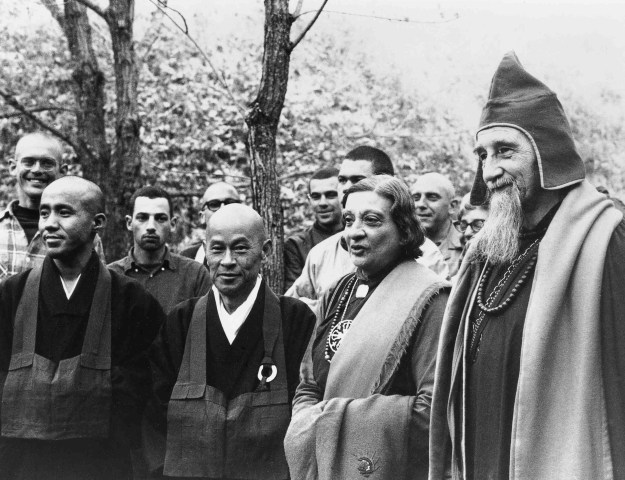
Suzuki Roshi, Li Gotami, and Lama Govinda.
Lama Govinda’s Review of The Act of Will
Unfortunately, this review by Govinda was never published by the Psychosynthesis Journal. However, a slightly edited version was published posthumously in The Lost Teachings of Lama Govinda: Living Wisdom from a Modern Tibetan Master, edited by Richard Power, foreword by Lama Surya Das. Quest Books, 2007.
What I found most interesting are Govinda’s definitions of the Transpersonal Will and Universal Will.
“Transpersonal Will (which is the urge to find a meaning in life, the urge towards highest realization [Sanskrit: Dharma-chanda]) and the Universal Will (in which the human will is in perfect harmony with the universal law [Dharma]).”
This is the third and last part of a series that explores psychosynthesis and Jungian analysis based on my article Psychosynthesis and Jung in a Nutshell.
In Part I I summarized some of the differences and similarities between Jungian psychology and psychosynthesis.
In Part II, I reflected on the relationship between these two great geniuses.
In this part, I will offer some of my own reflections on Jung’s concepts, which are confirmed by Assagioli.
Jung’s Writings Lack Clarity
Firstly and perhaps most importantly, one statement that seemed to be consistent throughout Assagioli’s notes, which resonates with my own opinion, was Jung’s writings lack clarity. I have often felt that Jung’s language is muddled and his writing verbose and meandering as opposed to Assagioli’s carefully crafted and meticulously worded books. Perhaps this is exemplified by the number of books attributed to both men. While Assagioli published five books (two posthumously), The Collected Works of C. G. Jung is a book series containing 20 volumes!
Edward C. Whitmont (1912-1998), a Jungian psychoanalyst who introduced many Americans to the fundamentals of Jungian psychology, once said:
I must warn you that insight into or comprehension of what Jung really stands for can not be gained from his published writings. Quite frequently they hide more than they express, unless, of course, you can read between the lines… I want to emphasize that you cannot judge what Jung said from his writings; you can judge [analytical psychology] only from the way it is being practiced.
Explaining that the only way to really understand Jung is through personal experience, Whitmont then related an example from when he was Jung’s student. Perplexed by a concept that Jung had written about, he asked Jung to further explain it.
“Where the hell did you read this nonsense?” Jung asked him.
“In your book!” Whitmont responded along with the page number and paragraph.
“Oh forget it!” said Jung.
If Jung tells his own students to forget about his writings because they contradict what he wants to express, and his own student warns us to not expect to understand Jung from his writings, then what are we supposed to understand from his publications?
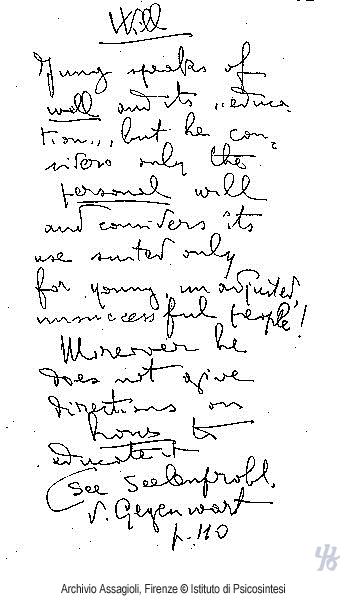
Note from Assagioli’s Archives.
The Animus Does Not Correspond to the Female Reality
Secondly, I have never been comfortable with Jung’s concept of the “animus” for women as a counterpart to the male principal of the “anima.” Jung used these terms to define: “the inner figure of a women held by a man and the figure of a man at work in a woman’s psyche.” The anima is a personification of all the feminine psychological tendencies in the male psyche. As a rule, the anima is shaped by the man’s mother and can manifest as and/or be projected upon both negative and positive symbolic figures.
The anima also personifies man’s relation to his unconscious. Negative figures include the femme fatale, the Greek Sirens, witches, and women who appear in erotic fantasy. Positive figures include romantic, idealized beauty, like Helen of Troy. Higher positive images include spiritual wisdom like the Chinese goddess Kwan-Yin who can bestow the gift of poetry or music and even immortality on her favorites, Sappho or the Virgin Mary.
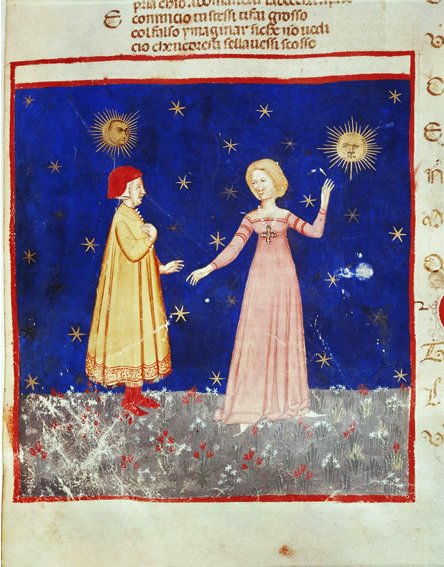
Assagioli suggests that men refer to Dante’s Beatrice as a symbol of the Ideal Woman.
Most importantly, however, according to Marie-Louise von Franz, the anima has the essential role of “conveying the vital messages of the Self” and “putting a man’s mind in tune with the right inner values and thereby opening the way into more profound inner depths.” Examples of this anima role appears in literary works such as Dante’s Divine Comedy in the form of Beatrice and as “the eternal feminine” in Goethe’s Faust.
The Impoverished Animus
In contrast, the male personification of the unconscious in women – the animus – does not play such a vital role for the female psyche. For example, while Dante’s spiritual journey may be the complete poetic form of psychosynthesis, his search for Beatrice is, nevertheless, quintessentially male. Dorothy L. Sayers argues that while Dante’s journey to Beatrice could symbolize man’s search for his anima, for the female “from time immemorial…there is no corresponding Enigma of Man.” She continues by pointing out that, in fact, Jung’s:
… corresponding animus in the female [when compared to] the rich, poetic, and magical content of the animain the male [is] so desiccated, impoverished, and lacking in any touch of the numinous that it might appear to have been artificially patched together for the sole purpose of completing the symmetrical pattern.
I am in total agreement with Sayers. I have always viewed and experienced the animus as the part of a woman’s inner psyche that seems to know how best to manage the patriarchal world in which she must cope and survive while being judged and treated (for the most part) as an inferior being. In a world that has been dominated by men for thousands of years, if anything, the animus is usually over-emphasized in a Western woman’s conscious life, especially when she is pursuing a successful career.
Instead of an Animus, A Triple Goddess
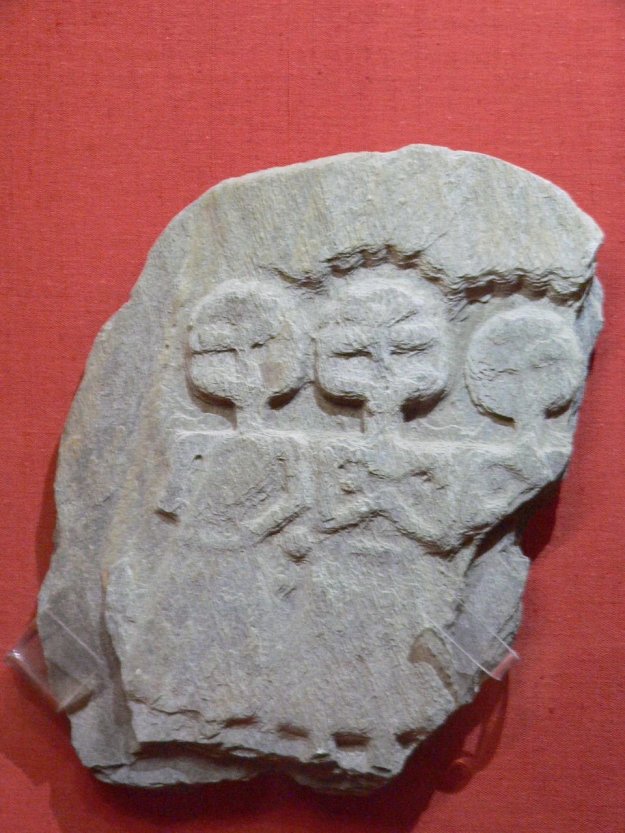
The Sumerian poem, The Descent of Inanna (c. 1900-1600 BCE) chronicles the journey of Inanna, the great goddess and Queen of Heaven, from her realm in the sky, to earth, and down into the underworld to visit her recently widowed sister Ereshkigal (pictured above) Queen of the Dead.
Similar to the anima, the animus can also manifest as and/or be projected upon both negative and positive symbolic figures. However, I do not believe that the animus personifies a woman’s relation to her unconscious nor is it the animus that can open the way to her inner depths or values. This door is unlocked instead by the triple power of the inner Divine Mother, the Dark Sister, and the Crone.
As Jungian Silvia Brinton Perera states, before grounding myself as a woman in order to “coagulate [my] feminine potency to confront the patriarchy and the masculine as an equal,” I must first come into relation – not with my male psyche tendencies – but rather with the ancient parts of my repressed feminine self. These parts of me are “too awesome to behold, the Great Round of nature, connected to active destruction but also to transformation.”
I was elated to have my intuition and feelings confirmed by this note by Assagioli:
Polarity and struggle between the artificial “personality” constructed for society and the unconscious repressed elements, regrouped by Jung under the designation of “anima” (questionable as a name and questionable as a unified grouping – in reality these elements remain multiple and often contrasting. Also this conception would only apply to men, not for women.)
Once again Assagioli first questions Jung’s choice of the term “anima” (which is Latin for ‘soul’). He then continues by refuting Jung’s definition of the term by the fact that it does not actually match the living reality. Finally, Assagioli confirms my belief that the animus, according to Jung’s definition, does not apply to women.
Jung Undervalued the Will
According to his biographer Deirdre Bair, Jung used his anima to avoid taking responsibility for his adulterous behavior with former client Toni Wolff. Years later, he is quoted as saying: “Back then I was in the midst of the anima problem.”
Often he felt caught in an affair that was outside of his control, saying: “What could you expect from me? – the Anima bit me on the forehead and would not let go.” This brings us to my final point regarding Jung, which Assagioli collaborates – the absence of the will from Jung’s approach (not to mention his numerous extramarital affairs!)
As demonstrated with his own confession of being dominated by his anima, Jung did not fully believe in free will. He also did not believe in determinism, but rather something in between the two. From Jung’s perspective, we are all capable of making conscious decisions, but, we are not capable of making any decision without some influence from both the personal unconscious and the collective unconscious.
Despite his vast number of publications, Jung wrote very little about the will. In Archetypes and the Collective Unconscious, he actually warns against training one’s will, saying that the more an individual trains his will, the more danger he has of “getting lost … and deviating further and further from the laws and roots of his being”.
He wrote that the use of the personal will is only suited for young, unadjusted, unsuccessful people (!) and that a person in “the second half of life no longer needs to educate his conscious will,” but instead needs “to understand the meaning of his individual life, needs to experience his own inner being.”
All this is, of course, in sharp contrast to psychosynthesis, in which the will is given a pre-eminent position. Assagioli states that
“The will has a directive and regulatory function, one that balances and constructively utilizes all the other activities and energies of the human being without repressing any of them.”
Not only does psychosynthesis recognize that the will exists and that we have a will – but it extends even further to the fact that we are will. In his book The Act of Will, Assagioli analyses “willing action” in its various stages, describes the specific aspects and qualities of the will, and offers practical techniques for its development and optimum use (which he does not say to stop upon reaching middle age!). He regards the will as a direct expression of the “I”, the individual’s authentic being, and states:
The discovery of the will in oneself, and even more the realization that the self and the will are intimately connected, may come as a real revelation which can change, often radically, a man’s self-awareness and his whole attitude toward himself, other people, and the world.
In his historical survey of the will, Assagioli criticizes Jung’s omission:
While he recognized and even emphasized the reality and the dynamic function of goals, aims, and purposes, he did not make an investigation of the various aspects and stages of the will, nor did he include the use of the will in his therapeutic procedures.
Assagioli, R. (n.d.) Archivio Assagioli – Firenze, ID Doc: 1738, 1901, 1922, 2335, 10490, 11240, 11357, 11472, 13010, 13546, 14888. Downloaded from archivioassagioli.org.
Assagioli, R. (2002). The Act of Will. London, UK: The Psychosynthesis & Education Trust.
Bair, D. (2003). Jung: A Biography. New York: Little, Brown, and Company..
Jung, C. G. (1966). The Practice of Psychotherapy (R. F. C. Hull, Trans.), Bollingen Series XX. Princeton, NJ: Princeton University Press.
Jung, C. G. (1969). The Archetypes and the Collective Unconscious (R. F. C. Hull, Trans.), Bollingen Series XX. Princeton, NJ: Princeton University Press.
Lombard, C. A. & den Biesen, K. (2014). Reading the Divine Comedy from a psychosynthesis perspective, Psychosynthesis Quarterly, September, 2014, pp. 5-11.
Creating harmony in your inner life requires patience, prayer, and lifelong practice.
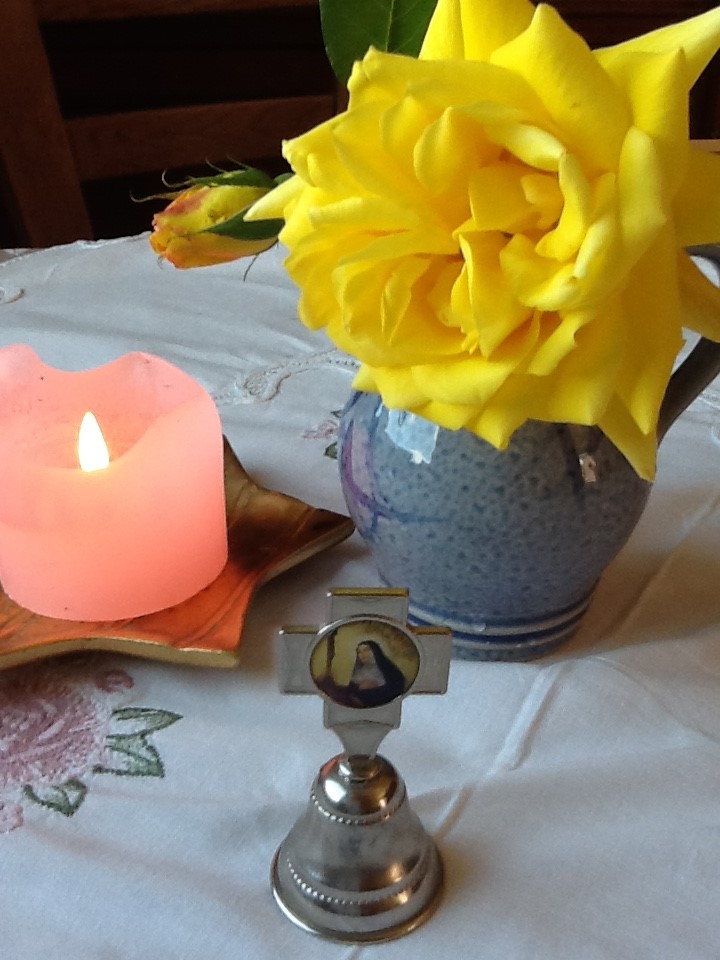
Today is Saint Rita’s feast day, and this afternoon I will be joining the local women in our Umbrian village in the small Marian chapel. Saint Rita is especially popular here since she was born and lived in the nearby town of Cascia, where you can still visit her incorrupt body at the Basilica of Saint Rita. All of the women this afternoon will be carrying a bouquet of roses – one of the saint’s iconic symbols – for the priest to bless with holy water.
Two years ago this article was published by Unity Magazine about my struggle to balance two conflicting subpersonalities – Annoyed Wife and Blessed Wife. Saint Rita came to my rescue and since then, I’m happy to say, these two subpersonalities have come into (more or less!) balance.




 Love and Will