Category Archives: Relationship

A Christmas Story of Big Love

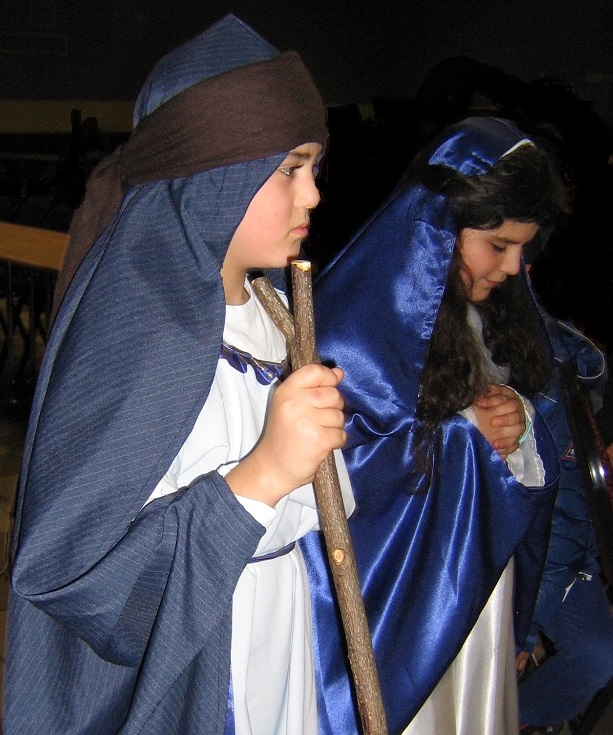
School children walk behind three-dimens

I want to write about Love. Big Love. Where do I start? And how can I possibly describe an experience that great visionaries throughout the centuries have attempted to capture in words, art, mystic prayers or song? Plato to Dante, Mozart to the Beatles, Rumi to Julian of Norwich, Bronze-age sculptors to Cezanne – they have all attempted to distill the spiritual essence of Love into matter.

Listen. Here is the Christian Christmas Story: The Higher Self and Transpersonal Will descended upon a young woman. She was frightened but, nevertheless, chose to accept this synthesis of Love and Will, nurture it, and give it birth. She gave birth to this Immense Love called God, embodied as a tiny, vulnerable child born in an abandoned cave. Choirs of angels sang for Joy!

We may wonder today where is this Big Love? How might we give birth to it? A question I often hear is: How can God let innocent children die and cause so much suffering all over the world? I believe that this question needs rewording. How can we let innocent children die, and how can we cause so much suffering in the world? The Big Love is there, everywhere, all around us, ready to fill us, waiting to overwhelm us. And yet, as we readily, hungrily grasp for it, we only too often transform this Love into something less desirable but just as powerful.

Like the Child born in Bethlehem, we too are born full of Immense Love. This love can never be at fault and is always joyful. But later, the choices of what or how we love can lead us and others towards suffering. For example, take a mother’s love for her child. Assagioli describes how initially, the mother joyfully is devoted to the protection and care of her infant. Mothers of small children must use their good will for self-denial in order to direct their energies towards their young ones. But once the child becomes older and independent, this devotion and sacrifice by the mother can turn into attachment and possessiveness.

Continue reading

Soul Harvest – Part 1

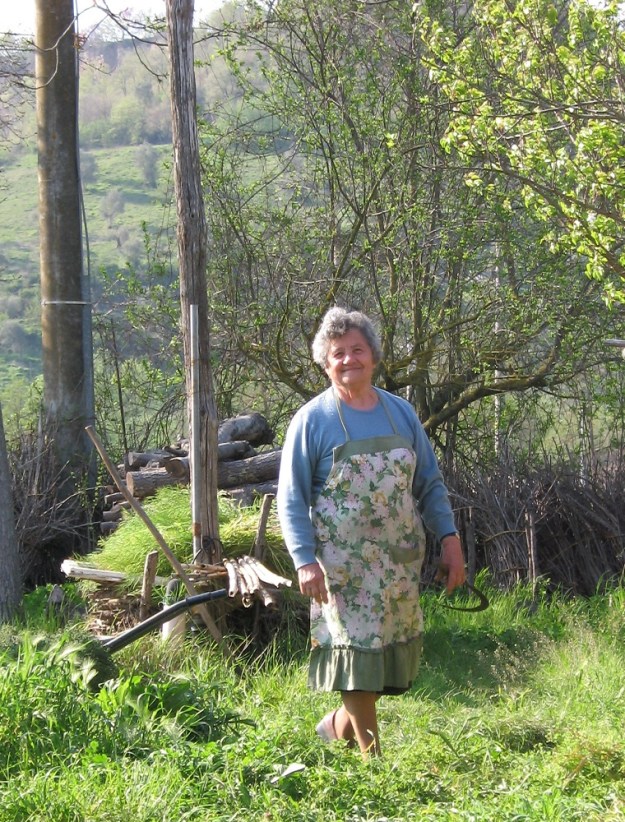
Signora Giuseppa in her Garden

Signora Giuseppa in her garden north of Rome.

It took me a long time and a good deal of sweat to understand it — just how much our Earth is a sanctuary for our souls. And this awareness evolved only thanks to Signora Giuseppa. Having worked the land for more than seventy years, Giuseppa quietly and wisely guided me towards this realization while we walked around her fields or campetto. Through her simple and daily vigil of being with, caring for, and depending upon the Earth, she initiated me into the profound experience of gardening and growing what one eats. For it is through this deeply experiential reality that we are best able to integrate the sacredness of the Earth with our own humanity.

Signora Giuseppa is a round but sturdy widow whose hands are small, yet broad and strong. Whenever she stands before you, her feet are firmly planted and her eyes steady upon you. She is eighty-two years old and one of the few people I have ever met that is really present to all that is around her. Every afternoon you can find her tending her two-acre campetto in the Italian countryside north of Rome. Since she was five years old, she has lived all her life (literally) off the fruits of her labor. From olive oil to fava beans to wine grapes and, of course, tomatoes, her harvest is as varied as it is delicious.

Whenever I visit, she chatters away in her Italian dialect as she heads out to feed her chickens with a bucket of soggy bread and milled corn in hand and an assortment of half-wild cats underfoot. She knows I don’t always understand, but what she seems to find more important is our time together. It is always a pleasure to visit her and see what she is sowing, planting, harvesting, gathering, drying, and feeding her chickens.

Only educated to the third grade (and only thanks to Mussolini insisting that all Italian children learn to read and write), Giuseppa has managed to integrate life’s lessons. For some time now, I have declared her farm “The University of Gardening” and she la professoressa. Whenever I say this in front of the many visitors and relatives that often drop by, Giuseppa beams proudly and quickly adds, “I was never much educated, but I do have some esperienza.”

It wasn’t until I too had this esperienza of hoeing, planting, composting, weeding, watering, and finally reaping the harvest of my own garden did I come to understand how holy the Earth really is. My education evolved mostly from my following Giuseppa around her campetto and simply watching. She used to tease me by telling everyone that I liked to come by and steal her secrets. Yet, while she showed me how far apart to plant tomatoes, when to harvest the garlic, and how to recognize a cauliflower that wouldn’t produce fruit, Giuseppa was also teaching me how to relate to the land, how to observe, care, tend, and support its needs, how to appreciate its bounty, receive its gifts, and surrender that which doesn’t survive.

Oh sure, I had been ecologically aware for years—bicycling to work, recycling my plastics, picking up tossed garbage left along the roadside, hanging up wash instead of using a dryer, and buying a fuel-efficient car. All these small conscious acts of conservation are vital to the planet’s ultimate survival. But until one actually works the Earth, one cannot appreciate the lessons it holds, nor how fundamentally attached we are to it, nor how much working on the land can actually help us to become fully human. As Gandhi once said, “To forget how to dig the earth and tend the soil is to forget ourselves.”

Note: This story was written while I was still living in Italy in 2007. It is the first part of a three part series to be continued next time…

Go to Soul Harvest – Part 2
Soul Harvest – Part 3

This year's harvest from the author's garden in Germany.

This year’s harvest from the author’s garden in Germany.

With gardening always comes the harvest — a communion with our Earth, the holy connection between us and the planet. What better way to participate in this than by eating a cherry tomato or snap pea that we have grown in relationship with the Earth? This replenishment of our bodies with what the Earth offers us through our own labor aided by nature’s gifts of sun and rain creates a circular relationship of spiritual unity. Perhaps this is the true meaning of Eucharist, which comes from the Greek for gratitude. By receiving the garden’s bounty into our bodies, we gain the strength, energy, and respect to continue our lives in tandem with it.

Signora Giuseppa enjoys the fruits of her labor - homemade foccacia baked in the wood-burning oven.

Signora Giuseppa enjoys the fruits of her labor – homemade foccacia baked in the wood-burning oven.

One August, when most Italians flee their homes for holidays in the countryside or al mare, Giuseppa was faithfully tending her rows of tomato plants. I passed by one cloudy afternoon to find her worried over the possibility of rain. “If it rains, Caterì, it will ruin all the ripe tomatoes.” She and her extended family spend two days peeling and canning these tomatoes for the winter months. I offered to help her pick them without realizing what I was actually getting into. She accepted my offer, grabbed some crates, and bounded out into the field, calling for me to follow with the wheelbarrow. We spent nearly four hours picking tomatoes that afternoon with her chatting the entire time.

“We used to work for a patrone,” she told me. “Half of what we harvested went to the landowner. One hot summer day, I carried a heavy basket of tomatoes the long road up to the landowner’s house. I used to carry everything on my head in those days, but the wet wash from the lavanderia was always the worst, especially in winter.

“I arrived in the midday heat with those tomatoes. I had been working all morning in the fields and hadn’t eaten a thing. It was a thirty-minute walk straight uphill. The sweat was pouring down me. Do you think that Signora offered me a glass of water or a shady place to rest for a moment?”

We hauled the crates onto the wheelbarrow. “Wait, Caterì, let me help you. These crates are too heavy.” She worked like a twenty-year-old and didn’t seem to tire. Visibly rejoicing in the summer harvest, she became more animated and energized as the number of crates of tomatoes grew and grew. Meanwhile, my back was killing me even as I marveled over the variety and seemingly endless number of tomatoes that lay hidden inside the masses of vines.

As we returned to the fields, Giuseppa lingered for a moment next to the tiny clusters of unripe grapes. “Do you remember last year?” my professoressa quizzed me. “The grapes were ruined with disease. This year the plants are green and lush with fruit. It will be a good year for wine.”

She brushed one hand tenderly over the grapes. “Every year has its own season. Just like our lives. One year there is fruit, another only ruin.”

“But at least here in the campo,” Giuseppa laughed, “there’s always something to eat.”

Note: This story was written while the author was still living in Italy in 2007. It is the last of a three part series.

Go to Soul Harvest – Part 1

Go to Soul Harvest – Part 2