Tag Archives: will

Useless Exercises as Will Gymnastics

pushing-a-car1

Strong will alone is like pushing a car uphill.

Upon agreeing to be the guest editor of the latest issue of the AAP Psychosynthesis Quarterly with its theme of “Awareness and Will”, I decided to search for inspiration in Assagioli’s online archives. Luckily I found two very interesting manuscripts. Luckier still, both of these were clearly dated ‘1929.’

Most of the tens of thousands of Assagioli’s notes held in Florence are rarely dated. Rarer still are any manuscripts written before WWII, since most of Assagioli’s documents were destroyed in two separate fires during this time. Continue reading

Successful Willing

We are now more than half-way through January and you may want to reflect on any New Years Resolutions you have made. Most of us choose goals like losing weight, giving up smoking, learning something new, and finding a better job or relationship. Studies show that only about 2 out of 10 of us will manage to achieve our goals. When we do succeed in achieving a set goal, we often feel joyful.

New-Year-Resolutions

As Assagioli wrote:

“Since the outcome of successful willing is the satisfaction of one’s needs, we can see that the act of will is essentially joyous.”

If you find yourself far from feeling joyous, struggling instead with your longing to change, then maybe it’s time to take a closer look at how you make decisions. Assagioli has written extensively on decision making in his book The Act of Will. He describes six stages of the decision making process: defining purpose, deliberation, choice, affirmation, planning, and execution. Continue reading

Living Kipling’s “If”

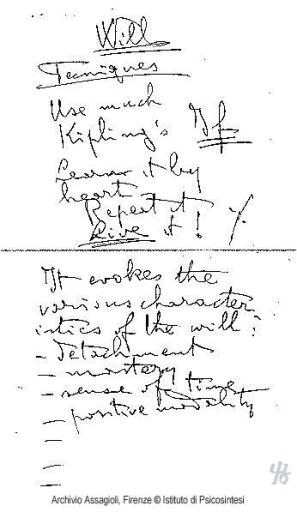
While recently conducting research in Assagioli’s Archives, I came across this note by chance:

kipling-ifWill
Techniques
Use much
Kipling’s If
Learn it by
heart.
Repeat it.
Live it!

­­­­­­­­­­­­­­­­

It evokes the
various character-
istics of the will
– detachment
– mastery
– sense of time
– positive modality

In fact, Assagioli wrote this note two times, indicating that he found Rudyard Kipling’s poem from 1895 significant.


My curiosity peaked, and I quickly found the poem on the internet. My first impression was how “male” the poem felt. Written in the form of a father’s advice to his son, I found it difficult to overcome my feelings of being excluded from its message. How might this poem be different if it had ended with: “You’ll be a Woman, my daughter!”[1]

Continue reading