Fresco in the Sacro Speco (‘sacred cave’) of St. Benedict in Subiaco, possibly the oldest and most faithful image of Francis.
“Pace e bene! Peace and all that is good! These words of Saint Francis (1182-1226) go beyond divisions, faiths and institutions, right to the core of our shared humanity. Today in Assisi, people are gathering to celebrate his feast day for he (along with Saint Catherine of Siene) is the patron of Italy.
Many people familiar with the life of St. Francis may like to think of him as a peace-loving eccentric who preached to the birds and wrote poems to Brother Sun and Sister Moon. But Francis was really a frightening radical! If he were alive today, I believe he would make us all feel quite uncomfortable.
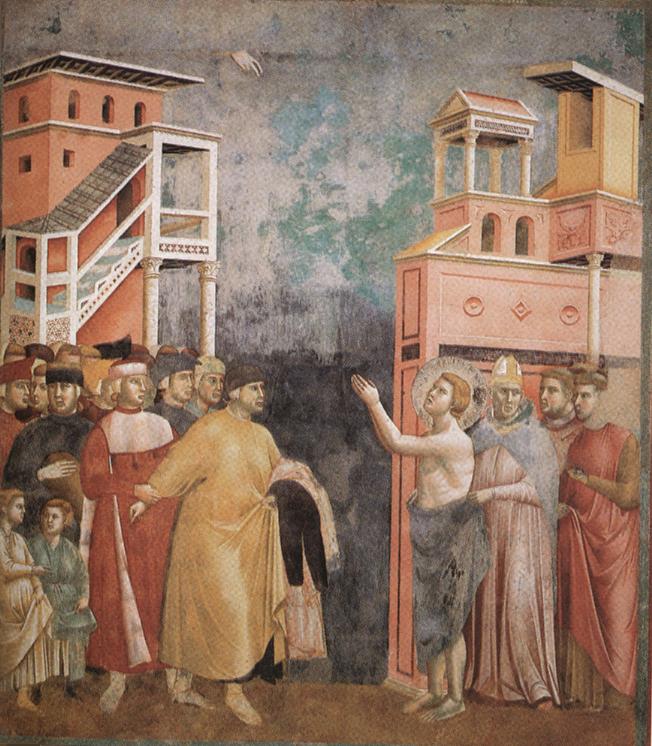
Francis renounces all worldly possessions, as painted by Giotto.
At the age of 25, Francis renounced a vast inherited wealth from his father by symbolically stripping naked in front of Bishop Guido and a great crowd in Assisi, forever devoting himself to ‘Lady Poverty.’ The painter Giotto depicts this scene complete with small boys throwing stones at the naked Francis.
Francis’ initial followers were not permitted to own any possessions. They lived in straw huts and preached and begged in the streets. In fact, Assagioli often referred to Francis as the “Poor Man of Assisi,” and he specifically mentions the saint in his article “Money and the Spiritual Life.”[1]
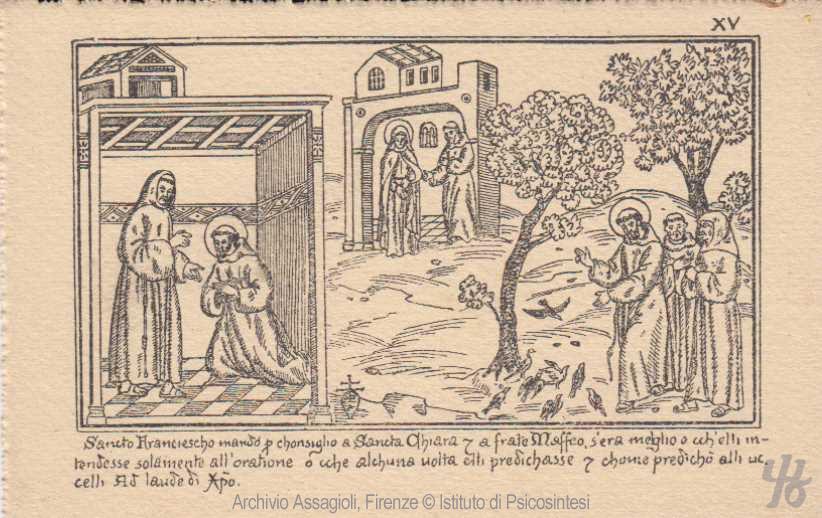
A hand drawn depiction of Francis with (left to right) Brother Masseo, Saint Clair, and Francis preaching to the birds. This is from Assagioli’s Archives, ID# 14609.
Assagioli states that living as Francis did is infeasible in our present age, pointing out that just decades after Francis’ death, the Franciscan Communities realized that “it was almost impossible to do without money and some form of buildings and land … Franciscans now use every means the modern world provides.”[2]
Assagioli continues by assuring us:
“If this is what the sons of Saint Francis do, how can any more be expected of us … caught up in the very fabric of economic, family, and social life?”
He then explains that spiritual transformation does not come from outside ourselves (where money might dominate), but from within.[3] However, Assagioli is then quick to qualify this statement by noting his intention is not:
“… to criticize or distract from the sublime act of Saint Francis, which was indeed heroic and had an incalculable positive effect as an example to others, providing us with a practical lesson in detachment … Our intention was only to show that this way cannot provide us with a generally applicable solution to our everyday lives.”[4]
In other words, money is a necessity for living our lives, but it is our attitude and actions towards money that determine its true worth. What matters most is how detached (or how identified) we are with the money and all that it can buy.
Assagioli’s Test with Money
Assagioli’s note from Freedom in Jail.
In his prison diary Freedom in Jail, we see firsthand Assagioli’s personal and spiritual struggle with money.[5] He writes about how he went through a psychological test and experience when he was told that the money his wife had deposited to pay for his extra privileges in jail was running out. This meant that he would have to leave his private “special” cell and move into a cell with others and eat the normal prison fare. He wrote that:
“A kind of physical instinctual panic surged which tended to create an emotional preoccupation. I fought it through clear reasoning: the food which I would get was quite sufficient… I roused myself a sense of shame for my selfish preoccupation. I realized the human value of sharing the experience with others of this “poverty.”
As soon as Assagioli had arrived at a deeper acceptance of his financial dilemma and was spiritually ready to share a cell with others, his was notified that his money had arrived, and that things would go on as before. He candidly writes:
“When the news was given to me, I distinctly registered two opposite inner reactions at the same time: an instinctual sense of relief and a feeling of disappointment for being deprived of the new experience and of the opportunity of helping my fellowmen.”
Personally, I have often found this to be the case whenever I spiritually feel conflicted and confused over the deeper meaning and use of money (usually around not having enough!). Whenever I finally manage to transmute my fears into a deeper awareness, the money finally arrives … and this always seems to happen at the very last minute!
Reflect on your attitude towards money
You might take some time to reflect on your own attitude towards money, especially as Europeans face energy bills that are doubling in price and the world sees the rising cost of food and other everyday products. Some questions to ask yourself are:
How identified am I with money? Do I gain recognition and acknowledgment from my money and possessions?
Am I generous with what I own?
How do I spiritually deal with any conflicts or confusion I experience over money (or the lack of it).
Like Assagioli, have you ever experienced “physical instinctual panic” when you face a financial challenge? Are you able to use your skillful will to detach from money and consequently find a higher solution to that challenge?
Final Words
Assagioli and St. Francis both called us to establish peace in every aspect of our lives. To celebrate this day joyfully, I end with a quote from Saint Francis written in Assagioli’s beautiful hand (in Italian) :[6]
Lighthearted Joy
What else are the servants of God if not his minstrels destined to raise up the heart of the people and to bring them to the Joy of the Spirit.
S. Francesco
[1] Roberto Assagioli, Transpersonal Development, The Dimension Beyond Psychosynthesis, The Aquarian Press, London, 1993, pp. 213-233.
[5] Roberto Assagioli, Freedom in Jail. Edited by Catherine Ann Lombard. Istituto di Psicosintesi, Florence, Italy. 2016, pp. 25-27, 35-36.
[6] Roberto Assagioli, N.D. ID #8405. Retrieved November 11, 2016 from archivioassagioli.org. This translation is mine. The original Italian text is: “Letizia – Che altro sono i servi di Dio se non i giullari di Lui, destinati a rialzare il cuore degli uomini e portarli alla gioia dello spirito? S. Francesco.”
Ahead of World Psychosynthesis Day on 20th September, I will be demonstrating a one-hour session via Zoom on how to navigate Assagioli Archives, home to approximately 19,000 notes and manuscripts from Roberto Assagioli, the founder of Psychosynthesis.
Gruppo alle Fonti, part of the Instituto di Psicosintesi in Florence, has dedicated many years to making Assagioli’s notes available, creating this free resource online to share his work as widely as possible. They launched Assagioli Archives in 2015 and have recently added the printed publications of Assagioli’s writings.
I will be introducing the archives and demonstrating how to navigate them with practical tips such as how to use the search engine and copy images. As a collaborator with Gruppo alle Fonti at the Istituto di Psicosintesi for many years, I have helped to catalogue and scan archive documents.
Feel free to join me on either day (Note that both workshops are the same).
There is no nice way to talk about this. Our planet is under siege and we are committing collective suicide. June was the hottest month ever recorded on Earth. As I write this, fires are scorching Western Europe and California. For the first time ever in the UK, temperatures topped 40° C (105° F). In Italy where I live, 28% of the land is currently turning into desert.
The U.N. Secretary-general, António Guterres, has said:
“Half of humanity is in the danger zone from floods, droughts, extreme storms and wildfires. No nation is immune. Yet we continue to feed our fossil fuel addiction. … We have a choice. Collective action or collective suicide. It is in our hands.”
Yes, it is in our hands, but time is slipping away. Our planetary disasters are slowly becoming normalized. Our hearts and minds continue to resist even the smallest personal change. Friends and family still fly off on long-distant holidays. Pineapples and mangos still appear on the supermarket shelves. We are eating too much meat. The planet is water-stressed. Everything is still swathed in plastic.
Yes, we are addicted to fossil fuels, but if we deeply assess the addiction, we see that it is an addiction to consume, to own, and to have power – all driven by a fear of not having enough.
Despite the need for radical systemic global change, our will is constantly twisted and out-maneuvered, sabotaged and stymied. We are being overrun by greed and betrayal. As Grete Thunberg has said, all the proposed mitigation to prevent the climate catastrophe has proven to be a lot of “Blah. Blah. Blah.”
Facing the Collapse
Lately I have been following webinars by Joanna Macy and Jonathan Gustin entitled “Climate Change as a Spiritual Practice”. During one of these events, an article written by ethicists David Schenck and Larry R. Churchill was presented. The article is entitled “Ethical Maxims for a Marginally Inhabitable Planet”. I highly recommend that you take time to read this article.
Based on their bioethics work in intensive care units (ICUs) and hospices, they have come up with six ethical maxims for a time of collapse. These maxims are useful guidelines for what we will need to face. Our world is in free fall, a state that researchers have recently coined as ‘Collaspsology’.
As Schenck and Churchill write: “Maxims are less how to analyze and choose and more how to be.” Maxims are moral virtues which we can start to cultivate now to help us inwardly prepare for catastrophic events.
The authors insist that theirs are not the only maxims, but a bare beginning. Think of them as seeds for the future. They are a place to start. A place to ask yourself: What values do I want to develop, gain some mastery of, and activate during this potential human tragedy and all that it implies?
Here are the six maxims, along with some of my own reflections on them. I also added two of my own. Feel free to do that same, and share with others.
Maxim 1: Work hard to grasp the immensity.
Photo by Leonid Danilov
Just as it is difficult to accept devastating news about one’s health, it is equally difficult to accept the devastation being imposed on the planet and all its living beings. Like any health crisis, we have to grasp all that we are facing before we can choose the best remedy.
While contemplating this maxim, I thought about Wilfred, whom I met years ago in London. Born in Germany in 1928, his father was a high ranking official in the German army. He thought, even though he was Jewish, that he and his family were perfectly safe from persecution. Failing to grasp the immensity of Nazism proved fatal to everyone except Wilfred, who at 13 managed to escape and walk by himself over the Swiss Alps to Milano. There he was able to locate a distant uncle who was working as a tailor. The story goes on, but teaches us not to be shortsighted or feel immune when facing looming disaster, especially while it’s happening to others all around us.
Maxim 2: Cultivate radical hope.
Schenck and Churchill explain that radical hope is the “kind of hope that reappears after optimism has died.” It is not fantasyland or magical thinking. Radical hope is the grace that comes once we hit rock bottom. Radical hope demands that we be courageous.
This maxim immediately brought to mind Dante’s Divine Comedy and his approach at the Gate of Hell. Like most of us, Dante would have preferred to avoid this gate all together, opting instead to ascend directly into Paradise. The inscription on the gate’s lintel stops him in his tracks: “Leave behind all hope, you who enter (Inf. 3. 9). Dante decries these words, and Virgil, “a man of quick discernment,” exhorts Dante – to not leave behind “all hope,” but rather to leave behind his “sheer black cowardice” (15).
One time while in Assagioli Archives I discovered a note that said “Will-to-Joy”. The words are double underlined with blue and red pencil. We could say the same about hope: “Will-to-Hope / The duty of Radical Hope”. A willful practice to be and create joy and hope.
Lately, I have been consciously practicing radical hope. In the garden, while pulling up weeds – yet again… When meeting someone new and thinking they might become a friend… While stumbling over my Italian – yet again! While praying for rain…(this goes with my Maxim #8).
Try practicing radical hope today and see what new energy it brings – especially when it seems like there’s nothing left to do.
Maxim 3: Have a line in the sand.
This maxim is not so intuitive. Having a line in the sand means coming to some understanding about what you will do and what you will refuse to do. It’s about setting boundaries. For someone who is dying, this maxim determines whether she will continue on life-support or not. For Viktor Frankl and Etty Hillesum, it meant defining their attitude while facing the horrors of concentration camps. In Long Walk to Freedom, Nelson Mandela tells of one of his lines in the sand; he refused to escape from prison, even though he had numerous opportunities to do so.
This maxim is a serious one and requires all aspects of will – strong, skillful, good, and transpersonal. In fact, this maxim is so serious that I couldn’t help playing humorously with it (see my Maxim #7). My line in the sand is: When there’s no more food, I will not eat my dog. But I will eat my neighbor’s dog, especially the one that barks all night. hahahaha
But seriously, who knows what I’ll be willing to eat if I’m starving? Like the authors say, drawing a line in the sand demands that we activate our imagination alongside the understanding that the sands are constantly shifting. We are more likely to manage shifting boundaries well if beforehand we imagined the worst and practiced this willful act to its conclusion.
Okay. Let’s try again… If I’m starving, I’ll eat my chicken’s eggs and then my chickens. And if my neighbors are starving, I’ll share my eggs and then my chickens. And if we are all starving…? Well… this obviously still needs some more work!
Maxim 4: Appreciate the astonishing and unique opportunity.
During the webinar, I was impressed by how Joanna Macy, who is 93 years old, expressed her joy to be alive at this moment and able to witness the transformation we are about to undergo. She said she wouldn’t want to be anywhere else. Personally, my initial instinct is to run away. But then I have a strong subpersonality who tends to operate in this fashion.
The key word here is ‘appreciation’. Now is the time to practice appreciation of our bodies, feelings and thoughts. Our ability to embody courage and grace. The daily gifts and smallest blessings.
I remember my mother telling me years after my father’s murder how she managed to take hold of her life again. Tragically widowed at 46 years old with four kids to raise in 1970, she spent the first year in shock while trying to contain her anger and sadness. “Then a year later in early spring,” she told me once, “I saw the first crocuses bloom. And suddenly I knew I would be okay.”
Practice appreciating those “blooming crocuses” in your life, both big and small.
Maxim 5: Train your body and your mind.
Artwork by Mary Beth Volpini. See more at drawntocolor.com
I would add to this maxim that we also need to train our heart, that is our ability to feel. The more conscious and healthy we are on every level – physically, emotionally, mentally, and spiritually – the more we will be able to deal with the challenges we will need to face.
The better we can cope, the better we can endure the suffering of those around us and help ourselves and others to grow, heal, and yes – even thrive – beyond the inevitable grief and rage. (This spiritual service ties in with Maxim #4.)
This training of heart, mind, and soul is necessary before we can be fit enough to become, like Etty Hillesum at Westerbork, a “thinking heart”. During the three months she spent living amongst the “mud, overcrowding and people arriving every day in truckloads”, she vowed to become the “thinking heart of the barracks”:
“At night, as I lay in the camp on my plank bed, surrounded by women and girls gently snoring, dreaming aloud, quietly sobbing and tossing and turning, women and girls who often told me during the day, “We don’t want to think, we don’t want to feel, otherwise we are sure to go out of our minds,” I was sometimes filled with an infinite tenderness, and lay awake for hours letting all the many, too many impressions of a much-too-long day wash over me, and I prayed, ‘Let me be the thinking heart of these barracks.’ And that is what I want to be again. The thinking heart of a whole concentration camp.”
Maxim 6: Act for the future generation of all species.
The authors urge us to “Act, personally and politically, to limit the damage being done to the biosphere. Speak for the poor, the unborn generations, the forests, seas, and animals.”
For me, this is a tough one, as this maxim runs headlong into “drawing a line in the sand.” I know that in the last 20 years, 45% of the worldwide insect species have died, but I don’t want ants running around my house. I can capture a spider and carry it outside to a nearby flowerbed, but a scorpion on my bathroom floor needs to be stepped on. Mice do not belong in my pantry.
“It is essential to find creative ways to cultivate an in-depth, emotional as well as intellectual understanding of interconnection, so that…we are acting for everything in the global web.”
The keywords here are “creative ways”. I’m still working on this one! Let’s try together!
Now I introduce my two personal maxims:
Maxim 7: Use humor whenever possible.
Humor can help bring a new perspective to any situation. In Assagioli’s seminal essay “Smiling Wisdom”, he begins by talking about the physical and psychological benefits of laughter. He then explores the spiritual value of laughter, especially as a means of overcoming suffering.
Often when we cannot find anything humorous about a situation, we are too serious and intensely attached to the issue we are facing. Humor can help bring a sense of proportion to any struggle, which in turn helps us to ground ourselves into what is real and eternal.
A beautiful example of humor mitigating tragedy can be seen in the movie La vita è bella (Life is Beautiful). In the film, a father employs his imagination and playful humor to shield his son from the horrors of internment in a concentration camp. Life at the camp becomes a complicated game for the boy, complete with points and a grand prize of winning a tank.
Like everything else in life, humor must be applied to good purpose and in the right proportion, otherwise it can turn into sarcastic criticism. A true humorist is one who can see human life in all its frailty with a compassionate and playful heart.
Maxim 8: Connect with a Higher Power.
The Self is an Experience
I believe this maxim is vital as we cannot depend on our egos alone to deal with this crisis. Whether you have faith in God, Allah, Jesus, the Cosmos, who or whatever – you need to have a connection to a higher source of Wisdom and Light, a connection that you continuously and regularly cultivate. To illustrate this fundamental and essential need, I return to Dante’s Divine Comedy, which so beautifully describes where we are right now and our emphatic need to connect to a Higher Power.
In the epic poem, Dante is guided by the poet Virgil through Hell where they meet shadow souls who are eternally lost because of the choices they have made. Hell is divided into three sections and as you journey downwards, the souls’ transgressions become more grievous.
Dante’s Inferno
While the souls in the upper part of Hell have not consciously chosen to do evil, they are there because they have not consciously refused evil. They are only half-conscious and weak of will.
This is exactly where many of us are right now. During the past decades, we might have known that our actions were effecting the earth’s health, (the first Earth Day was, after all, April 1970!), but we remained only half-conscious and weak of will. We did not consciously choose to pollute, blunder, and destroy our earthly home, but we also did not consciously refuse to do so.
The middle and lower parts of Hell, however, are for those who have consciously chosen to commit acts of violence and fraud respectively. In other words, the souls condemned for violence and fraud have consciousness and will, but they have only directed their attention and action toward darker and negative goals leading them to endless suffering. In psychosynthesis terms, these souls have consciously used their will to completely disconnect themselves from the Higher Self, a Higher Power.
This lower part of Hell could easily accommodate all the oil and gas executives that consciously chose not to disclose their company’s scientific findings on how devastating the exploitation of natural resources would be to future generations. But we also must be honest about our own culpability. At this moment in time, we all stand at this threshold. If we don’t make wise, clear choices right now, we are doomed to consciously commit acts of violence, betraying ourselves, our planet, and our future.
An angel opens the gate for Dante and Virgil, allowing them to enter the City of Dis
Upon reaching the middle circle of Hell, Virgil and Dante are barred from entering the City of Dis (i.e. the City of Satan) by great iron battlements. This gate is guarded by hundreds of fierce demons. To make matters worse, three Furies appear – images symbolic of haunting remorse – and threaten to uncover Medusa’s head. Virgil quickly orders Dante to cover his eyes with his hands and further protects his prodigy by placing his own hands over Dante’s. If a living man catches even the smallest glimpse of the Medusa, he will forever turn to stone – petrified by the destructive forces of evil.
All Virgil and Dante can do is wait for divine help. Soon a messenger from Heaven arrives and the Furies and Medusa vanish. An angel touches the gate with a wand and cries out the will of God. Virgil and Dante are finally unopposed to enter into the middle regions of Hell.
In this example, both Dante and Virgil require the will of the Higher Self before they can enter deep and terrifying gloom. This is the same for us as we face the crises we are in. Without a connection to a Higher Power, we can too easily be turned into stone (i.e., we gaze upon Medusa), frozen and unable to act, as we become overwhelmed by grief and remorse.
The gate of Dis can only be safely passed by those who have come to the kind of faith and humility which brought the angel to Dante’s aid. Without such faith and humility, looking upon the darkness within oneself and others can, in effect, result in our losing our humanity to insanity or despair or becoming completely possessed and identified with evil.
It is truly a lifetime endeavor to discern how much depends on our will alone to act, and when we need to patiently wait for the moment when our will and the will of a Higher Power are aligned. This alignment will bring us great insight, courage, and immediacy when coming face-to-face with the dark side of reality and helping us to choose against evil itself.