Category Archives: Spirituality

Balancing Silent Night with the Roar of Nightly News

Light in the darknessIn northern Europe the days are growing shorter. Except for the oak trees with their withered sienna-brown leaves, most of the trees are bare against a bleak landscape and gray skies laden with cold, damp winds. The Dutch have a saying for this time of year: De donkere dagen voor Kerstmis. The dark days before Christmas. Indeed, every day is shorter and the nights seem to stretch out like a long, endless dream.

We are in the season of Advent, which mark the days before Christmas. Advent comes from the Latin word adventus meaning arrival. We freely use the word advent to simply mean “to come into being.”  This is the time of year that we await the arrival of light when the Earth will once again begin to tilt towards our sun. The days can then slowly “come into being,” promising their full splendor of sunshine and warmth at the summer solstice. For Christians, this is the time during which they await the birth of Jesus, when the Divine comes into being.

Darkness Inside

For most of us, these days are more than just physically dark. We can also become lost and overwhelmed in all the expectations of the season. The shopping, planning, cooking, baking, wrapping, cards, music, school plays, church concerts. The running and stress, travel and traffic, not to mention all the money worries.

Typically, we are expected to spend time with our families, with the idea that everyone should be happily singing songs around a piano or opening perfect presents or eating gourmet meals. But our reality may actually lead us to feeling only more lonely and unsatisfied. Under pressure by the media and our own unreal expectations, many of us become depressed this time of year and some of us may even feel suicidal.

Assagioli's notes on polarities.

Assagioli’s notes on polarities.

Darker still are the constant reminders, between the tinsel and flashing lights, of the pain and suffering in the world. Not to mention, of course, our own pain and suffering. How can we possibly feel Joy? The entire season can feel like a sham. Bah Humbug! Where is the Higher Self in all this tragic mess?

Balancing Darkness with Light

Simon and Garfunkel once recorded a song called “7:00 News/Silent Night,” in which the familiar carol is quietly and beautiful sung. At first dimly, then more clearly and loudly, we simultaneously hear the voice of a newscaster dispassionately announcing the kind of violent and terrible news we are all too familiar with. Even though, at the end, the voice of the announcer seems to overwhelm the song, the tender voices unceasingly sing – they are not even faintly shaken.

One could experience this song as another symbol of despair – the submergence once again of peace and joy in the harsh violence of our day. But when listened to in its wholeness, the song expresses the reality that light does shine in the darkness. If we tune into the song of peace, we will be able to hear its still small voice singing clearly under the din of the crowd.

Light and dark. Joy and hatred. These are two of the many polarities that exist in the world. Our job is to learn to live with their tension in order to transform and synthesize their energies into a higher reality. Assagioli says that this process is analogous to a chemical combination when two elements are absorbed into a higher unity endowed with qualities different from what each individual element has.

Transforming Opposites into a Synthesis

The idea is to balance these opposites, hold their creative tension, and give space for a completely new and higher entity to be born. You do this by first being with the violent darkness but not identify with it. Then be with the joyful light and not identify with it either. Finally, we need to be with all that is and hold an objective understanding of the tensions between them in order to creatively seek wholeness.

Assagioli insisted that the mid-way point between two opposites is not static inside us, but rather in “a state of continuous oscillation.” We can actually experience this oscillation between Darkness and Light when we listen to the song “7:00 News/Silent Night.”

Once we can hold onto this mid-way point, then psychosynthesis can occur. It is a wise person who can play with opposites and watch with awe as they awaken and manifest into a complete formed higher quality.

So during these dark days before Christmas, practice hanging on and letting go. Hang onto the dark, and then let it go. Then hang onto the light, and let it go. Try to stand in the mid-way point by expressing Human Affection during this season. Then wait quietly and patiently for the advent of Spiritual Love that is quietly, calming, and ceaselessly singing in the world’s chaos.

Spiritual Lessons of Money (or the Lack of)

Figure 1 Francis
Fresco in the Sacro Speco (‘sacred cave’) of St. Benedict in Subiaco, possibly the oldest and most faithful image of Francis.

Pace e bene! Peace and all that is good! These words of Saint Francis (1182-1226) go beyond divisions, faiths and institutions, right to the core of our shared humanity. Today in Assisi, people are gathering to celebrate his feast day for he (along with Saint Catherine of Siene) is the patron of Italy.


(For further reading, see Catherine’s article
Assagioli’s Reflections on the Poor Man of Assisi”.)


Can Money and Spirituality Mix?

Many people familiar with the life of St. Francis may like to think of him as a peace-loving eccentric who preached to the birds and wrote poems to Brother Sun and Sister Moon. But Francis was really a frightening radical! If he were alive today, I believe he would make us all feel quite uncomfortable.

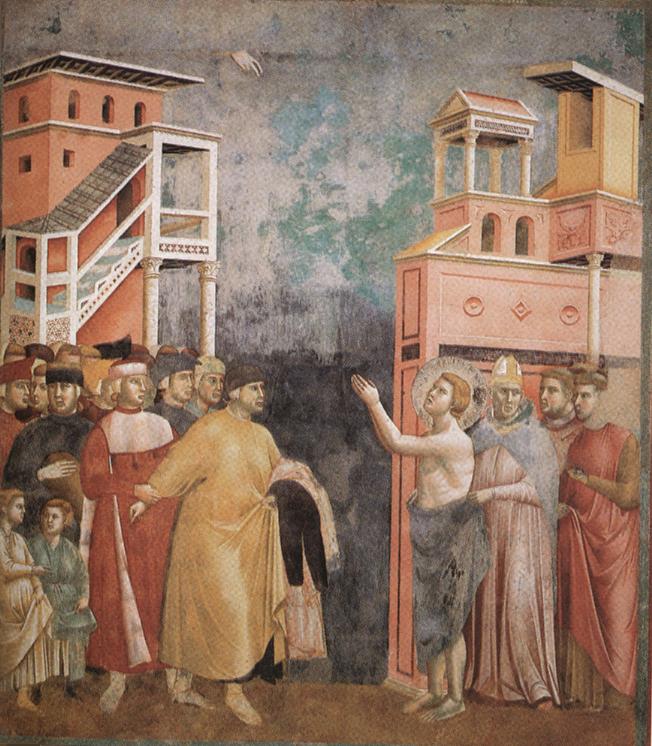
Renunciation_of_Wordly_Goods
Francis renounces all worldly possessions, as painted by Giotto.

At the age of 25, Francis renounced a vast inherited wealth from his father by symbolically stripping naked in front of Bishop Guido and a great crowd in Assisi, forever devoting himself to ‘Lady Poverty.’ The painter Giotto depicts this scene complete with small boys throwing stones at the naked Francis.

Francis’ initial followers were not permitted to own any possessions. They lived in straw huts and preached and begged in the streets. In fact, Assagioli often referred to Francis as the “Poor Man of Assisi,” and he specifically mentions the saint in his article “Money and the Spiritual Life.”[1]

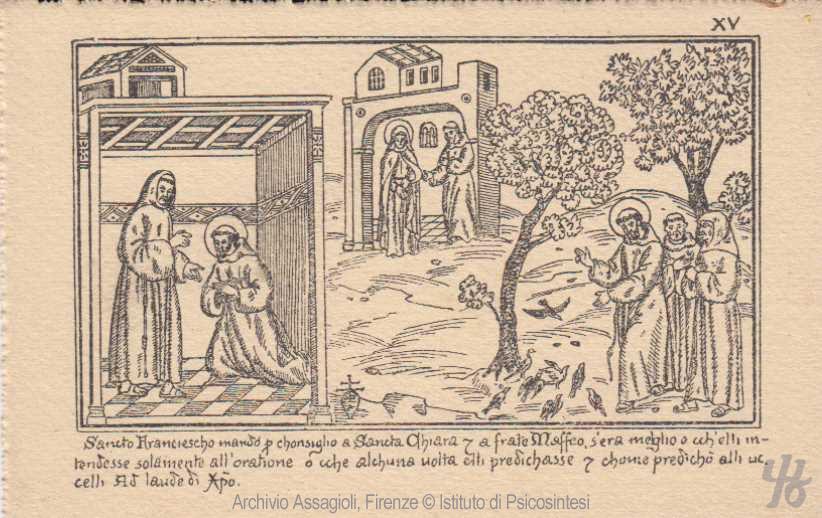
Figure 4. Francis from Archives
A hand drawn depiction of Francis with (left to right) Brother Masseo, Saint Clair, and Francis preaching to the birds. This is from Assagioli’s Archives, ID# 14609.

Assagioli states that living as Francis did is infeasible in our present age, pointing out that just decades after Francis’ death, the Franciscan Communities realized that “it was almost impossible to do without money and some form of buildings and land … Franciscans now use every means the modern world provides.”[2]

Assagioli continues by assuring us:

“If this is what the sons of Saint Francis do, how can any more be expected of us … caught up in the very fabric of economic, family, and social life?”

He then explains that spiritual transformation does not come from outside ourselves (where money might dominate), but from within.[3] However, Assagioli is then quick to qualify this statement by noting his intention is not:

“… to criticize or distract from the sublime act of Saint Francis, which was indeed heroic and had an incalculable positive effect as an example to others, providing us with a practical lesson in detachment … Our intention was only to show that this way cannot provide us with a generally applicable solution to our everyday lives.”[4]

In other words, money is a necessity for living our lives, but it is our attitude and actions towards money that determine its true worth. What matters most is how detached (or how identified) we are with the money and all that it can buy.

Assagioli’s Test with Money

007922 FIJ An Incident and a Test
Assagioli’s note from Freedom in Jail.

In his prison diary Freedom in Jail, we see firsthand Assagioli’s personal and spiritual struggle with money.[5] He writes about how he went through a psychological test and experience when he was told that the money his wife had deposited to pay for his extra privileges in jail was running out. This meant that he would have to leave his private “special” cell and move into a cell with others and eat the normal prison fare. He wrote that:

“A kind of physical instinctual panic surged which tended to create an emotional preoccupation. I fought it through clear reasoning: the food which I would get was quite sufficient… I roused myself a sense of shame for my selfish preoccupation. I realized the human value of sharing the experience with others of this “poverty.”

As soon as Assagioli had arrived at a deeper acceptance of his financial dilemma and was spiritually ready to share a cell with others, his was notified that his money had arrived, and that things would go on as before. He candidly writes:

“When the news was given to me, I distinctly registered two opposite inner reactions at the same time: an instinctual sense of relief and a feeling of disappointment for being deprived of the new experience and of the opportunity of helping my fellowmen.”

Personally, I have often found this to be the case whenever I spiritually feel conflicted and confused over the deeper meaning and use of money (usually around not having enough!). Whenever I finally manage to transmute my fears into a deeper awareness, the money finally arrives … and this always seems to happen at the very last minute!

Reflect on your attitude towards money

You might take some time to reflect on your own attitude towards money, especially as Europeans face energy bills that are doubling in price and the world sees the rising cost of food and other everyday products. Some questions to ask yourself are:

  • How identified am I with money? Do I gain recognition and acknowledgment from my money and possessions?
  • Am I generous with what I own?
  • How do I spiritually deal with any conflicts or confusion I experience over money (or the lack of it).
  • Like Assagioli, have you ever experienced “physical instinctual panic” when you face a financial challenge? Are you able to use your skillful will to detach from money and consequently find a higher solution to that challenge?

Final Words

Assagioli and St. Francis both called us to establish peace in every aspect of our lives. To celebrate this day joyfully, I end with a quote from Saint Francis written in Assagioli’s beautiful hand (in Italian) :[6]

Figure 7.Francis quote 2 from Archives

Lighthearted Joy

What else are the servants of
God if not his minstrels
destined to raise up
the heart of the people
and to bring them
to the Joy of the Spirit.

S. Francesco


[1] Roberto Assagioli, Transpersonal Development, The Dimension Beyond Psychosynthesis, The Aquarian Press, London, 1993, pp. 213-233.

[2] Ibid., p. 217.

[3] Ibid., p. 218.

[4] Ibid., Footnote on pp 220-221.

[5] Roberto Assagioli, Freedom in Jail. Edited by Catherine Ann Lombard. Istituto di Psicosintesi, Florence, Italy. 2016, pp. 25-27, 35-36.

[6] Roberto Assagioli, N.D. ID #8405. Retrieved November 11, 2016 from archivioassagioli.org. This translation is mine. The original Italian text is: “Letizia – Che altro sono i servi di Dio se non i giullari di Lui, destinati a rialzare il cuore degli uomini e portarli alla gioia dello spirito? S. Francesco.”

A Spiritual Warrior for Human Rights

FILE – In this Sept. 17, 1965 file photo, Fannie Lou Hamer, of Ruleville, Miss., speaks to Mississippi Freedom Democratic Party sympathizers outside the Capitol in Washington after the House of Representatives rejected a challenger to the 1964 election of five Mississippi representatives. (AP Photo/William J. Smith, File)

February is black history month in the U.S., and I recently learned about Fannie Lou Hamer, an inspiring and heroic woman who fought for civil rights, women’s rights, class rights, and overall human rights. What caught my attention was that her courageous fight against oppression was motivated by a spiritual awakening that she had at the age of 44.

During her lifetime, Hamer was extorted, threatened, harassed, shot at, and assaulted by racists, including members of the police, while trying to register for and exercise her right to vote. She later helped and encouraged thousands of African-Americans in Mississippi to become registered voters and helped hundreds of poverty-strickened people through her work in programs like the Freedom Farm Cooperative.

Hamer (1917-1977) was the last of 20 children born to a sharecroppers in Mississippi. Tricked into picking cotton when she was only six, the owner of the plantation promised her snacks and sweets that her family could not afford from his store. She only attended school until the 6th grade, having to return to the fields to help support her aging parents. By age 13, she would pick 200–300 pounds (90 to 140 kg) of cotton daily while living with polio.

In 1944, she married Perry Hamer and the couple toiled on a Mississippi plantation. Because Hamer was the only worker who could read and write, she also served as plantation timekeeper. The Hamers wanted to have children, but in 1961, Fanny Lou received a hysterectomy by a white doctor without her consent while undergoing surgery to remove a uterine tumor. The Hamers later adopted two daughters.

In the summer of 1964, Hamer attended a meeting led by civil rights activists in the Student Non-Violent Coordinating Committee (SNCC) and Southern Christian Leadership Conference (SCLC). It was the first time she learned that black people had the right to vote. Hamer’s biographer, Dr. Keisha N. Blain says that, at that moment, Hamer found her calling. Blain explains:

“It was certainly a political awakening for Hamer, but it also was a spiritual awakening.

“She felt that it was God’s plan for her to become an activist and take a leading role in the expansion of black political rights.

“The one reason that she never gave up despite all she had to struggle through was that she really believed that ‘God was on her side.’ She truly believed that it was not so much a political mission, but a spiritual one. She saw herself ‘speaking light into a world of darkness’.”

Once the owner of the farm where she worked learned that she had tried to register to vote (which was initially denied because of a trumped up ‘literacy test’), she was immediately fired. Despite having to move house, loose most of her possessions, and ultimately flee for her life, Hamer was free to pursue her calling. Reflecting later, she said “They kicked me off the plantation, they set me free. It’s the best thing that could happen. Now I can work for my people.”

Hamer is perhaps most famous for her speech at the 1964 Democratic Convention during which she described her brutal beating in a Mississippi jail during her struggle to register to vote. President Lyndon Johnson was so frightened by the power of her message that he called an impromptu televised press conference so she would not get any television airtime. But her speech was later aired and inevitably moved even Johnson and many others to help pass the 1964 Voting Rights Act.

Hamer speaking at the 1964 Democratic National Convention in Atlantic City, N.J.

During Hamer’s time as an activist, she traveled extensively, giving powerful speeches on behalf of civil rights. Woven into her speeches was a deep level of confidence, biblical knowledge, and even comedy. One of her famous lines, that appears on her tombstone, is “I’m sick and tired of being sick and tired.” She often inspired other activists with her singing of spiritual Gospel songs during times of great stress and even terror.

In 1964, Hamer was one of the 11 SNCC delegates (including John Lewis and Harry Belefonte) who visited Ghana. The visit was revolutionary for her, for she saw for the first time black people in charge of their own destiny, including holding positions of political power. (Hamer would run for both for the U.S. Senate in 1964 and the Mississippi State Senate in 1971.) After a three-hour interview with the Diallo Alpha, Director General of the Ministry for Information and Tourism, Hamer received a musical instrument only found in Africa.

In the end, Hamer grew frustrated with politics. She said she was “tired of all this beating” and “there’s so much hate. Only God has kept the Negro sane”. A great cook and knowledgeable about growing crops and raising animals, in 1968, she returned to her hometown of Ruleville, Mississippi, and began a “pig bank” to provide free pigs for black farmers to breed, raise, and slaughter. A year later she launched the Freedom Farm Cooperative, buying up land that blacks could own and farm collectively. With the assistance of donors, she purchased 640 acres and launched a coop store, boutique, and sewing enterprise. She single-handedly ensured that 200 units of low-income housing were built—many still exist in Ruleville today.

Hamer may be remembered best as a civil rights activist, but she was foremost a spiritual warrior. Her faith and calling is what sustained her. Hamer was convinced that God was working through the civil rights movement to usher in the Kingdom of God.  Her favorite Bible passage was from the Gospel of Luke 4:18:

The Spirit of the Lord is upon me, he as sent me to heal the brokenhearted, to preach deliverance to the captive, and recover the sight to the blind, to set at liberty to them who are bruised, to preach the acceptable year of the Lord.

In the end, Hamer died of breast cancer after suffering for many years with various physical illinesses, some sustained from her beatings. May God rest her soul.

May God grant us all the her spiritual strength to preserver in whatever area of activism we are called upon to passionately undertake.

Discover More about Fanny Lou Hamer

Read the speech Hamer gave with Malcolm X in Harlem, New York.

Read the full report of the SNCC visit to Ghana.

Read an article about Hamer’s pastoral and prophetic styles of leadership as acts of public prayer by Breanne K. Barber.

Buy Until I Am Free: Fannie Lou Hamer’s Enduring Message to America by Dr. Keisha N. Blain 

Search for more information on Fanny Lou Hammer in the digital collection at the University of Southern Mississippi