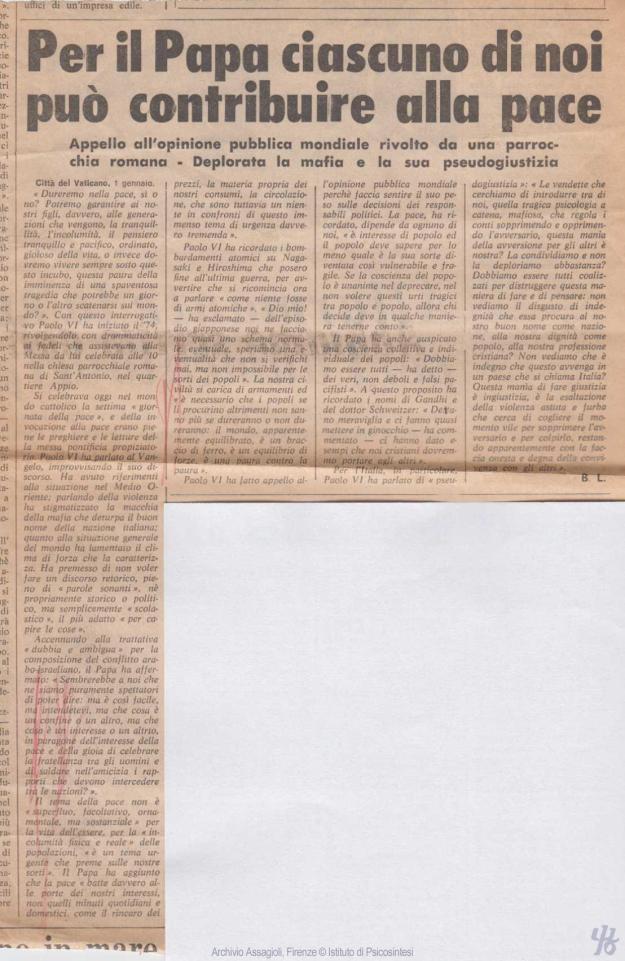
While poking around Assagioli’s online archives, searching for the words “peace” and “pace”, I came across an Italian newspaper clipping published precisely fifty years ago on New Years Day. The year was 1974, and this would be the last New Years Day Assagioli would experience as he would die on 23 August that same year at the age of 86.
The article has the headline “Per il Papa ciascuno di noi può contribuire alla pace” (According to the Pope, each of us can contribute to peace) and the text feels especially poignant given all that is happening in the world today. I can just imagine Assagioli in his study, reading through the newspaper and clipping out this article. You can see the paragraphs he marked with a red pencil held in a shaky hand.
Newspaper article dated New Year’s Day 1974 from Assagioli’s Archives
The article reiterates what Pope Paolo VI had to say on the Seventh World Day of Peace celebrated by the Catholic Church. Eerily, the first conflict that the Pope refers to fifty years ago was occurring in the Middle East. He then condemns the mafia and laments the general use of force throughout the world.
If we zoom in on what Assagioli considered worth noting, we see that he has marked what the Pope said about the conflict between the Palestinians and Israelis.
“It might seem to those of us, who are merely spectators, that we can simply say: ‘But it’s so easy…why not just try to understand each other? What does one border mean as opposed to another? What is the value of one thing as opposed to another when compared to the value of peace and of the joy of celebrating brotherhood among mankind and of welding in friendship the relations that need to be forged between nations?’
“The theme of peace is not superfluous, optional, or ornamental, but essential to the life of every person and to their physical and actual safety. Peace is an urgent theme weighing on our destinies.”
We know that Assagioli sought peace – inner and outer – all his life, even to the point of spending four weeks as a prisoner in Regina Coeli jail, in the heart of Rome. On one August night in 1940, he was arrested at his home outside of Florence, handcuffed, placed on a night train for Rome, interrogated, stripped searched, fingerprinted and sentenced indefinitely for “praying for peace and other international crimes.” Once released, he was placed under house arrest and was constantly under surveillance by the fascist government.
Domed ceiling of the entrance to Regina Coeli Prison (photo by Pietro Snider)
It appears that even in his old age – frail, ill of health, and nearly deaf – Assagioli was still praying for peace. The second section that Assagioli marked was Paolo IV’s thoughts on the atomic bombs dropped on Nagasaki and Hiroshima in 1945. The Pope spoke of the nonchalant acceptance of these horrendous acts that occurred thirty years before. He lamented that people were beginning to talk about atomic weapons “as if they were nothing.”
“My God!” the Pope exclaimed. “We’ve almost turned the Japanese episode into a normal occurrence, hopefully an occurrence that will never come to pass, yet one that is not impossible for the people’s fate.”
The article goes onto say:
Our civilization is laden with weapons and “it is necessary for people to procure them otherwise they no longer know whether they will survive or not. The seemingly balanced world is in a tug of war, a balancing of forces. It is fear against fear.”
Let us begin 2024 as Assagioli did fifty years ago during the last year of his life. Let us begin by finding the best way that we too can diminish the fear and contribute to peace – whether through prayer or action, inner spiritual awareness or outer acts of will… Let us demonstrate through our words, thoughts, and lives any and all signs of peace.
As you can see, we haven’t gotten very far in fifty years… As Pope Paolo VI said, “We all need to be true – not false or weak – pacifists. True pacifists like Gandhi and Dr. Albert Schweitzer.” Let’s start 2024 by identifying our ideal model of Peace (There are so many!) and seeking their guidance in the New Year.
For further reading, see Assagioli’s article below.
It’s been eight years that I’ve been sharing these reflections with you and that’s a long time to be together. In his book Psicosintesi: Per l’armonia della vita, Roberto Assagioli writes that it is better to concentrate on a large project rather than many smaller ones. His words made me pause. I’ve been thinking about leaving this writing space for a while and this day of the full moon in May feels like the right time …
Yoko Ono displayed her message “Imagine Peace” in London, Berlin, Los Angeles, Melbourne, Milan, New York and Seoul.
They say ‘never say never’, so I won’t. Who knows when I’ll be back? Perhaps when my heart is burning with something I need to say. Hopefully to announce the completion of my ‘large project’. But for now, I will say thank you to all my readers over the years, especially those who reached out to me with appreciation and encouragement.
I close with a reflection on three peacemakers – an Italian, an Indian, and an Austrian – two women, one man. All three happen to be writers. All three have been marginalized or forgotten, despite their ardent striving towards peace. I believe they have something to offer us today…
Prof. Ornella Mariani – Activist for Truth
Recently I watched a video (in Italian) of Prof. Dr. Ornella Mariani, accompanied by a number of other Italian women including journalist Gloria Callarelli, being interviewed after they paid a visit to the Russian Embassy in Rome on April 27th.
“Our government has a lack of will towards any peace, so we took it upon ourselves to visit the First Counselor to the Russian Ambassador,” said Mariani. “Italy has banned any communication with Russian delegates. This situation feels very grave to me.
Ornella Mariani, Essayist
“Obviously, we don’t feel represented by a government that doesn’t understand the value of peace, and only wants to send arms. If we really want peace, we shouldn’t be sending arms. Article 11 of our Constitution repudiates war, so we should all be doing everything we can to diplomatically find a solution, a peaceful solution to this terrible conflict.”
“We represent the Italian people, not the politicians. We hope to open doors,” said Callerelli. “to help build a bridge in whatever way we can, between the popolo italiano and the popolo russo.”
Three days later at 7 a.m., the DIGOS or Italian Special Operating Division, who are in charge of investigating terrorism and organized crime, arrived at Mariani’s apartment to tell her that she was under investigation for contempt of Italian State institutions. Her apartment and person was to be searched. “Obviously, I did not consent to this,” she said in a video posted afterwards. They ended up taking her phone, but leaving its SIM card.
“We will not lose courage,” she said. “We are stronger than they are.”
Rabindranath Tagore – Prophet of War, Prophet of Peace
Rabindranath Tagore (1861-1941) poet, novelist, dramatist, musician, artist and Nobel Prize winner of literature, devoted much of his life to working towards peace, both in his own country of India as well as internationally. However, he was realist and his words from nearly 100 years ago are eerily prophetic for us today.
Tagore believed that until the powerful nations, aided by their superiority and vast technological advancement, ceased their desire for territorial expansion and control over the smaller nations, world peace could never be achieved.
In a visit to Japan during the middle of World War I, Tagore declared:
Rabindranath Tagore
“When, with the help of science, a nation’s power begins to grow and brings in harvests of wealth, then it crosses its boundaries with amazing rapidity. For then it goads all its neighboring societies with greed of material prosperity, and consequent mutual jealousy, and by the fear of each other’s growth into powerfulness. The time comes when it can stop no longer, for the competition grows keener, organization grows vaster, and selfishness attains supremacy. Trading upon the greed and fear of man, it occupies more and more space in society and at last becomes its ruling force.”
Tagore’s answer to ending this progression towards world destruction was a bondage of love and spirituality. “All imperialism – except for the imperialism of love – is wrong,” he said. According to Tagore, peace was not a non-war situation, but could only occur when all peoples could evolve into their unique selves, and then join into a singular united bond. He wrote in a letter to a his close friend Charles Andrews:
“When the spiritual ideal is lost, when the human relationship is completely broken up, then individuals freed from the creative bond of wholeness find a fearful joy in destruction.”
In 1938, as he watched the unfolding of World War II, Tagore wrote his famous poem:
Those crushed and trodden lives of the meek and the weak which are sacrificed as food offerings for the mighties. Those human flesh-eaters, snatching and scrambling, tearing the gut, scattering everywhere pieces of flesh bitten by sharp teeth, Stained the lap of the mother earth with the muddy blood. From the thrust of that fierce destruction one day, peace will emerge in the end with a great power. We will not fear, overcoming the distress, victory for us at the end.
To read more about Tagore’s ideas on world peace, click here to download an article “Rabindranath Tagore and World Peace” by Kalyan Kundu.
Bertha von Suttner – First Woman to Win the Nobel Peace Prize
Bertha von Suttner (1843-1914) was an Austrian baroness with a fascinating life story who became a renowned novelist. She also greatly influenced Alfred Nobel to establish the Nobel Prizes. In 1889 she became world famous for her brutally realistic depiction of war in her antiwar novel Die Waffen Nieder! (Lay Down Your Arms!, translated and published in 1905).
Von Suttner had personally lived through four wars herself – in 1859 (Italy and Austria), 1865 (the German states and Denmark), 1866 (Austria and Prussia), and 1870-71 (France and Prussia). In addition to using her own experiences for the novel, she interviewed veterans and read government documents. Publishers kept rejecting the novel, insisting that it was impossible to sell “in our military state.”
Die Waffen Nieder! became an instant success and was translated into eight languages. Von Suttner took advantage of the book’s popularity by establishing an Austrian peace society in 1891. She believed that military weapons always seem to acquire new lives, and their only purpose is to cause death.
For the rest of her life, von Suttner was a celebrated speaker at international conferences and peace meetings, and became heavily involved in a variety of peace organizations, including: the International Arbitration and Peace Society in London; the War and Peace Museum in Lucerne, Switzerland; the Berne Peace Congress in 1892; and the Inter-planetary Union. She and her husband also founded a pacifist journal. While touring the US, she said in no uncertain terms:
“War, all war is hell. Your Secretary of War is a Secretary of Hell. And your War Department is a Department of Hell. Your great generals and military men are all Hell Lords, perpetuating barbarism.”
Von Sutter received the Nobel Peace Prize in 1905, making her even more famous. The Carnegie Peace Foundation awarded her a lifelong pension for her work towards peace. As World War I approached, she grew more alarmed by the arms race in Europe and militarization of the air. She lamented:
“They are fighting like beasts about who is the worst beast. And they don’t see that the beast itself is war.”
She died four weeks before the start of the first World War. It is said that her final words on her deathbed were:
“Lay down your arms! Tell it to all!”
Overview of pledged and/or delivered weapons for Ukraine
Australia: missiles and weapons – AUD $70 million ($51.6 million)
Belgium: 200 anti-tank weapons and 5,000 automatic rifles/machine guns
Canada: 8 armored vehicles, M777 howitzers, 4500 M72 rocket launchers and up to 7500 hand grenades, as well as $1 million dollars for the purchase of commercial satellite high resolution and modern imagery, machine guns, pistols, carbines, 1.5 million rounds of ammunition, sniper rifles, and various related equipment ($7.8 million), plus additional $20 million in military aid (CAD $25 million – details undisclosed)– CAD $118 million total (as of April 22)
Croatia: rifles and machine guns, protective equipment valued at 124 million kuna (€16.5 million)
Czech Republic: T-72 tanks and infantry fighting vehicles;400 million koruna ($18.23 million) of non-light weapons, including 160 shoulder-fired MANPADS systems (probably 9K32 Strela-2), 20 light machine guns, 132 assault rifles, 70 submachine guns, 108,000 bullets, 1,000 tactical gloves, all worth 17 million crowns ($756,000), and an earlier 188 million koruna ($8.6 million) worth of 4,000 mortars, 30,000 pistols, 7,000 assault rifles, 3,000 machine guns, a number of sniper rifles, and one million bullets.
Denmark: 2,700 anti-tank weapons, 300 Stinger missiles (returned to United States to be made operational), protective vests
Estonia: Javelin anti-tank missiles; nine howitzers (with German permission)
European Union: other weapons (unspecified- €500 million) [originally included fighter jets, which currently appears no longer true]
Finland: 2,500 assault rifles and 150,000 cartridges for them, 1,500 single-shot anti-tank weapons, and combat ration packages
France: MILAN anti-tank guided missile systems and CAESAR artillery howitzers, plus “additional defense equipment”
Germany: 50 Cheetah anti-aircraft systems, 56 PbV-501 IFVs, 1,000 anti-tank weapons and 500 Stinger anti-aircraft defense system, plus permission for select other countries to send weapons controlled by Germany
Greece: portable rocket launchers, ammunition, and Kalashnikov rifles
Ireland: 200 units of body armor, medical supplies, fuel, and other non-lethal aid
Italy: Cabinet approved transfer of military equipment, pending Parliamentary approval.- reported to include Stinger surface-to-air missiles, anti-tank weapons, heavy machine guns, MG-type light machine guns and counter-IED systems
Japan: bulletproof vests, helmets, and other non-lethal military aid
Latvia: scheduled to deliver Stinger anti-aircraft missiles
Lithuania: Stinger anti-aircraft missile systems and ammunition
Luxembourg: 100 NLAW (Next Generation Light Anti-Tank Weapon), Jeep Wrangler 4×4 vehicles, 15 military tents, and additional non-lethal equipment
Netherlands: 200 Stinger missiles, 3000 combat helmets and 2000 fragmentation vests with accompanying armor plates, one hundred sniper rifles with 30,000 pieces of ammunition, plus other equipment; 400 rocket-propelled grenade launchers (with German permission)
North Macedonia: unspecified military equipment
Norway: 4,000 anti-tank weapons, helmets, bulletproof vests, other protection equipment
Poland: 200+ T-72 tanks, other approved delivery of Piorun (Thunderbolt) short-range, man-portable air defense (MANPAD) systems and munition; Defense Minister expressed readiness to supply several dozen thousand rounds of ammunition and artillery ammunition, air defense systems, light mortars, and reconnaissance drones
Portugal: grenades and ammunition, G3 automatic rifles, and other non-lethal equipment
Romania: €3 million of fuel, bulletproof vests, helmets, ammunition, military equipment, and medical treatment
Slovakia: S-300 air defense system
Slovenia: T-72 tanks (reported), undisclosed amount of Kalashnikov rifles, helmets, and ammunition
Spain: 1,370 anti-tank grenade launchers, 700,000 rifle and machine-gun rounds, and light machine guns, 20 tons of medical supplies, defensive, and personal protective equipment composing of helmets, flak jackets, and NBC (nuclear-biological-chemical) protection waistcoats
Sweden: 10,000 AT4 anti-tank weapons, helmets, and body shields
Turkey: co-production of Bakar Bayraktar TB2 armed drones
United Kingdom: anti-aircraft capabilities (Stormer), 10,000 short-range and anti-tank missiles (including NLAWs and Javelins), Saxon armored vehicles, Starstreak air defence systems, loitering munitions — with aid at £200 million, to rise to as high as £500m – see April 25 (note: on April 8, reports indicated aid already at £350 million)
United States: Howitzers and artillery rounds; laser-guided rocket systems; Switchblade, Puma, and Counter-Unmannered Aerial systems; counter-artillery radars; Stinger and Javelin missiles; anti-armor systems, small arms and various munitions; more than 50 millions rounds of ammunition; body armor ($3.6 billion since invasion began);; five Mi-17 helicopters, 70 High Mobility Multipurpose Wheeled Vehicles (HMMWVs) (pre-invasion)
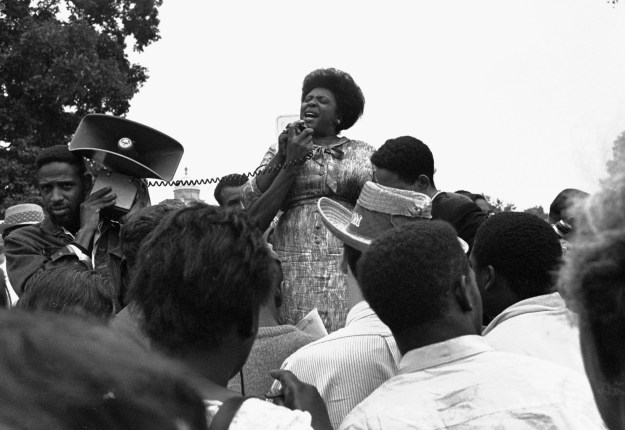
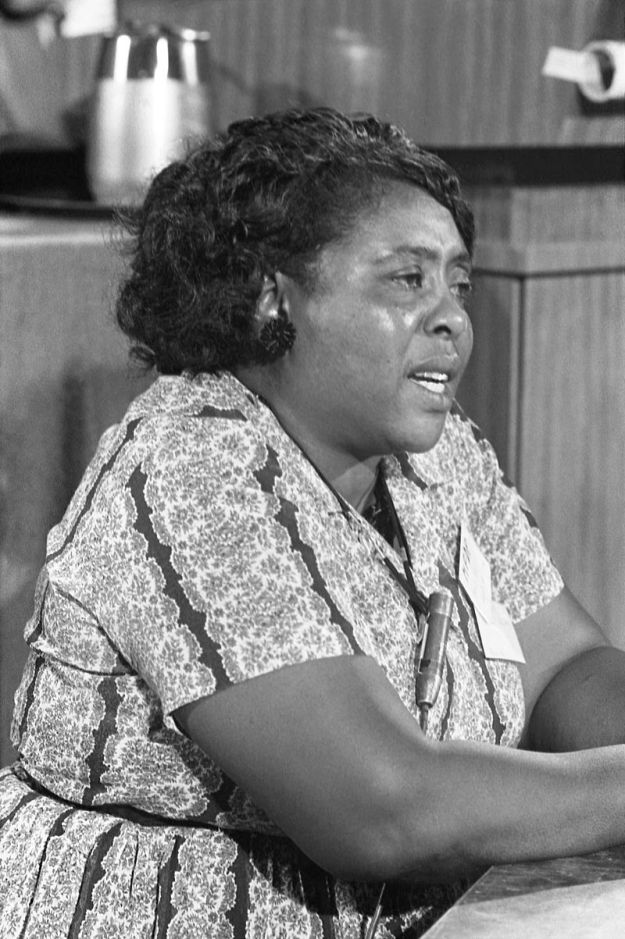
FILE – In this Sept. 17, 1965 file photo, Fannie Lou Hamer, of Ruleville, Miss., speaks to Mississippi Freedom Democratic Party sympathizers outside the Capitol in Washington after the House of Representatives rejected a challenger to the 1964 election of five Mississippi representatives. (AP Photo/William J. Smith, File)
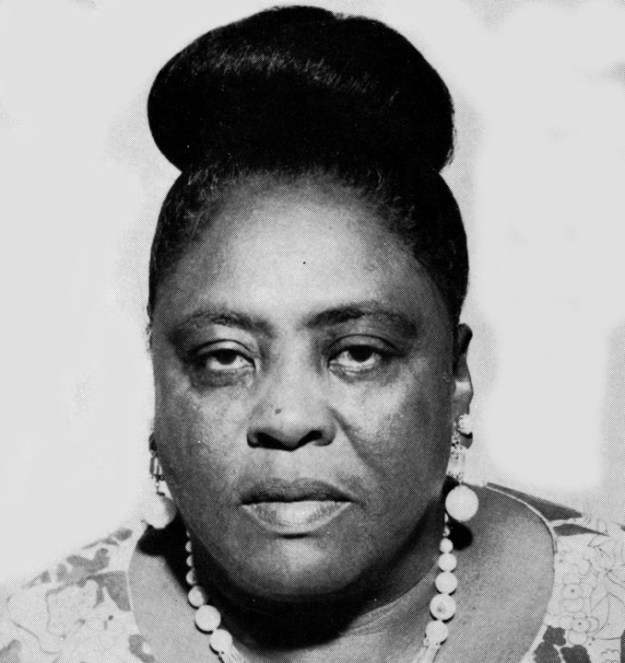
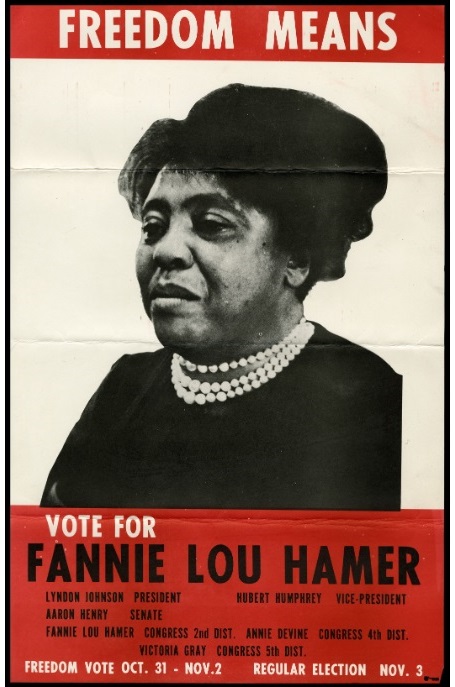
February is black history month in the U.S., and I recently learned about Fannie Lou Hamer, an inspiring and heroic woman who fought for civil rights, women’s rights, class rights, and overall human rights. What caught my attention was that her courageous fight against oppression was motivated by a spiritual awakening that she had at the age of 44.
During her lifetime, Hamer was extorted, threatened, harassed, shot at, and assaulted by racists, including members of the police, while trying to register for and exercise her right to vote. She later helped and encouraged thousands of African-Americans in Mississippi to become registered voters and helped hundreds of poverty-strickened people through her work in programs like the Freedom Farm Cooperative.
Hamer (1917-1977) was the last of 20 children born to a sharecroppers in Mississippi. Tricked into picking cotton when she was only six, the owner of the plantation promised her snacks and sweets that her family could not afford from his store. She only attended school until the 6th grade, having to return to the fields to help support her aging parents. By age 13, she would pick 200–300 pounds (90 to 140 kg) of cotton daily while living with polio.
In 1944, she married Perry Hamer and the couple toiled on a Mississippi plantation. Because Hamer was the only worker who could read and write, she also served as plantation timekeeper. The Hamers wanted to have children, but in 1961, Fanny Lou received a hysterectomy by a white doctor without her consent while undergoing surgery to remove a uterine tumor. The Hamers later adopted two daughters.
In the summer of 1964, Hamer attended a meeting led by civil rights activists in the Student Non-Violent Coordinating Committee (SNCC) and Southern Christian Leadership Conference (SCLC). It was the first time she learned that black people had the right to vote. Hamer’s biographer, Dr. Keisha N. Blain says that, at that moment, Hamer found her calling. Blain explains:
“It was certainly a political awakening for Hamer, but it also was a spiritual awakening.
“She felt that it was God’s plan for her to become an activist and take a leading role in the expansion of black political rights.
“The one reason that she never gave up despite all she had to struggle through was that she really believed that ‘God was on her side.’ She truly believed that it was not so much a political mission, but a spiritual one. She saw herself ‘speaking light into a world of darkness’.”
Once the owner of the farm where she worked learned that she had tried to register to vote (which was initially denied because of a trumped up ‘literacy test’), she was immediately fired. Despite having to move house, loose most of her possessions, and ultimately flee for her life, Hamer was free to pursue her calling. Reflecting later, she said “They kicked me off the plantation, they set me free. It’s the best thing that could happen. Now I can work for my people.”
Hamer is perhaps most famous for her speech at the 1964 Democratic Convention during which she described her brutal beating in a Mississippi jail during her struggle to register to vote. President Lyndon Johnson was so frightened by the power of her message that he called an impromptu televised press conference so she would not get any television airtime. But her speech was later aired and inevitably moved even Johnson and many others to help pass the 1964 Voting Rights Act.
Hamer speaking at the 1964 Democratic National Convention in Atlantic City, N.J.
During Hamer’s time as an activist, she traveled extensively, giving powerful speeches on behalf of civil rights. Woven into her speeches was a deep level of confidence, biblical knowledge, and even comedy. One of her famous lines, that appears on her tombstone, is “I’m sick and tired of being sick and tired.” She often inspired other activists with her singing of spiritual Gospel songs during times of great stress and even terror.
In 1964, Hamer was one of the 11 SNCC delegates (including John Lewis and Harry Belefonte) who visited Ghana. The visit was revolutionary for her, for she saw for the first time black people in charge of their own destiny, including holding positions of political power. (Hamer would run for both for the U.S. Senate in 1964 and the Mississippi State Senate in 1971.) After a three-hour interview with the Diallo Alpha, Director General of the Ministry for Information and Tourism, Hamer received a musical instrument only found in Africa.
In the end, Hamer grew frustrated with politics. She said she was “tired of all this beating” and “there’s so much hate. Only God has kept the Negro sane”. A great cook and knowledgeable about growing crops and raising animals, in 1968, she returned to her hometown of Ruleville, Mississippi, and began a “pig bank” to provide free pigs for black farmers to breed, raise, and slaughter. A year later she launched the Freedom Farm Cooperative, buying up land that blacks could own and farm collectively. With the assistance of donors, she purchased 640 acres and launched a coop store, boutique, and sewing enterprise. She single-handedly ensured that 200 units of low-income housing were built—many still exist in Ruleville today.
Hamer may be remembered best as a civil rights activist, but she was foremost a spiritual warrior. Her faith and calling is what sustained her. Hamer was convinced that God was working through the civil rights movement to usher in the Kingdom of God. Her favorite Bible passage was from the Gospel of Luke 4:18:
The Spirit of the Lord is upon me, he as sent me to heal the brokenhearted, to preach deliverance to the captive, and recover the sight to the blind, to set at liberty to them who are bruised, to preach the acceptable year of the Lord.
In the end, Hamer died of breast cancer after suffering for many years with various physical illinesses, some sustained from her beatings. May God rest her soul.
May God grant us all the her spiritual strength to preserver in whatever area of activism we are called upon to passionately undertake.




 Love and Will