Author Archives: Catherine Ann Lombard

Don’t Count Your Success!

Actor George Clooney and Amal Alamuddin found true love and married in Venice.

How does it make you feel? Actor George Clooney and Amal Alamuddin’s wedding in Venice.

Everyday, we hear about successful people – people who are more beautiful, richer, and happier than ourselves. Our hearts might give a slight squeeze when we compare our lives to theirs. We never seem good enough … But wait! Next to these people full of unattainable wealth, beauty, and happiness are the fallen ones. The once successful people who have ended up divorcing, in trouble with substance abuse or alcohol, or worse, committing suicide. We might experience a slight sigh of relief. After all, we are much better off than them.

We often count numbers, especially when it comes to measuring success. We count the money in our bank account, and assume the larger the number the larger our success. We count the size of our car, boobs, house – the bigger, the better. For our spiritual lives, we count how many times we do yoga a week, how often we pray everyday or go to church every week, or how many minutes we meditate. The more, the better. We count how many friends we have on Facebook, followers on Twitter and Likes on our blog. The more, the better!

Where did all this counting come from? Today, blind faith in science has become the dogma of our modern Western society, along with its methodology. Empirical evidence, that is numbers, are unquestioned as truth, because numbers can be quantitatively counted, compared, and placed on a graph. This ideology has also filtered into our society as a way as measuring who we are as persons. But this kind of counting is sterile and leaves us always wanting more. Counting success in this way depletes all creative energy. We are left feeling exhausted and alienated and far from recognizing the process of living as full human beings.

Continue reading

Celebrating and Redeeming Flesh

baby with muscles

I am writing on a warm morning in early autumn. The oak branches are full and alive, corn fields lean with their ripeness, and rabbits graze in the filtered light. As the days grow shorter, I am trying to embrace autumn (and then the long winter) that will soon descend on Northern Europe. To do this, I have been collecting the yellow birch leaves that strew my path, acorns fallen from the night winds, and chestnuts that are still encased in their prickly green shells.

To fully participate in the beauty we find in nature, perhaps we need to start with appreciating our own living nature, beginning with our bodies. Autumn is autumn with all the decline and loss it might evoke, and all its shimmering colors, low filtered sunlight, and the fervent calling of wild geese overhead. This is true of who we are as well. We are who we are … wondrous and onerous, fragile and strong, light and dark.

This time of year also seems to be mirroring my own aging process. Lately, I have experienced a number of what I call OPTs (Old Person Things). I leave the kitchen, walk down the steps into the cellar, and stand bemused as I try to remember what I came down for. I take my wallet out of my purse and put it back without removing the bills that I need. I search for glasses, shoes, jackets and even credit cards that are sitting right in front of me. I watch (horrified at times) as my cognitive skills slow to a near standstill, yet at the same time I can feel myself grow more open, grounded, and at peace.

Take a moment now to wonder about your own body — to find your body wonderful! Your body contains a hundred times more cells than there are stars in the galaxy. Everyday, your heart, on average, does the daily work of lifting 1000 kilos from the ground up to the top of a five-story building. We have 656 muscles throughout the body. Our senses of sight, hearing, smell, touch, breathing, thinking, and speech bring us powerful revelations and gifts.

Continue reading

Soul Harvest – Part 1

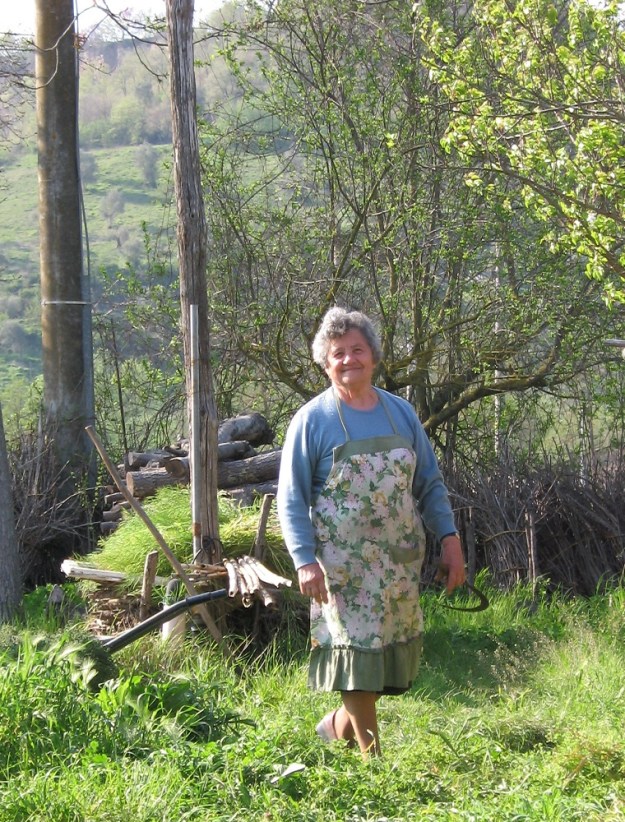
Signora Giuseppa in her Garden

Signora Giuseppa in her garden north of Rome.

It took me a long time and a good deal of sweat to understand it — just how much our Earth is a sanctuary for our souls. And this awareness evolved only thanks to Signora Giuseppa. Having worked the land for more than seventy years, Giuseppa quietly and wisely guided me towards this realization while we walked around her fields or campetto. Through her simple and daily vigil of being with, caring for, and depending upon the Earth, she initiated me into the profound experience of gardening and growing what one eats. For it is through this deeply experiential reality that we are best able to integrate the sacredness of the Earth with our own humanity.

Signora Giuseppa is a round but sturdy widow whose hands are small, yet broad and strong. Whenever she stands before you, her feet are firmly planted and her eyes steady upon you. She is eighty-two years old and one of the few people I have ever met that is really present to all that is around her. Every afternoon you can find her tending her two-acre campetto in the Italian countryside north of Rome. Since she was five years old, she has lived all her life (literally) off the fruits of her labor. From olive oil to fava beans to wine grapes and, of course, tomatoes, her harvest is as varied as it is delicious.

Whenever I visit, she chatters away in her Italian dialect as she heads out to feed her chickens with a bucket of soggy bread and milled corn in hand and an assortment of half-wild cats underfoot. She knows I don’t always understand, but what she seems to find more important is our time together. It is always a pleasure to visit her and see what she is sowing, planting, harvesting, gathering, drying, and feeding her chickens.

Only educated to the third grade (and only thanks to Mussolini insisting that all Italian children learn to read and write), Giuseppa has managed to integrate life’s lessons. For some time now, I have declared her farm “The University of Gardening” and she la professoressa. Whenever I say this in front of the many visitors and relatives that often drop by, Giuseppa beams proudly and quickly adds, “I was never much educated, but I do have some esperienza.”

It wasn’t until I too had this esperienza of hoeing, planting, composting, weeding, watering, and finally reaping the harvest of my own garden did I come to understand how holy the Earth really is. My education evolved mostly from my following Giuseppa around her campetto and simply watching. She used to tease me by telling everyone that I liked to come by and steal her secrets. Yet, while she showed me how far apart to plant tomatoes, when to harvest the garlic, and how to recognize a cauliflower that wouldn’t produce fruit, Giuseppa was also teaching me how to relate to the land, how to observe, care, tend, and support its needs, how to appreciate its bounty, receive its gifts, and surrender that which doesn’t survive.

Oh sure, I had been ecologically aware for years—bicycling to work, recycling my plastics, picking up tossed garbage left along the roadside, hanging up wash instead of using a dryer, and buying a fuel-efficient car. All these small conscious acts of conservation are vital to the planet’s ultimate survival. But until one actually works the Earth, one cannot appreciate the lessons it holds, nor how fundamentally attached we are to it, nor how much working on the land can actually help us to become fully human. As Gandhi once said, “To forget how to dig the earth and tend the soil is to forget ourselves.”

Note: This story was written while I was still living in Italy in 2007. It is the first part of a three part series to be continued next time…

Go to Soul Harvest – Part 2