There is talk of a ceasefire, humanitarian pause, resolutions, and emergency joint summits. But Peace? Where is the Peace?
I have been searching for peace for a long time. Both inside and out. Longing for peace, I sometimes to go to Assisi, also known as the City of Peace (near my home), just to ring the Peace Bell.
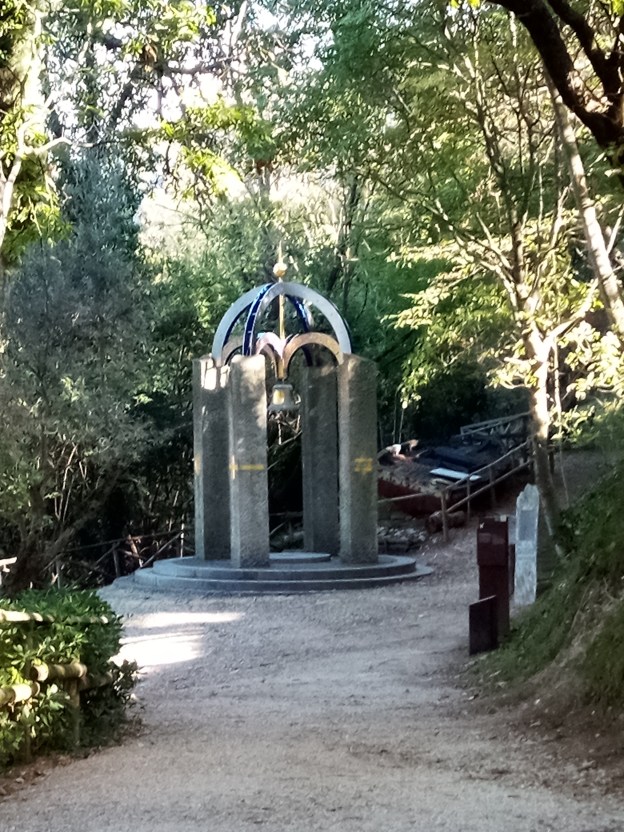
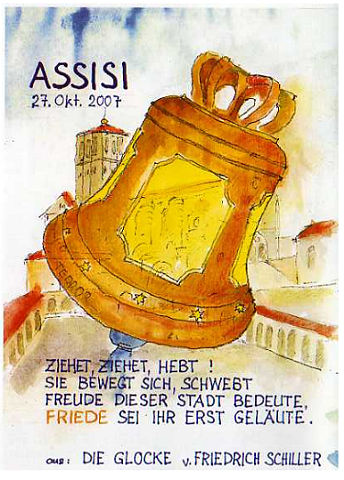
Not far from the Basilica of San Francesco, the Peace Bell is outside of the old walls of the city in the nearby woods. The bell is held aloft by four granite columns, each representing a different religion: Christianity, Judaism, Islam, and Buddhism. Designed by German artist Gerhard Kadletz, the bell is named Regina Pacis (Queen of Peace) and it unites the four religions to announce peace with one voice.
Inaugurated in 2007, the Peace Bell’s official song is “Numquam. Renascantum. Uis. Bellum. Terror.” (Never again violence. Never again war. Never again terror.) This declaration is inscribed on the lower edge of the bell along with the signatures of four religious leaders: Cardinal Ratzinger who later became Pope Benedict XVI; His Holiness the 14th Dalai Lama; Ali Gomaa, the Gran Mufti of Egypt; and Chief Rabbi of Israel, Jona Metzger.
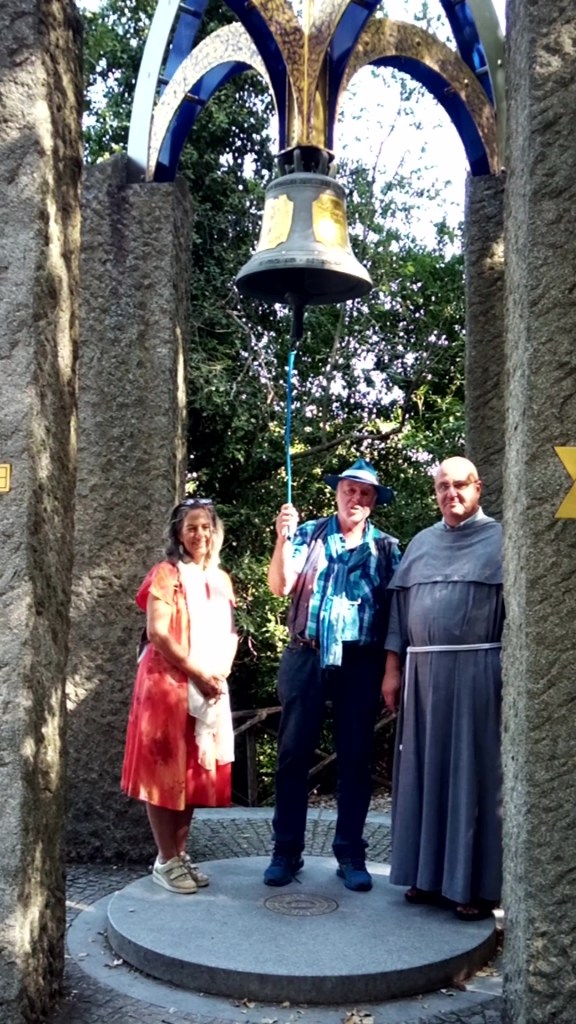
The Author rings the bell with artist Gerhard Kadletz and Brother Thomas.
When rung, the sweet message of the Peace Bell resounds across the town and out into the world.
This Peace Bell should be ringing 24/7!
Unbind our Hearts to Ring Out Peace
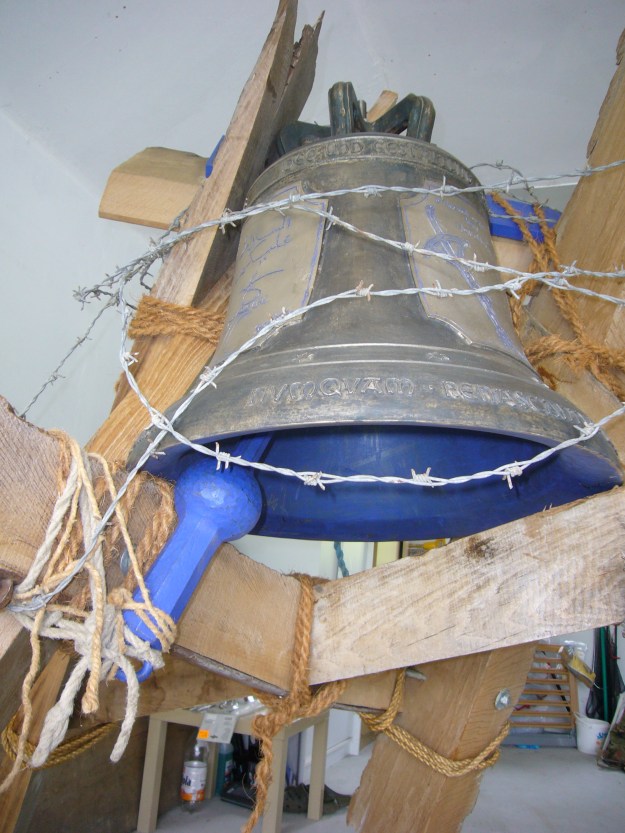
Gerhard Kadletz, the artist who created the Peace Bell, recently completed another work, entitled Wo ist der Frieden? (Where is the Peace?).
Mr. Kadletz’s new bell is an exact replica of the Peace Bell in Assisi. However, he has deliberately silenced his new bell. This bell is tightly wound with barbed wire from the Ganacker concentration camp in Germany. The bell itself precariously hangs on a 10,000-year-old bog oak that is partially charred. And the clapper is tightly tied with rope so the bell can not be rung.
May this work of art remind us of our responsibility to radiate and be disciples of peace. Peace doesn’t just happen. It requires us to engage with it, to be in relationship with it. Just as we have to pull the cord to ring the Peace Bell, so must we pull the cords of our broken heartstrings and work towards peace within. We must unwrap the barbed wire entwined around the our inner Peace Bell and unbind the rope that holds fast our clapper from connecting with the bell.
Angels are Waiting to Help Us
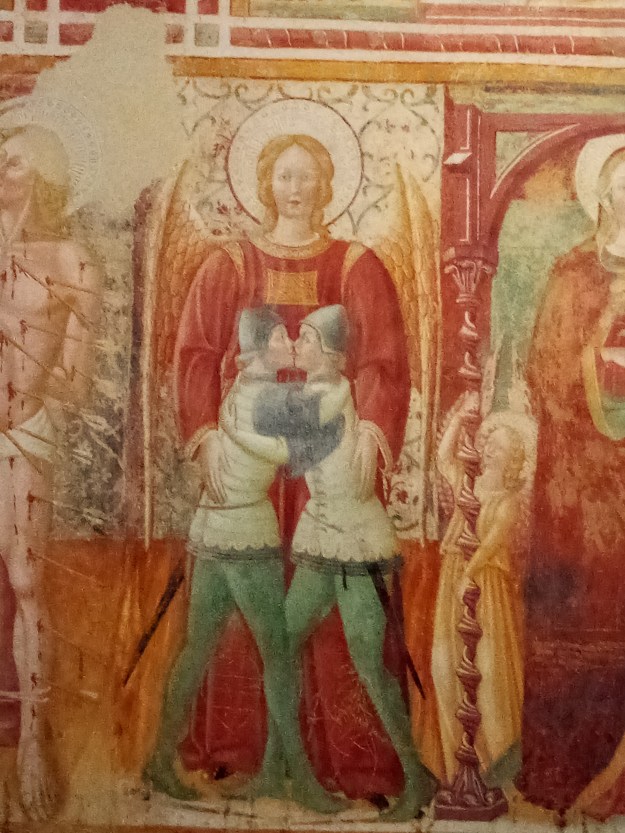
We can call on the multitude of angels around to help us. They are often hanging about, just waiting for us to ask for their assistance. In a Umbrian sanctuary near my home is a beautiful 15th-century fresco of the Archangel Saint Michael. He is the only angel mentioned by name in the Torah (Judaism), Bible (Christianity), and Qur’an (Islam). In all of three faiths, believers consider Michael an angel who fights evil with the power of good. Hence he is often depicted with a sword. During the time this sanctuary was built, the Archangel Saint Michael would have been seen as a protector of soldiers, as the angel that accompanies their souls to heaven, and as a healer. In fact, the sanctuary is built near a spring and its waters are said to have therapeutic properties.
In this fresco, we see the Archangel Saint Michael with his wings over two armed soldiers. The Archangel unites them in a gentle embrace, as they, in turn, embrace and kiss each other in reconciliation. It is said that centuries ago, one day a year, nearby warring factions would come to this sanctuary to reconcile their differences.
Let us Arrive at a Fruitful, Dynamic and Constructive Peace
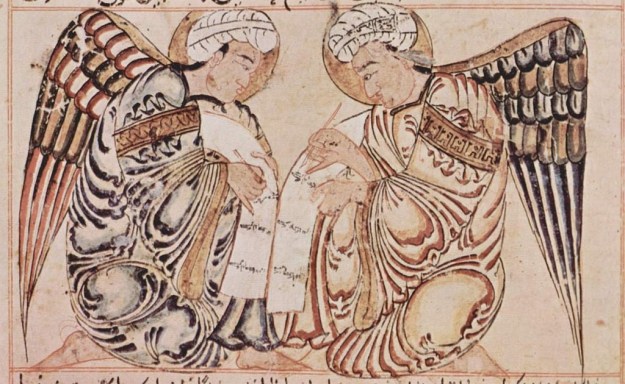
Two Islamic angels write in the Book of Life, suggesting angels’ ongoing and attentive interest in human affairs (1280 A.D., Iraq)
“The Angel of Peace wraps the whole world in its big white wings…
“Some people may be helped along by the image of a big Angel, with white wings, which emanates streams of peace, spreading waves of Peace throughout ourselves, our country, the whole Earth, the human race.
“Real Peace is a peak to climb, an ideal to conquer, a point of arrival.
“True Peace has to remain steadfast before evil, in times of pain, during emotional reactions, in the midst of any kind of assault, in the face of any loss, defeat or separation.
“True Peace coexists with inner personal suffering. It is not a mood of joyfulness and delight; it produces a double life inside ourselves, till the moment when our personality appears completely regenerated, so that the inner Peace will become incarnated and the whole being permeated through PEACE, transformed into PEACE.”
Yoko Ono displayed her message “Imagine Peace” in London, Berlin, Los Angeles, Melbourne, Milan, New York and Seoul (2022).
To celebrate World Psychosynthesis Day, I thought I would share a document that I found a few years ago while working in Assagioli’s archives. It is a review by Lama Anagarika Govinda (1898-1985) of Roberto Assagioli’s book The Act of Will. Govinda’s review starts out with this very powerful statement, which can apply today as much as it did more than 50 years ago:
The world is said to be in the grip of a “power crisis”, but few people realize that this is true in a much deeper sense than that of a mere economic problem. Power has become a human obsession and a self-destructive principle. At the same time it has resulted in a psychological revolt against the very root of power, namely the intellect and the human will, which have led to the domination and misuse of the forces of nature and may result in the gradual destruction of our planet’s ecology and the human race.
Lama Anagarika Govinda
About the Document
On the top margin of the first page of this typewritten review you can see a handwritten note by Lama Govinda to Assagioli: “With kindest regards and best wishes! Lama Govinda”
On the bottom margin of the last page, there is the following handwritten note:
“Copy sent to the Editor Psychosynthesis Journal, San Francisco”
Then in Italian:
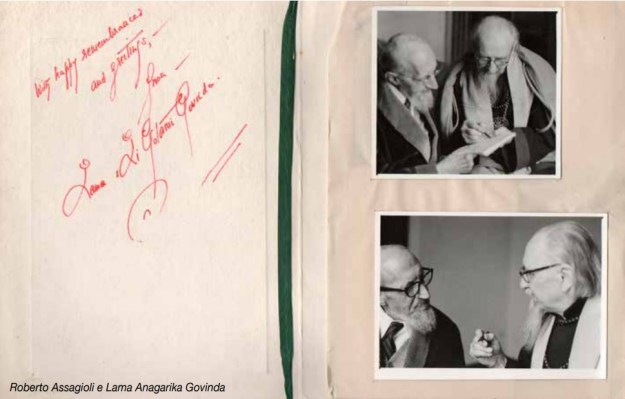
Spero che Lei ha ricevuto le fotografie che mia moglie ha fatto durante il nostro soggiorno Castiglioncello. LG. (I hope you received the photographs that my wife took during our stay Castiglioncello. LG)
Govinda and Assagioli’s Meeting
In his autobiography, Piero Ferrucci writes about the two men’s meeting which took place in Castiglioncello, Tuscany, in August 1972. Here is a brief excerpt:
“At one time Assagioli achieved a degree of fame overseas, far more than in Italy, and various people came to meet him. Lama Govinda came while Assagioli was spending a few days at Castiglioncello on the Tirrenian coast. Lama Govinda had written books on Tibetan Buddhism, and had made available to the public its forgotten teachings. Assagioli and Lama Govinda were puny, frail old men with white beards and an air of wisdom about them.
“His meeting with Assagioli was a great piece of theatre. Lama Govinda was slowly climbing a staircase with friends, Assagioli was waiting at the top and began going down the stairs to meet him. He had asked me: “Should I greet him the Oriental way, with hands clasped, or the Western way, with a handshake?” A fair question, seeing as Lama Govinda was actually a German scholar transplanted in the East. I said he should greet him with hands clasped. When the meeting took place, Assagioli gave him the Oriental greeting, but Lama Govinda extended his hand. So Assagioli started to give him his hand, but meanwhile Lama Govinda had decided to greet with hands clasped. It looked like a strange ritual: East meets West.
“The conversation began and Lama Govinda pointed out that the concept of will in psychosynthesis was similar to that of the Buddhist virya, inner strength. After a while the two asked to be left alone… Sometime later the two of them came back looking radiant and resembling each other even more.”
Piero Ferrucci
Above are two photos of the two “puny, frail men with white beards.” I am not certain, but perhaps these photos are the ones mentioned by Lama Govinda. You can see the note written by him: “With happy remembrances and greetings – from – Lama and Li Gotami Govinda. Li Gotami Govinda (1906-1988) was his wife. More about her below.
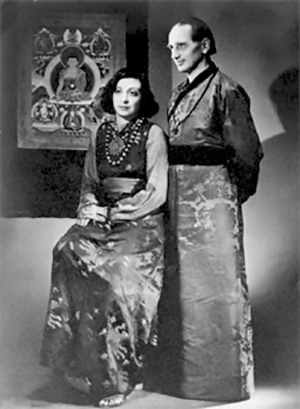
Lama Govinda and Li Gotami Govinda
The Govindas in 1947 at one of their four wedding ceremonies.
One life event that Govinda and Assagioli shared was during World War II. While Assagioli spent one month in prison, followed by his time under house arrest and then more than a year in hiding, Govinda spent three years in a British internment camp at Dehra Dun, India.
Govinda and his wife Li Gotami were married after the war in 1947 and soon afterwards undertook research expeditions to Tibet, making a large number of drawings and photographs of Buddhist art and architecture. Govinda described these expeditions in his popular book The Way of the White Clouds and Li Gotami’s photographs appear in her book Tibet in Pictures.
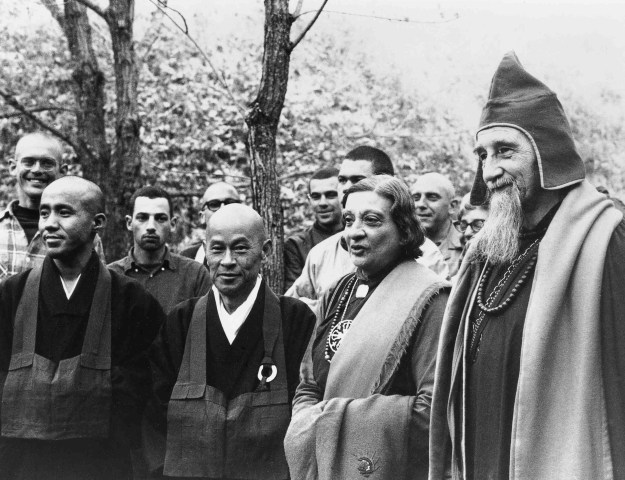
Perhaps what delighted me most while preparing this short reflection was Govinda’s connection to Rabindranath Tagore. Govinda taught at Rabindranath Tagore’s Vishva-Bharati University in Shantiniketan and that is where he met his wife. Li Gotami Govinda was Parsi, born in Bombay, and a famous photographer and painter in India. At the time she was studying at the university. Their encounter took place when she was making her way to the hostel where Lama Govinda was staying, as described below:
“A door opened and out strolled this handsome, smiling foreigner dressed in the burgundy robes of a monk. She recalled asking herself who this “bright merry person” might be, and in retrospect (at least on her part) remembered the incident as very romantic.”
Suzuki Roshi, Li Gotami, and Lama Govinda.
Lama Govinda’s Review of The Act of Will
Unfortunately, this review by Govinda was never published by the Psychosynthesis Journal. However, a slightly edited version was published posthumously in The Lost Teachings of Lama Govinda: Living Wisdom from a Modern Tibetan Master, edited by Richard Power, foreword by Lama Surya Das. Quest Books, 2007.
What I found most interesting are Govinda’s definitions of the Transpersonal Will and Universal Will.
“Transpersonal Will (which is the urge to find a meaning in life, the urge towards highest realization [Sanskrit: Dharma-chanda]) and the Universal Will (in which the human will is in perfect harmony with the universal law [Dharma]).”
Today is Assagioli’s birthday (he would have been 135 years young today). So why not buy yourself an Assagioli birthday gift — one or both of his newly published books!
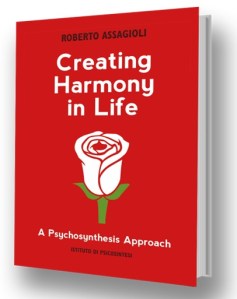
I’m particularly happy to have been part of these two publications. Creating Harmony in Life: A Psychosynthesis Approach is a collection of Assagioli’s lectures from the 1930s and 1960s, published for the first time in English. I had the privilege of introducing, translating and annotating this book.
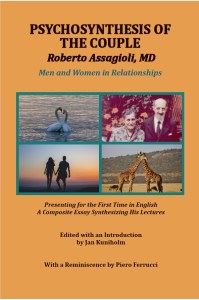
Psychosynthesis of the Couple is collection of lectures that Assagioli gave on the topic (mostly in Italian). Jan Kuniholm has synthesized these lectures into a highly readable composite essay. I was also able to contribute to the translations from the Italian.
Creating Harmony in Life: A Psychosynthesis Approach
Published by the Istituto di Psicosintesi, Florence Available from Amazon ISBN 979-12-21402-74-2
Originally published in Italian in 1966 as Psicosintesi: Per l’armonia della vita, this book provides a fundamental overview of psychosynthesis by bringing together the early lectures of Roberto Assagioli. These lectures explore what psychosynthesis is and how it can be applied towards the practice of personal and spiritual self-development.
A great book for anyone new to psychosynthesis, Creating Harmony in Life is also a treasure trove for experienced psychosynthesis practitioners, with Assagioli’s nuggets of wisdom waiting to be discovered, contemplated, and put into practice.
Jan Kuniholm presents this book, Psychosynthesis of the Couple a synthetic essay that gathers the teachings of Roberto Assagioli, MD, concerning marriage, couples, relationships, and “inter-individual” psychosynthesis, many of which have been translated to English for the first time. The title is edited with notes and an introductory essay by Jan Kuniholm, with a reminiscence by Piero Ferrucci.
Of particular interest are the many diagrams that Assagioli drew to symbolically represent his concepts regarding, for example, communication between couples, stages of union, and various types of man-woman relationships.
ψς of the Couple/ Mutual Integration/Self-realization / through the other/ The Couple as an Entity (Note by Assagioli)



 Love and Will