I am thrilled and honored to have a personal essay included in the recent publication of Coordinates, a digital multi-media magazine jointly published by World BEYOND War and The Sahira Collective. This beautiful magazine is full of powerful poems, artwork and essays by writers and artists from around the world, each reflecting on the notion of home and how it can become mangled and transformed, both physically and emotionally, during and after violent conflict.
My story entitled “A Glassful of Peace” describes my disorientation and loss of American identity soon after 911, my return to Egypt afterwards where I and my husband were living at the time, and our celebration of the Iftar feast with Mr. Mohammed and his family during Ramadan.
War not only unsettles, uproots, and even destroys the places we once called home. War can also bring our identity into crisis and upheaval. Coordinates is full of poignant and heartfelt stories and works of art that ask and attempt to answer difficult, yet very human, questions: What are our coordinates when home is violently torn away from us? And how do we redraw our place of being, peace, and safety in the aftermath?
I am thrilled to have my essay “Hoe to Harvest: Connecting Soil, Soul and Society” be selected as a one of the winners of the WATER Essay Contest. The task was to write a 650-word essay on a topic related to feminist work for social change that springs from spiritual commitments. The contest was in honor of Rosemary Ganley, a Peterborough, Ontario feminist activist and writer whose weekly columns in The Peterborough Examiner reach a wide audience.
I hope you enjoy reading my essay below and perhaps be inspired to plant a few spring seeds!
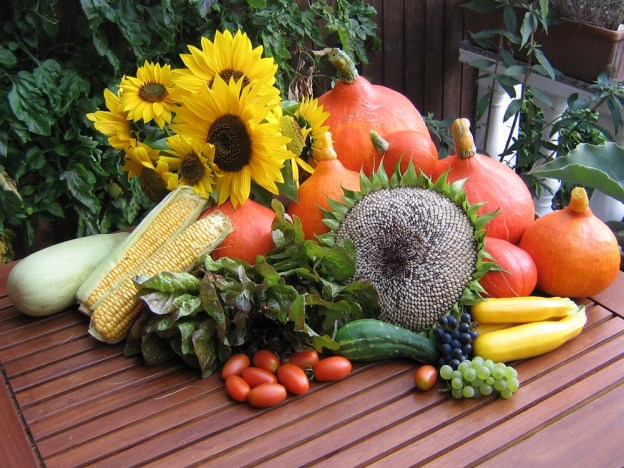
Catherine in her garden in Germany in 2014. These sunflowers planted themselves!
Hoe to Harvest: Connecting Soil, Soul and Society
It took me a long time and a good deal of sweat to understand it — just how much growing food extends beyond the garden. Not only does a garden feed us, but it also forms us – as persons and as a community. My husband and I have been growing much of what we eat for the past twenty-five years. We started out with a small plot and a few lettuce and tomato plants, but we now have enough land to keep us busy and well-fed.
Once you work in tandem with the soil and seasons, you learn to appreciate the spiritual lessons they hold. How fundamentally attached we are to this place called Earth. How much working the land can actually help us to become fully human. As Gandhi once said, “To forget how to dig the earth and tend the soil is to forget ourselves.”
While a garden provides us with fruits and vegetables, it also acts as a mirror for the soul. As we interact with hoe, shovel and watering can upon our Earth, the Earth is ready to teach us about ourselves.
There are days when I find myself tearing at weeds, only moments later to feel the fierce roots of long-buried anger and resentment clinging to my heart. Other days I am filled with joy, longing to spill seeds upon every patch of bare soil. By gardening we create a place where our inner and outer worlds can meet. And in this space, with time and nourishment, we are encouraged to move closer to ourselves and each other.
My neighbor once explained why gardening was the humblest of tasks. “Your head is always bowed and sometimes you have to go down on your knees.” Growing food is also a revolutionary act. Physically, the small farmer spends time hoeing, seeding, planting, composting, weeding, watering, and finally harvesting – not only produce, but also the seeds for next year’s crop. Meanwhile, spiritually the farmer is creating a new way of being. As Vandana Shiva said, “The power to feed ourselves is the power to free ourselves.”
Gardening also brings us in communion with our Earth and the universe. From the millions of microorganisms alive in the soil to the moon’s phases telling us what to plant and when. The German mystic and saint Hildegard von Bingen wrote: “Humankind is called to co-create. With nature’s help, humankind can set into creation all that is necessary and life-sustaining.” What better way to co-create alongside Nature’s diversity than to bite down on a cherry tomato or munch snap green peas grown with our own two hands?
Sharing a bountiful harvest is also a way to shift the economic paradigm from exploiting the Earth to sharing her abundance. Many times I have given away (and received in return) crates of plump tomatoes, fava beans, juicy apples and plums. Sharing harvested food cultivates friendship, gratitude, and peace.
Even without much land to sow, everyone can find a way to grow something to eat. Try planting herbs in flowerpots on the windowsill or grace your terrace or balcony with larger pots full of salads, beans, and tomatoes. Otherwise, commit to buy produce from local farmers, contribute time or energy to community gardens, or plant some perennial flowers (preferably edible!) somewhere … anywhere in your neighborhood.
Recently I planted a seed-thought that has bared fruit. At the charity where I volunteer, I suggested that we start growing food in the small plot next to where we distribute food and clothes. Together with a local cooperative that grows biological grains and legumes, charity volunteers and recipients have planted fruit trees this autumn and tilled the soil for spring planting.
The lessons gardening offers are simple. Every seed we plant holds a fruitful past and a tender promise. All we give to the soil feeds our future. And the small farmer is a humble, radical peacemaker.
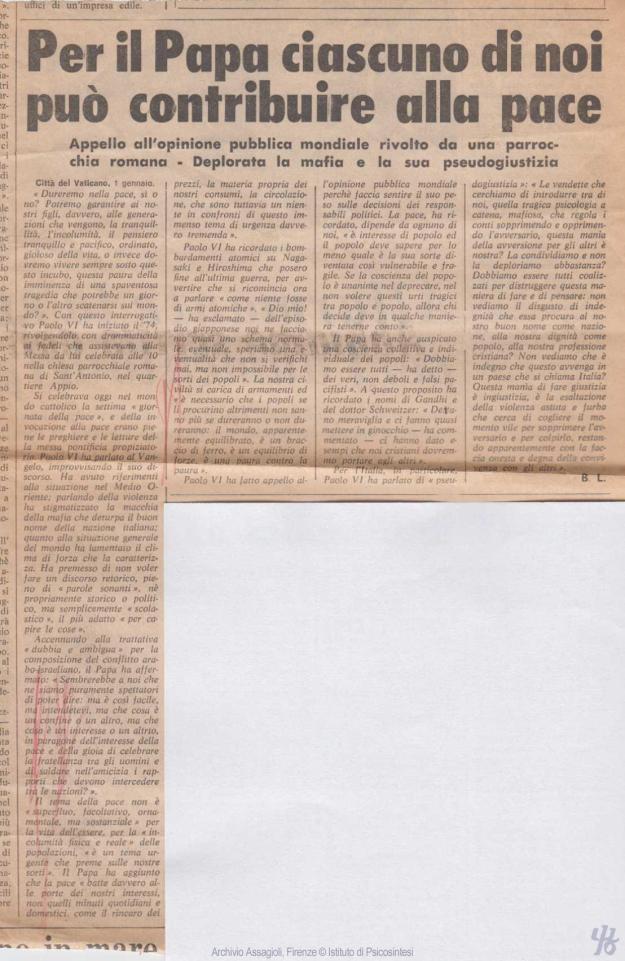
While poking around Assagioli’s online archives, searching for the words “peace” and “pace”, I came across an Italian newspaper clipping published precisely fifty years ago on New Years Day. The year was 1974, and this would be the last New Years Day Assagioli would experience as he would die on 23 August that same year at the age of 86.
The article has the headline “Per il Papa ciascuno di noi può contribuire alla pace” (According to the Pope, each of us can contribute to peace) and the text feels especially poignant given all that is happening in the world today. I can just imagine Assagioli in his study, reading through the newspaper and clipping out this article. You can see the paragraphs he marked with a red pencil held in a shaky hand.
Newspaper article dated New Year’s Day 1974 from Assagioli’s Archives
The article reiterates what Pope Paolo VI had to say on the Seventh World Day of Peace celebrated by the Catholic Church. Eerily, the first conflict that the Pope refers to fifty years ago was occurring in the Middle East. He then condemns the mafia and laments the general use of force throughout the world.
If we zoom in on what Assagioli considered worth noting, we see that he has marked what the Pope said about the conflict between the Palestinians and Israelis.
“It might seem to those of us, who are merely spectators, that we can simply say: ‘But it’s so easy…why not just try to understand each other? What does one border mean as opposed to another? What is the value of one thing as opposed to another when compared to the value of peace and of the joy of celebrating brotherhood among mankind and of welding in friendship the relations that need to be forged between nations?’
“The theme of peace is not superfluous, optional, or ornamental, but essential to the life of every person and to their physical and actual safety. Peace is an urgent theme weighing on our destinies.”
We know that Assagioli sought peace – inner and outer – all his life, even to the point of spending four weeks as a prisoner in Regina Coeli jail, in the heart of Rome. On one August night in 1940, he was arrested at his home outside of Florence, handcuffed, placed on a night train for Rome, interrogated, stripped searched, fingerprinted and sentenced indefinitely for “praying for peace and other international crimes.” Once released, he was placed under house arrest and was constantly under surveillance by the fascist government.
Domed ceiling of the entrance to Regina Coeli Prison (photo by Pietro Snider)
It appears that even in his old age – frail, ill of health, and nearly deaf – Assagioli was still praying for peace. The second section that Assagioli marked was Paolo IV’s thoughts on the atomic bombs dropped on Nagasaki and Hiroshima in 1945. The Pope spoke of the nonchalant acceptance of these horrendous acts that occurred thirty years before. He lamented that people were beginning to talk about atomic weapons “as if they were nothing.”
“My God!” the Pope exclaimed. “We’ve almost turned the Japanese episode into a normal occurrence, hopefully an occurrence that will never come to pass, yet one that is not impossible for the people’s fate.”
The article goes onto say:
Our civilization is laden with weapons and “it is necessary for people to procure them otherwise they no longer know whether they will survive or not. The seemingly balanced world is in a tug of war, a balancing of forces. It is fear against fear.”
Let us begin 2024 as Assagioli did fifty years ago during the last year of his life. Let us begin by finding the best way that we too can diminish the fear and contribute to peace – whether through prayer or action, inner spiritual awareness or outer acts of will… Let us demonstrate through our words, thoughts, and lives any and all signs of peace.
As you can see, we haven’t gotten very far in fifty years… As Pope Paolo VI said, “We all need to be true – not false or weak – pacifists. True pacifists like Gandhi and Dr. Albert Schweitzer.” Let’s start 2024 by identifying our ideal model of Peace (There are so many!) and seeking their guidance in the New Year.
For further reading, see Assagioli’s article below.



 Love and Will