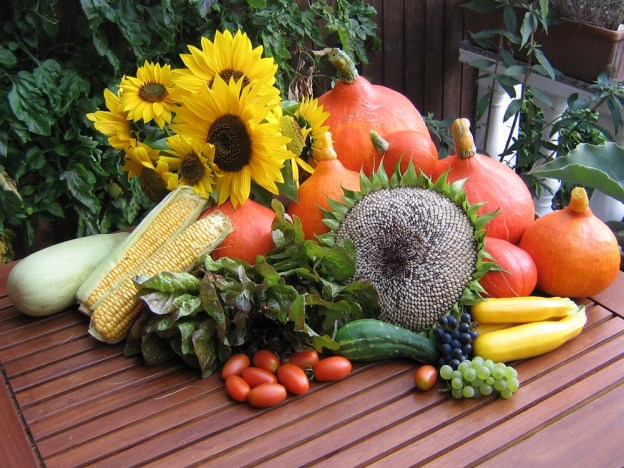
I am thrilled to have my essay “Hoe to Harvest: Connecting Soil, Soul and Society” be selected as a one of the winners of the WATER Essay Contest. The task was to write a 650-word essay on a topic related to feminist work for social change that springs from spiritual commitments. The contest was in honor of Rosemary Ganley, a Peterborough, Ontario feminist activist and writer whose weekly columns in The Peterborough Examiner reach a wide audience.
I hope you enjoy reading my essay below and perhaps be inspired to plant a few spring seeds!

Hoe to Harvest: Connecting Soil, Soul and Society
It took me a long time and a good deal of sweat to understand it — just how much growing food extends beyond the garden. Not only does a garden feed us, but it also forms us – as persons and as a community. My husband and I have been growing much of what we eat for the past twenty-five years. We started out with a small plot and a few lettuce and tomato plants, but we now have enough land to keep us busy and well-fed.
Once you work in tandem with the soil and seasons, you learn to appreciate the spiritual lessons they hold. How fundamentally attached we are to this place called Earth. How much working the land can actually help us to become fully human. As Gandhi once said, “To forget how to dig the earth and tend the soil is to forget ourselves.”
While a garden provides us with fruits and vegetables, it also acts as a mirror for the soul. As we interact with hoe, shovel and watering can upon our Earth, the Earth is ready to teach us about ourselves.
There are days when I find myself tearing at weeds, only moments later to feel the fierce roots of long-buried anger and resentment clinging to my heart. Other days I am filled with joy, longing to spill seeds upon every patch of bare soil. By gardening we create a place where our inner and outer worlds can meet. And in this space, with time and nourishment, we are encouraged to move closer to ourselves and each other.
My neighbor once explained why gardening was the humblest of tasks. “Your head is always bowed and sometimes you have to go down on your knees.” Growing food is also a revolutionary act. Physically, the small farmer spends time hoeing, seeding, planting, composting, weeding, watering, and finally harvesting – not only produce, but also the seeds for next year’s crop. Meanwhile, spiritually the farmer is creating a new way of being. As Vandana Shiva said, “The power to feed ourselves is the power to free ourselves.”
Gardening also brings us in communion with our Earth and the universe. From the millions of microorganisms alive in the soil to the moon’s phases telling us what to plant and when. The German mystic and saint Hildegard von Bingen wrote: “Humankind is called to co-create. With nature’s help, humankind can set into creation all that is necessary and life-sustaining.” What better way to co-create alongside Nature’s diversity than to bite down on a cherry tomato or munch snap green peas grown with our own two hands?
Sharing a bountiful harvest is also a way to shift the economic paradigm from exploiting the Earth to sharing her abundance. Many times I have given away (and received in return) crates of plump tomatoes, fava beans, juicy apples and plums. Sharing harvested food cultivates friendship, gratitude, and peace.
Even without much land to sow, everyone can find a way to grow something to eat. Try planting herbs in flowerpots on the windowsill or grace your terrace or balcony with larger pots full of salads, beans, and tomatoes. Otherwise, commit to buy produce from local farmers, contribute time or energy to community gardens, or plant some perennial flowers (preferably edible!) somewhere … anywhere in your neighborhood.
Recently I planted a seed-thought that has bared fruit. At the charity where I volunteer, I suggested that we start growing food in the small plot next to where we distribute food and clothes. Together with a local cooperative that grows biological grains and legumes, charity volunteers and recipients have planted fruit trees this autumn and tilled the soil for spring planting.
The lessons gardening offers are simple. Every seed we plant holds a fruitful past and a tender promise. All we give to the soil feeds our future. And the small farmer is a humble, radical peacemaker.




 Love and Will