
“Pace e bene! Peace and all that is good! These words of Saint Francis (1182-1226) go beyond divisions, faiths and institutions, right to the core of our shared humanity. Today in Assisi, people are gathering to celebrate his feast day for he (along with Saint Catherine of Siene) is the patron of Italy.
(For further reading, see Catherine’s article
“Assagioli’s Reflections on the Poor Man of Assisi”.)
Can Money and Spirituality Mix?
Many people familiar with the life of St. Francis may like to think of him as a peace-loving eccentric who preached to the birds and wrote poems to Brother Sun and Sister Moon. But Francis was really a frightening radical! If he were alive today, I believe he would make us all feel quite uncomfortable.
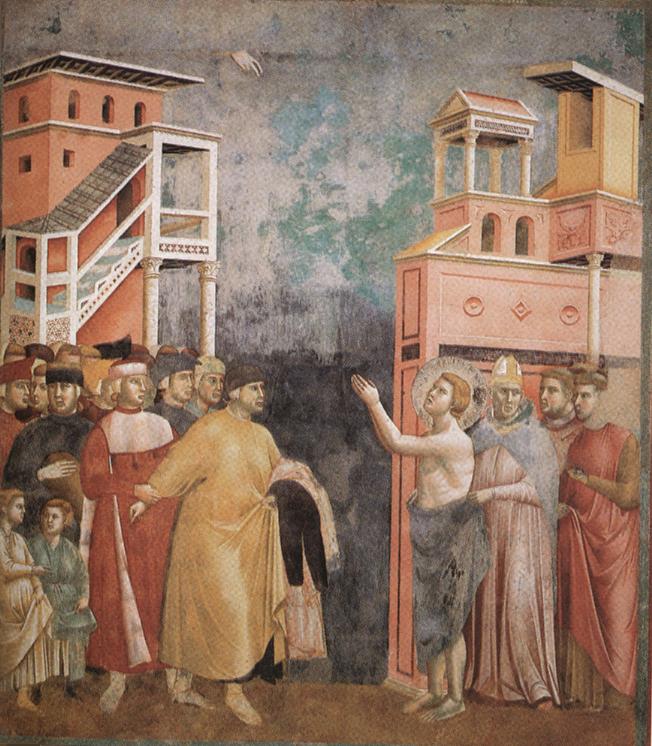
At the age of 25, Francis renounced a vast inherited wealth from his father by symbolically stripping naked in front of Bishop Guido and a great crowd in Assisi, forever devoting himself to ‘Lady Poverty.’ The painter Giotto depicts this scene complete with small boys throwing stones at the naked Francis.
Francis’ initial followers were not permitted to own any possessions. They lived in straw huts and preached and begged in the streets. In fact, Assagioli often referred to Francis as the “Poor Man of Assisi,” and he specifically mentions the saint in his article “Money and the Spiritual Life.”[1]
Assagioli states that living as Francis did is infeasible in our present age, pointing out that just decades after Francis’ death, the Franciscan Communities realized that “it was almost impossible to do without money and some form of buildings and land … Franciscans now use every means the modern world provides.”[2]
Assagioli continues by assuring us:
“If this is what the sons of Saint Francis do, how can any more be expected of us … caught up in the very fabric of economic, family, and social life?”
He then explains that spiritual transformation does not come from outside ourselves (where money might dominate), but from within.[3] However, Assagioli is then quick to qualify this statement by noting his intention is not:
“… to criticize or distract from the sublime act of Saint Francis, which was indeed heroic and had an incalculable positive effect as an example to others, providing us with a practical lesson in detachment … Our intention was only to show that this way cannot provide us with a generally applicable solution to our everyday lives.”[4]
In other words, money is a necessity for living our lives, but it is our attitude and actions towards money that determine its true worth. What matters most is how detached (or how identified) we are with the money and all that it can buy.
Assagioli’s Test with Money

In his prison diary Freedom in Jail, we see firsthand Assagioli’s personal and spiritual struggle with money.[5] He writes about how he went through a psychological test and experience when he was told that the money his wife had deposited to pay for his extra privileges in jail was running out. This meant that he would have to leave his private “special” cell and move into a cell with others and eat the normal prison fare. He wrote that:
“A kind of physical instinctual panic surged which tended to create an emotional preoccupation. I fought it through clear reasoning: the food which I would get was quite sufficient… I roused myself a sense of shame for my selfish preoccupation. I realized the human value of sharing the experience with others of this “poverty.”
As soon as Assagioli had arrived at a deeper acceptance of his financial dilemma and was spiritually ready to share a cell with others, his was notified that his money had arrived, and that things would go on as before. He candidly writes:
“When the news was given to me, I distinctly registered two opposite inner reactions at the same time: an instinctual sense of relief and a feeling of disappointment for being deprived of the new experience and of the opportunity of helping my fellowmen.”
Personally, I have often found this to be the case whenever I spiritually feel conflicted and confused over the deeper meaning and use of money (usually around not having enough!). Whenever I finally manage to transmute my fears into a deeper awareness, the money finally arrives … and this always seems to happen at the very last minute!
Reflect on your attitude towards money
You might take some time to reflect on your own attitude towards money, especially as Europeans face energy bills that are doubling in price and the world sees the rising cost of food and other everyday products. Some questions to ask yourself are:
- How identified am I with money? Do I gain recognition and acknowledgment from my money and possessions?
- Am I generous with what I own?
- How do I spiritually deal with any conflicts or confusion I experience over money (or the lack of it).
- Like Assagioli, have you ever experienced “physical instinctual panic” when you face a financial challenge? Are you able to use your skillful will to detach from money and consequently find a higher solution to that challenge?
Final Words
Assagioli and St. Francis both called us to establish peace in every aspect of our lives. To celebrate this day joyfully, I end with a quote from Saint Francis written in Assagioli’s beautiful hand (in Italian) :[6]

Lighthearted Joy
What else are the servants of
God if not his minstrels
destined to raise up
the heart of the people
and to bring them
to the Joy of the Spirit.
S. Francesco
[1] Roberto Assagioli, Transpersonal Development, The Dimension Beyond Psychosynthesis, The Aquarian Press, London, 1993, pp. 213-233.
[2] Ibid., p. 217.
[3] Ibid., p. 218.
[4] Ibid., Footnote on pp 220-221.
[5] Roberto Assagioli, Freedom in Jail. Edited by Catherine Ann Lombard. Istituto di Psicosintesi, Florence, Italy. 2016, pp. 25-27, 35-36.
[6] Roberto Assagioli, N.D. ID #8405. Retrieved November 11, 2016 from archivioassagioli.org. This translation is mine. The original Italian text is: “Letizia – Che altro sono i servi di Dio se non i giullari di Lui, destinati a rialzare il cuore degli uomini e portarli alla gioia dello spirito? S. Francesco.”

 Love and Will