Category Archives: The Will

Some Problems with Jungian Psychology (Part III)

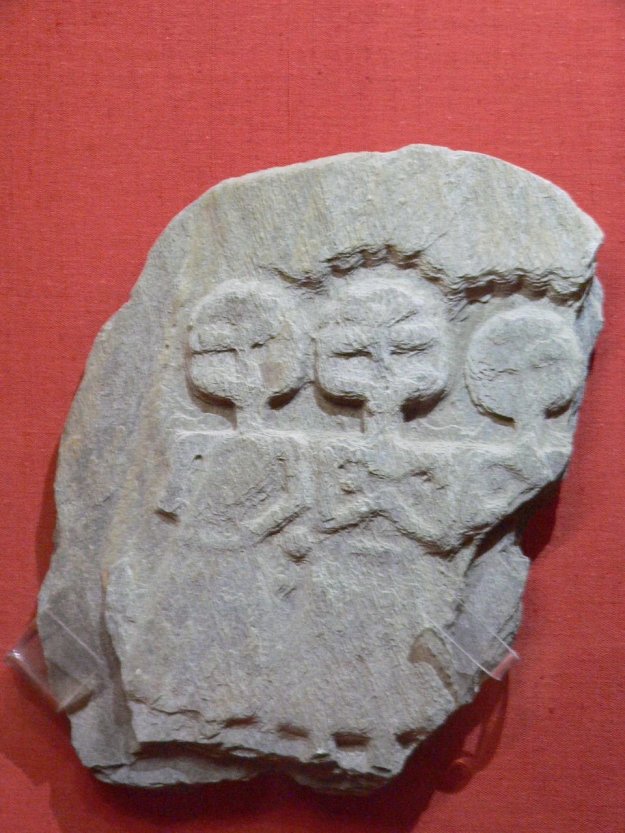
Mórrigna, The Celtic Triple Goddess

This is the third and last part of a series that explores psychosynthesis and Jungian analysis based on my article Psychosynthesis and Jung in a Nutshell.

In Part I I summarized some of the differences and similarities between Jungian psychology and psychosynthesis.

In Part II, I reflected on the relationship between these two great geniuses.

In this part, I will offer some of my own reflections on Jung’s concepts, which are confirmed by Assagioli.


Jung’s Writings Lack Clarity

Firstly and perhaps most importantly, one statement that seemed to be consistent throughout Assagioli’s notes, which resonates with my own opinion, was Jung’s writings lack clarity. I have often felt that Jung’s language is muddled and his writing verbose and meandering as opposed to Assagioli’s carefully crafted and meticulously worded books. Perhaps this is exemplified by the number of books attributed to both men. While Assagioli published five books (two posthumously), The Collected Works of C. G. Jung is a book series containing 20 volumes!

Edward C. Whitmont (1912-1998), a Jungian psychoanalyst who introduced many Americans to the fundamentals of Jungian psychology, once said:

I must warn you that insight into or comprehension of what Jung really stands for can not be gained from his published writings. Quite frequently they hide more than they express, unless, of course, you can read between the lines… I want to emphasize that you cannot judge what Jung said from his writings; you can judge [analytical psychology] only from the way it is being practiced.

Explaining that the only way to really understand Jung is through personal experience, Whitmont then related an example from when he was Jung’s student. Perplexed by a concept that Jung had written about, he asked Jung to further explain it.

“Where the hell did you read this nonsense?” Jung asked him.

“In your book!” Whitmont responded along with the page number and paragraph.

“Oh forget it!” said Jung.

If Jung tells his own students to forget about his writings because they contradict what he wants to express, and his own student warns us to not expect to understand Jung from his writings, then what are we supposed to understand from his publications?

Note from Assagioli’s Archives.

The Animus Does Not Correspond to the Female Reality

Secondly, I have never been comfortable with Jung’s concept of the “animus” for women as a counterpart to the male principal of the “anima.” Jung used these terms to define: “the inner figure of a women held by a man and the figure of a man at work in a woman’s psyche.” The anima is a personification of all the feminine psychological tendencies in the male psyche. As a rule, the anima is shaped by the man’s mother and can manifest as and/or be projected upon both negative and positive symbolic figures.

The anima also personifies man’s relation to his unconscious. Negative figures include the femme fatale, the Greek Sirens, witches, and women who appear in erotic fantasy. Positive figures include romantic, idealized beauty, like Helen of Troy. Higher positive images include spiritual wisdom like the Chinese goddess Kwan-Yin who can bestow the gift of poetry or music and even immortality on her favorites, Sappho or the Virgin Mary.
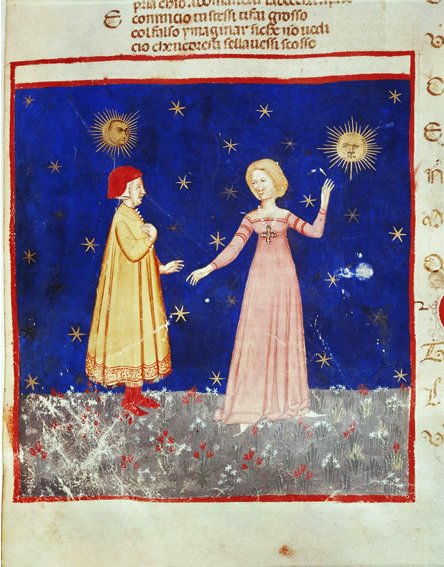
Assagioli suggests that men refer to Dante’s Beatrice as a symbol of the Ideal Woman.

Most importantly, however, according to Marie-Louise von Franz, the anima has the essential role of “conveying the vital messages of the Self” and “putting a man’s mind in tune with the right inner values and thereby opening the way into more profound inner depths.” Examples of this anima role appears in literary works such as Dante’s Divine Comedy in the form of Beatrice and as “the eternal feminine” in Goethe’s Faust.

The Impoverished Animus

In contrast, the male personification of the unconscious in women – the animus – does not play such a vital role for the female psyche. For example, while Dante’s spiritual journey may be the complete poetic form of psychosynthesis, his search for Beatrice is, nevertheless, quintessentially male. Dorothy L. Sayers argues that while Dante’s journey to Beatrice could symbolize man’s search for his anima, for the female “from time immemorial…there is no corresponding Enigma of Man.” She continues by pointing out that, in fact, Jung’s:

… corresponding animus in the female [when compared to] the rich, poetic, and magical content of the animain the male [is] so desiccated, impoverished, and lacking in any touch of the numinous that it might appear to have been artificially patched together for the sole purpose of completing the symmetrical pattern.

I am in total agreement with Sayers. I have always viewed and experienced the animus as the part of a woman’s inner psyche that seems to know how best to manage the patriarchal world in which she must cope and survive while being judged and treated (for the most part) as an inferior being. In a world that has been dominated by men for thousands of years, if anything, the animus is usually over-emphasized in a Western woman’s conscious life, especially when she is pursuing a successful career.

Instead of an Animus, A Triple Goddess

The Sumerian poem, The Descent of Inanna (c. 1900-1600 BCE) chronicles the journey of Inanna, the great goddess and Queen of Heaven, from her realm in the sky, to earth, and down into the underworld to visit her recently widowed sister Ereshkigal (pictured above) Queen of the Dead. 

Similar to the anima, the animus can also manifest as and/or be projected upon both negative and positive symbolic figures. However, I do not believe that the animus personifies a woman’s relation to her unconscious nor is it the animus that can open the way to her inner depths or values. This door is unlocked instead by the triple power of the inner Divine Mother, the Dark Sister, and the Crone.

As Jungian Silvia Brinton Perera states, before grounding myself as a woman in order to “coagulate [my] feminine potency to confront the patriarchy and the masculine as an equal,” I must first come into relation – not with my male psyche tendencies – but rather with the ancient parts of my repressed feminine self. These parts of me are “too awesome to behold, the Great Round of nature, connected to active destruction but also to transformation.”

I was elated to have my intuition and feelings confirmed by this note by Assagioli:

Polarity and struggle between the artificial “personality” constructed for society and the unconscious repressed elements, regrouped by Jung under the designation of “anima” (questionable as a name and questionable as a unified grouping – in reality these elements remain multiple and often contrasting. Also this conception would only apply to men, not for women.)

Once again Assagioli first questions Jung’s choice of the term “anima” (which is Latin for ‘soul’). He then continues by refuting Jung’s definition of the term by the fact that it does not actually match the living reality. Finally, Assagioli confirms my belief that the animus, according to Jung’s definition, does not apply to women.

Jung Undervalued the Will
According to his biographer Deirdre Bair, Jung used his anima to avoid taking responsibility for his adulterous behavior with former client Toni Wolff. Years later, he is quoted as saying: “Back then I was in the midst of the anima problem.”

Often he felt caught in an affair that was outside of his control, saying: “What could you expect from me? – the Anima bit me on the forehead and would not let go.” This brings us to my final point regarding Jung, which Assagioli collaborates – the absence of the will from Jung’s approach (not to mention his numerous extramarital affairs!)

As demonstrated with his own confession of being dominated by his anima, Jung did not fully believe in free will. He also did not believe in determinism, but rather something in between the two. From Jung’s perspective, we are all capable of making conscious decisions, but, we are not capable of making any decision without some influence from both the personal unconscious and the collective unconscious.

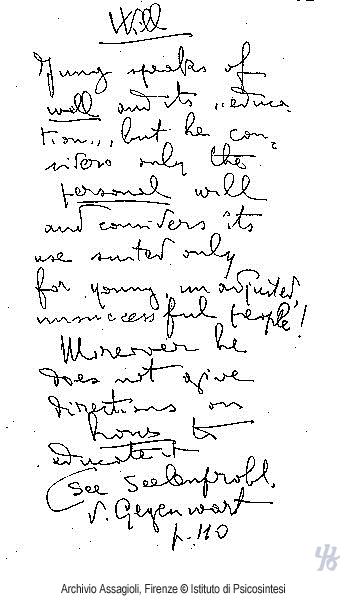
Despite his vast number of publications, Jung wrote very little about the will. In Archetypes and the Collective Unconscious, he actually warns against training one’s will, saying that the more an individual trains his will, the more danger he has of “getting lost … and deviating further and further from the laws and roots of his being”.

He wrote that the use of the personal will is only suited for young, unadjusted, unsuccessful people (!) and that a person in “the second half of life no longer needs to educate his conscious will,” but instead needs “to understand the meaning of his individual life, needs to experience his own inner being.”

All this is, of course, in sharp contrast to psychosynthesis, in which the will is given a pre-eminent position. Assagioli states that

“The will has a directive and regulatory function, one that balances and constructively utilizes all the other activities and energies of the human being without repressing any of them.”

Not only does psychosynthesis recognize that the will exists and that we have a will – but it extends even further to the fact that we are will. In his book The Act of Will, Assagioli analyses “willing action” in its various stages, describes the specific aspects and qualities of the will, and offers practical techniques for its development and optimum use (which he does not say to stop upon reaching middle age!). He regards the will as a direct expression of the “I”, the individual’s authentic being, and states:

The discovery of the will in oneself, and even more the realization that the self and the will are intimately connected, may come as a real revelation which can change, often radically, a man’s self-awareness and his whole attitude toward himself, other people, and the world.

In his historical survey of the will, Assagioli criticizes Jung’s omission:

While he recognized and even emphasized the reality and the dynamic function of goals, aims, and purposes, he did not make an investigation of the various aspects and stages of the will, nor did he include the use of the will in his therapeutic procedures.


Click here to read the full article “Psychosynthesis and Jung in a Nutshell“.

Click here to read a series on Jung and Assagioli being published by the Psychosynthesis Trust.


References

Assagioli, R. (n.d.) Archivio Assagioli – Firenze, ID Doc: 1738, 1901, 1922, 2335, 10490, 11240, 11357, 11472, 13010, 13546, 14888. Downloaded from archivioassagioli.org.

Assagioli, R. (2002). The Act of Will. London, UK: The Psychosynthesis & Education Trust.

Bair, D. (2003). Jung: A Biography. New York: Little, Brown, and Company..

Jung, C. G. (1966). The Practice of Psychotherapy (R. F. C. Hull, Trans.), Bollingen Series XX. Princeton, NJ: Princeton University Press.

Jung, C. G. (1969). The Archetypes and the Collective Unconscious (R. F. C. Hull, Trans.), Bollingen Series XX. Princeton, NJ: Princeton University Press.

Lombard, C. A. & den Biesen, K. (2014). Reading the Divine Comedy from a psychosynthesis perspective, Psychosynthesis Quarterly, September, 2014, pp. 5-11.

Meachem, W. (2016). “Carl Jung’s Concept of Humanity and Theory of Personality,” Owlcation, October 15, 2016, https://owlcation.com/social-sciences/Psychology-405-Theory-of-Personality-The-Balance-of-Carl-Jung.

Perera, S. B. (1981), Descent to the Goddess, Toronto, Canada: Inner City Books.

Sayers, D. L. (1955). Introduction. In Alighieri, Dante, 1955. The Divine Comedy 2: Purgatory, (translated by D.L. Sayers). London, UK: Penguin Books.

von Franz, M.-L. (1964). The Process of Individuation, in Jung, C.G (ed), Man and his Symbols. London, UK: Aldus Books Limited.

Whitmont, E.D. (1968). A Jungian’s View of Psychosynthesis, Psychosynthesis Seminar 1967/8 Series. New York: Psychosynthesis Research Foundation.

Jung: “A Courageous and Genius Pioneer” (Part I)

Medion   DIGITAL CAMERA

July 26 marks the 148th birthday of Carl Gustav Jung and I thought it might be a good time to revisit his relationship with Roberto Assagioli and once again take a look at some of the differences and similarities between Jungian psychology and psychosynthesis.

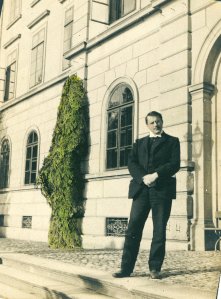
The two men – Roberto Assagioli (1888-1974), the founder of psychosynthesis, and Carl Gustav Jung (1875–1961), the founder of analytical psychology (also referred to as Jungian psychology) – probably first met in 1907, when Assagioli was spending time at the Psychiatric Clinic at Burghölzi, University of Zürich. While studying in Zürich, Assagioli came into contact with psychoanalytic theory and worked directly with Jung and Eugen Bleuler, famous for his discovery and work on schizophrenia.

Figure 2 Jung_1910-rotated
Carl Gustav Jung around the time he met Assagioli. They both attended the Clinic at Burghölzi, pictured behind.

Assagioli wrote about meeting with Jung at his villa in Küssnacht, during which they had “animated conversations” in Jung’s study, which Assagioli noted was full of books and curious exotic objects. “Among psychotherapists,” Assagioli wrote: “Jung is one of the closest to the conceptions and practice of psychosynthesis”.

To fully explore the similarities and differences between psychosynthesis and Jung, you would need to devote many hours researching the two psychologies and then writing a book. Nevertheless, I have (boldly!) compiled an overview (Also a handy table, see Psychosynthesis and Jung in a Nutshell Table Landscape) to help compare and contrast these two great visionaries’ understanding of the human psyche.

In this blog, I briefly describe a few similarities that the two psychologies share. I then mention two of their main differences. In the next few blogs, I will talk about the two men’s relationship over the years, and then offer some of my own reflections on Jung’s concepts, which were often confirmed by Assagioli’s personal observations.

Similarities

They are transpersonal psychologies. Psychosynthesis and Jungian psychology integrate the spiritual and transcendent aspects of the human experience within their frameworks. Both psychological approaches recognize and proclaim the reality and importance of spiritual needs and a spiritual dimension of the human psyche. This spiritual dimension includes the need to reach an understanding of the meaning of life and to believe that it has a purpose of a spiritual nature.

They include the concept of a collective unconscious. According to Jung, the human collective unconscious contains shared structures of the unconscious mind such as universal symbols, instincts and archetypes. Assagioli included the collective unconscious in his diagram of the human psyche, also referred to as the “egg-diagram.”

The process of psychosynthesis is very similar to the process of individuation. Psychosynthesis and Jungian psychology prefer to understand human beings from the perspective of their health as opposed to their pathologies. Jung aimed to produce for each client a profound transformation of the personality and its integration by means of what he called the “process of individuation.” Assagioli stated that this process and its phases are “akin to psychosynthetic therapy”.

Two Main Differences

Figure 4 Unconscious according to Jung
Assagioli’s note from his archives about Jung’s view of the unconscious.

Different ways of viewing the unconscious. One major difference between psychosynthesis and Jungian psychology is how each defines the unconscious, including the collective unconscious.

In Assagioli’s model of the human psyche, he divides the personal unconsciousness into lower, middle, and higher unconsciousness. Jung does not make this distinction, which Assagioli says “lumps everything together into a great mishmash”.

Jung undervalued the Will. Jung did not fully believe in free will. He also did not believe in determinism, but rather something in between the two. From Jung’s perspective, we are all capable of making conscious decisions, but, we are not capable of making any decision without some influence from both the personal unconscious and the collective unconscious.

Figure 5 002789 Jung speaks of will
Assagioli’s note criticizing Jung for not giving directions on how to “educate” the will.

This perspective is in sharp contrast to psychosynthesis, in which the will is given a pre-eminent position. Assagioli states that:

“The will has a directive and regulatory function, one that balances and constructively utilizes all the other activities and energies of the human being without repressing any of them”.

Not only does psychosynthesis recognize that the will exists and that we have a will – but it extends even further to the fact that we are will.

In his historical survey of the will, Assagioli criticizes Jung’s omission:

“While he recognized and even emphasized the reality and the dynamic function of goals, aims, and purposes, he did not make an investigation of the various aspects and stages of the will, nor did he include the use of the will in his therapeutic procedures.”

Conclusion

I will end with Assagioli’s thoughts about Jung that are generous in spirit as well as full of admiration and gratitude:

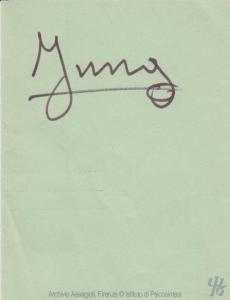
Figure 3 014888 The word Jung

Jung has been a courageous and genius pioneer, who has opened new ways and dimensions to the human mind. His contributions have been of great value, he has most of all liberated us from the narrow limits of objectivism, of purely …descriptive study.

He has immensely expanded the field of psychoanalysis, demonstrating as well the propensity and need for spirituality…Thus he successfully invites one to pursue the course of individuation, that is, to discover and develop one’s own true being, one’s own Self. There he indeed deserves our great appreciation and our deep gratitude”.

Click here to read the full article Psychosynthesis and Jung in a Nutshell.

References

Assagioli, R. (n.d.) Archivio Assagioli – Firenze, ID Doc: 1901,13546. Downloaded from archivioassagioli.org.

Assagioli, R. (1974). Jung and Psychosynthesis. Journal of Humanistic Psychology, 14: 1, pp. 35-55.

Assagioli, R. (2002). The Act of Will. London, UK: The Psychosynthesis & Education Trust.

Giovetti, P. (1995). Roberto Assagioli: La vita e l’opera del fondatore della Psicosintesi [Roberto Assagioli: The life and work of the founder of Psychosynthesis]. Edizione Mediterranee, Roma.

Jung, C. G. (1966). The Practice of Psychotherapy (R. F. C. Hull, Trans.), Bollingen Series XX. Princeton, NJ: Princeton University Press.

Jung, C. G. (1969). The Archetypes and the Collective Unconscious (R. F. C. Hull, Trans.), Bollingen Series XX. Princeton, NJ: Princeton University Press.

Jung, C. G. (1989). Memories, Dreams, Reflections, A. Jaffé, ed. (R. Winston and C. Winston, trans.). New York: Vintage Books.

Meachem, W. (2016). “Carl Jung’s Concept of Humanity and Theory of Personality,” Owlcation, October 15, 2016,

Rosselli, M. & Vanni, D. (2014). Roberto Assagioli and Carl Gustav Jung, The Journal of Transpersonal Psychology, 46:1, pp. 7-34

Crossing Over

This is Holy Week for many Christians who are anticipating the celebration of Easter next Sunday. Below is an article of mine that was published ten years ago in the AAP Psychosynthesis Quarterly. I describe a meeting with one of my clients that happened on Good Friday, which also that year coincided with Passover.

During this meeting, so many things started to converge and cross over that I was nearly overtaken by them. This story revolves around the converging life paths of my client and myself, and how we both ended up traveling long distances to witness and help guide our grandmothers towards their imminent death.


“It’s been a week of Passion,” Paula’s voice quivered as she dropped down into the chair in front of me. She had already emailed to say that her grandmother was dying and she couldn’t decide whether to go home. Paula had a long history of not being able to decide. We had been meeting for nearly 2-1/2 years, I as her psychosynthesis guide and she as my client. Together, we had explored her feelings of never being good enough and her consequent control of and search for illusive perfection in everything from shoes to menu items to true love. We had attempted to unravel and unbind her never-ending endings. And we had spent hours peeling away Paula’s habitual lateness to discover the face of cold fear of having to wait for the other and relive a surge of emotions around abandonment.

Her week of Passion was literal and figurative. It had been Holy Week and the day we met in 2011 was not only Good Friday, but also Jewish Passover. The word Pasque for Easter actually comes from the Hebrew word which means to “go through.” This week of ‘crossing over’, of leaving slavery for freedom, of moving from this world to the next, from death to everlasting life, seemed to reflect Paula’s own inner and outer struggle.

Since our last meeting, Paula had been confronted with death, an encounter that cannot be controlled or perfected or tricked into arriving before you or never at all. Her grandmother was dying of cancer and was finally surrendering to its call. Paula’s Nonna, an Italian as well as a private icon, no longer held the energy to sustain the Milanese family as she had for all of Paula’s 30 years.

Nonna had been the family pillar, the Corinthian column of strength and integrity around whom Christmas and birthdays and Holy Communions had been celebrated. This grandmother had finally decided to crumble, leaving everyone else to deal with their feelings of loss and painful loneliness. Grandmother, lucid and detached, was quietly slipping away. Her husband was angry that she had given up and stopped fighting, her family felt in many ways that she was already dead.

Three days earlier, Paula’s mother had called to prepare her daughter for the worst. While insisting that Paula not travel home from the Netherlands to Italy, her mother had wanted Paula to prepare for the imminent funeral. “Don’t come,” said Paula’s mother crying into the phone. “It’s better you remember her as she was. Your brother and sister go in to hug her and she does nothing. Nonna doesn’t care anymore. She doesn’t care if you are there are not. You are lucky not to see her this way. Besides, you will only have to fly back for the funeral. Get ready for that instead. It’s better this way.”

Paula recounted all this in tears. Throughout her childhood, her mother’s mother had been the one to comfort Paula, the one to take care of her while Paula’s mother fretted over Paula’s sickly younger brother, cooed over his comical antics.

Nonna had always told Paula that she was her favorite grandchild, and Paula wanted to go home and see her. But she struggled with her own mother’s wishes along with the fact that another ending was looming in front of her—her PhD thesis which was already late and had to be finished in less than three weeks. Logic and reason, Paula’s major accomplices throughout most of her lifetime, told her not to go home, and yet her heart was telling her otherwise…


You can continue reading this story below. Happy Easter!