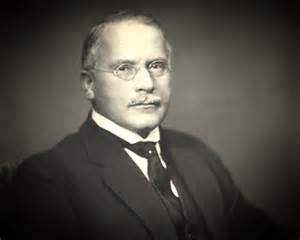
Today marks the 148th birthday of Carl Gustav Jung. This is the second part of a three part series that explores psychosynthesis and Jungian analysis based on my article Psychosynthesis and Jung in a Nutshell. In Part I I summarized some of the differences and similarities between Jungian psychology and psychosynthesis. In this part, I reflect on the relationship between these two great geniuses. In Part III, I will offfer some of my own reflections on Jung’s concepts, which were often confirmed by Assagioli’s personal observations.
Roberto Assagioli (1888-1974), the founder of psychosynthesis, and Carl Gustav Jung (1875–1961), the founder of analytical psychology (also referred to as Jungian psychology), knew each other early in their careers. The two young men (Assagioli was Jung’s junior by 13 years) probably first met in 1907, when Assagioli was spending time at the Psychiatric Clinic at Burghölzli, University of Zürich. While studying in Zürich, Assagioli came into contact with psychoanalytic theory and worked directly with Jung. In a letter to Freud, dated 13 July 1909, Jung describes Assagioli, as follows:
The birds of passage are also moving in, i.e., the people who visit one. Among them is a very pleasant and perhaps valuable acquaintance, our first Italian, a Dr. Assagioli from the psychiatric clinic in Florence. Prof. Tanzi assigned him our work for a dissertation. The young man is very intelligent, seems to be extremely knowledgeable and is an enthusiastic follower, who is entering the new territory with the proper brio.
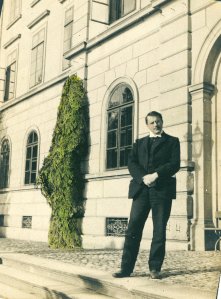
Along with twenty other doctors, Assagioli participated (as an outside guest) in the “Freud Society,” newly founded in 1907 by Jung, who at the time was an assistant physician under Eugen Bleuler. Sometime around 1910, Bleuler began holding meetings of what was loosely called the “study group for doctors interested in Freudian ideas,” and we can assume Assagioli attended these meetings.
Assagioli later wrote about meeting with Jung at his villa in Küssnacht, during which they had “animated conversations” in Jung’s study, which Assagioli noted was full of books and curious exotic objects. In a 1971 interview, Assagioli said:
My relationship with Jung took place years later [after 1914] when he had published something of his own. Then I went to see him in Zurich at his place, several times, one year off and one year on. We had very good contacts, He was a delightful man, also interested in Eastern things, and he was also a book fiend, as was I.
A Taste of Jung and Assagioli Correspondence
While the two men would meet over the years, it seems that Assagioli was always the one to travel to Zurich. Jung choose never to visit Rome during his lifetime and, to the best of my knowledge, it doesn’t seem he ever spent time in Florence. However, the two did exchange letters, in which Assagioli addressed Jung as “Trѐs honoré et cher Confrѐre” (Very honored and dear colleague) and “Illustre e caro collega” (Illustrious and dear colleague).
Here are two interesting exchanges between them that occurred after World War II.
Assagioli asks Jung for a reference

In a letter dated January 16, 1946, Assagioli first thanks Jung for his welcome when Assagioli stopped by for a visit in 1939 before the war while on his way back from England to Rome. He asks Jung for a “small favor,” asking for his help in providing a reference for Assagioli to enter Switzerland. Assagioli’s son Ilario, who was suffering with a serious case of pulmonary tuberculosis, had a chance to receive a special six-month cure at the University Sanatorium of Leysin along with twenty other Italian students. As a medical doctor, Assagioli hoped to accompany his son and the entire group of students, but needed a reference from a “notable Swiss citizen.” He wrote, with a touch of humor:
“So I have taken it upon myself to give your name, and if you are asked about me, I hope you will say that I am not an ‘undesirable’ guest for a short stay in Switzerland!”
Assagioli then complimented Jung, saying how much he has always followed Jung’s publications which he greatly admired and appreciated. Upon his arrival to Switzerland, Assagioli wrote how he hoped to acquire what Jung has published during the war years. He then signed the letter, “Your devotee.”
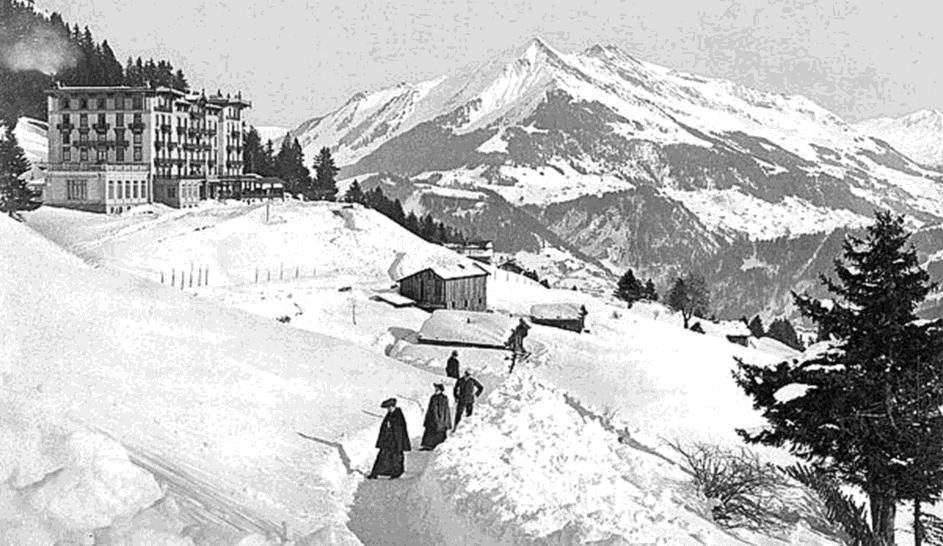
Jung responded with a brief reply in French. He first thanked Assagioli, whom he addressed as “Sir and dear Colleague,” for the news Assagioli had sent to all his acquaintances soon after the war ended about his time in Regina Coeli prison and in hiding. Jung was happy to learn that Assagioli and his family “survived the disaster” of World War II. “I’ve often wondered,” Jung wrote, “what your destiny might have been over the last few years.”
In response to Assagioli’s request for a reference, Jung then wrote:
“It goes without saying that I’ll be happy to serve as a reference for you and to give you all the information and recommendations you need to make your entry into Switzerland as easy as possible.”
Arranging a rendezvous
It is not clear if Assagioli and Ilario were able to go the University Sanatorium of Leysin that year. However, in August 1948, Assagioli wrote again to Jung. He was spending time in Switzerland at the Monthey Hospital where Ilario was receiving treatment, and Assagioli asked if he and his friend the Duke of San Clemente might visit Jung. Assagioli wrote: “I would give me great pleasure if we could meet after all these years (and what years!)” Jung’s secretary wrote back immediately saying that Jung would be very happy to meet them both, but he wasn’t feeling well of late and could Assagioli please call first before arriving to ensure that Jung would be well enough to receive them.
Friends, Colleagues, or … ?
Most biographies that include an exploration of Assagioli’s relationship with Jung paint a positive, friendly, and long-term relationship between them. However, only a nominal amount of documentation is available to assert this claim.
According to his biographer Deirdre Bair, Jung apparently had a history of not having long-lasting male friendships and noted him saying on numerous occasions that men in psychology “always need to best other men.” Maria-Louise von Franz said that Jung actually got on better with men who were in another field, such as writers and artists, rather than those in psychology.
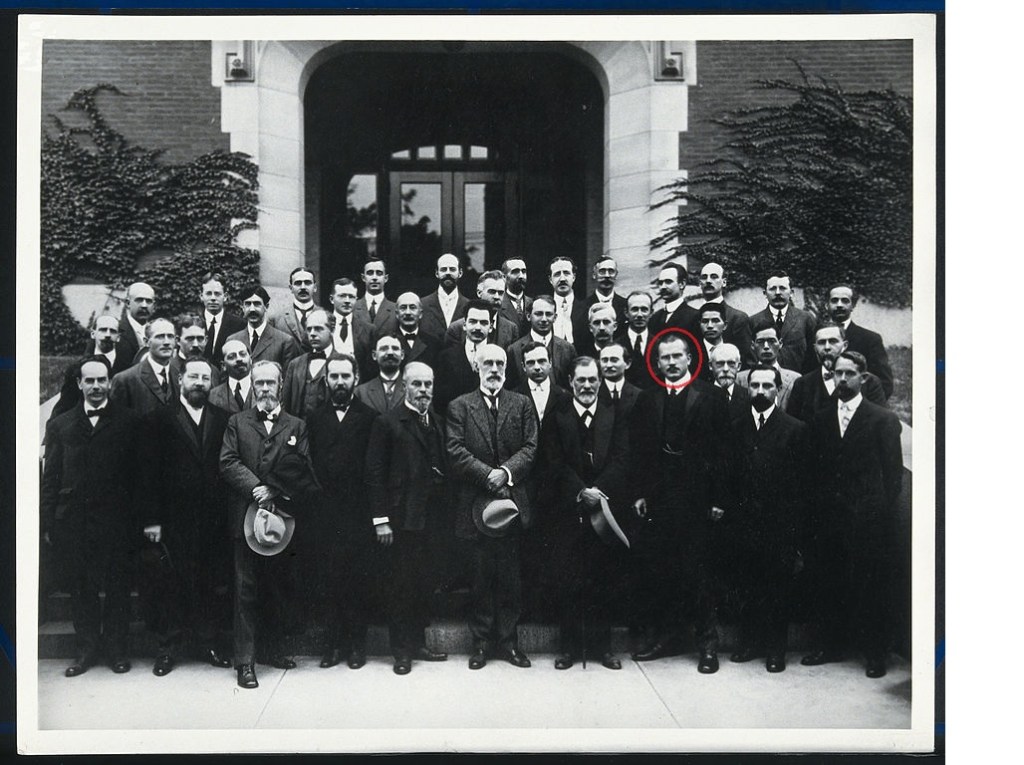
Such competition might have also existed between the two men, at least on the part of Jung. There is evidence of this in Hahl’s historical account of Eranos, the center in Ascona, Switzerland, sponsored by Olga Fröbe-Kapteyn (1888-1962) as “meeting place between East and West.” According to Hahl, Fröbe sent a letter of invitation to Jung but he initially declined because of her close connection to the Theosophical Movement and to Assagioli who was associated with Alice Bailey. Jung only came to Eranos to lecture in 1933 once Bailey and Assagioli were no longer attending the Eranos Tagung.
We can also see Assagioli’s unmitigated opinion of Jung’s work from his following notes:
Lack of clarity, uncertainty, confusion between the various aspects and levels of the unconscious; lack of a real spiritual experience and therefore a nebulous and defective conception of spirit; lack of any social aspect or inter-individual psychosynthesis; lack of any understanding of the role of action in psychosynthesis and lack of appreciation and utilization of the will and therefore of discipline, form and self-restraint.
(Assagioli as cited by Vanni & Rosselli, 2014, p. 26)
Both Men have Near-death Experiences
One thing that struck me while doing the research for this article is that both Assagioli and Jung had near-death experiences. Jung had a heart attack when he was 69 years old, and he describes the visions he had while he “hung on the edge of death” in his autobiography Memories, Dreams, and Reflections. In the end he envisioned his doctor standing before him telling him that he “had no right to leave the earth and must return.” Gary Lachman claims that after this experience Jung realized that he had to start revealing the paranormal and esoteric influences in his life and work.
At the age of 77, Assagioli was undergoing prostrate surgery when complications occurred and he too was on the edge of dying. Afterwards and once recovered, Assagioli said that “they have kicked me back”. Soon afterwards, his first book was published in the United States, Psychosynthesis – A Manual of Principles and Techniques, and psychosynthesis began to spread worldwide.
Final Words

I will leave the final words to Sergio Bartoli, who was one of Assagioli’s close collaborators. Bartoli told how he once knew psychoanalyst from Milan who studied directly under Jung and for a while was also one of Assagioli’s collaborators. When this person was asked about the difference between the two men, she responded by saying:
“Jung was a man who was intelligent, charming, and very likable. Assagioli was a guru.”
Click here to read the full article “Psychosynthesis and Jung in a Nutshell“.
Click here to read a series on Jung and Assagioli being published by the Psychosynthesis Trust.
References
Assagioli, R. (n.d.) Archivio Assagioli – Firenze, ID Doc: 1901,13546. Downloaded from archivioassagioli.org.
Assagioli, R. (1946). Letter to C. Jung dated 18 January 1946. Zürich ETH-Bibliothek, Wissenschaftliche Sammlungen [The Zurich ETH Library, Scientific Collection].
Assagioli, R. (1948). Letter to C. Jung dated 9 August 1948. Zürich ETH-Bibliothek, Wissenschaftliche Sammlungen [The Zurich ETH Library, Scientific Collection].
Bair, D. (2003). Jung: A Biography. New York: Little, Brown, and Company.
Giovetti, P. (1995). Roberto Assagioli: La vita e l’opera del fondatore della Psicosintesi [Roberto Assagioli: The life and work of the founder of Psychosynthesis]. Edizione Mediterranee, Roma.
Hahl, H. T. (2013). Eranos: An Alternative Intellectual History of the Twentieth Century. New York: Routledge.
Jung, C. G. (1946). Letter to R. Assagioli dated 1 March 1946. Zürich ETH-Bibliothek, Wissenschaftliche Sammlungen [The Zurich ETH Library, Scientific Collection].
Jung, C. G. (1948). Letter to R. Assagioli dated 10 August 1948. Zürich ETH-Bibliothek, Wissenschaftliche Sammlungen [The Zurich ETH Library, Scientific Collection].
Jung, C. G. (1989). Memories, Dreams, Reflections, A. Jaffé, ed. (R. Winston and C. Winston, trans.). New York: Vintage Books.
Lachman, G., (2010). Jung the mystic. New York: Jeremy P. Tarcher/Penquin.
McGuire, W. (ed.), 1974. The Freud/Jung letters: The correspondence between Sigmund Freud and C.G. Jung. London, UK: The Hogarth Press and Routledge & Kegan Paul.
Rosselli, M. (2012). Roberto Assagioli: A bright star.” International Journal of Psychotherapy, 16(2), 7-19.
Rosselli, M. & Vanni, D. (2014). Roberto Assagioli and Carl Gustav Jung, The Journal of Transpersonal Psychology, 46:1, pp. 7-34.
von Franz, M-L. (1977). “Marie Louise von Franz – Jung’s Genius Made Men Jealous”. https://www.youtube.com/watch?v=x_CKSnCYLQo
 Love and Will